By: Dipin Sehdev
For decades, McIntosh has occupied a unique position in high-end audio. While much of the industry has raced toward streaming integrations, HDMI connectivity, room correction, apps, and digital signal processing, McIntosh has remained remarkably committed to traditional two-channel audio. That philosophy continues with the newly announced MA2375 Vacuum Tube Integrated Amplifier, the company's first new tube-based integrated amplifier in more than a decade.
And it's a fascinating product, because it almost completely ignores digital audio.
In a world dominated by streaming amplifiers from NAD, Cambridge Audio, Marantz, Hegel, Naim, and even McIntosh's own solid-state lineup, the MA2375 is unapologetically analog. The question is whether that's enough in today's market.
A Return to McIntosh's Tube Heritage
Vacuum tubes have always been part of McIntosh's DNA. Long before streaming existed, McIntosh built its reputation on tube amplification, creating some of the most respected hi-fi components ever produced. The MA2375 continues that legacy. Unlike many modern integrated amplifiers that combine digital streaming, DACs, and amplification into a single chassis, the MA2375 focuses exclusively on analog performance.
Inside you'll find:
- Fully analog tube preamplifier stage
- Fully analog tube power amplifier stage
- 75 watts per channel
- McIntosh Unity Coupled Circuit Output Transformers
That last point is important. McIntosh's proprietary output transformer technology has been one of its defining innovations for decades. It allows the amplifier to deliver its full rated power regardless of whether speakers are rated at 4, 8, or 16 ohms. For owners of difficult-to-drive loudspeakers, that's a significant advantage.
The Tube Complement
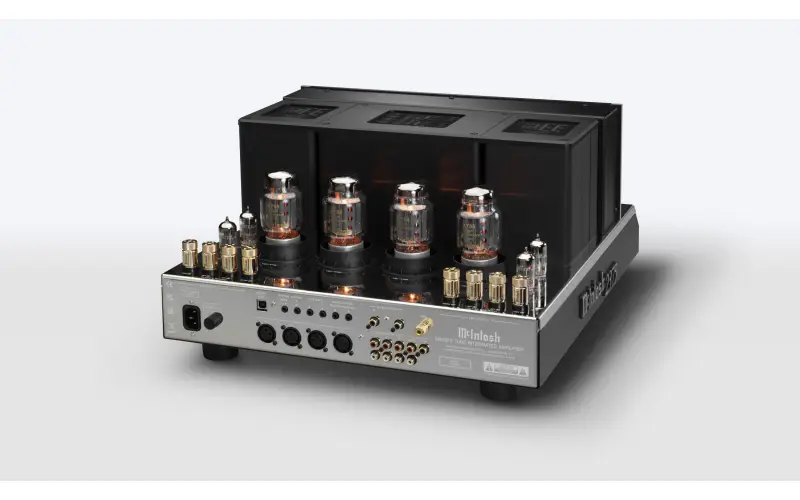
The MA2375 uses an impressive tube array consisting of:
- Four KT88 output tubes
- Four 12AT7 driver tubes
- Two 12AX7A preamp tubes
- Two additional 12AT7 preamp tubes
This configuration is designed to deliver the warmth, dimensionality, and natural musicality tube enthusiasts often seek while still maintaining enough power to drive a wide range of loudspeakers. At 75 watts per channel, this is not a low-powered boutique tube amplifier.
It's intended to be a serious centerpiece for a premium two-channel system.
What's Missing?
This is where things become interesting. And perhaps a little controversial. For an amplifier expected to retail around £16,900 / €19,500, many buyers will naturally ask:
What exactly am I getting that justifies the price?
And equally important:
What am I not getting?
The answer is a lot. There is:
? No built-in DAC
? No network streaming
? No HDMI eARC
? No AirPlay
? No Bluetooth
? No Wi-Fi
? No Roon Ready certification
? No app control
In 2026, that's unusual. Most integrated amplifiers in this price category include at least some level of digital integration. McIntosh clearly believes the target customer either already owns dedicated digital components or doesn't want them integrated into the amplifier in the first place.
For traditional audiophiles, that's a feature. For newer buyers entering the hobby, it may feel like a limitation.
Built for Purists
To be fair, McIntosh isn't trying to compete with products like the NAD M66, Cambridge Evo 150, or Marantz MODEL 10. The MA2375 is designed for listeners who believe separating digital and analog components remains the best path to achieving ultimate sound quality.
That's why the amplifier includes:
- Configurable phono input
- Subwoofer output
- Preamplifier outputs
- Home Theater PassThru
- RS232 integration
- Data Ports
- 5-band analog EQ
Everything here serves the goal of creating a traditional high-end audio system.
Classic McIntosh Design
Visually, the MA2375 is exactly what you'd expect from McIntosh. And that's a good thing. The amplifier features:
- Illuminated vacuum tubes
- Signature blue watt meters
- Polished stainless-steel chassis
- Glass front panel
- Gold-plated speaker terminals
If you're spending this kind of money, you want it to look special. The MA2375 certainly accomplishes that.
McIntosh MA2375 Specifications, Availability & Pricing
| Feature | McIntosh MA2375 |
|---|---|
| Amplifier Type | Vacuum Tube Integrated Amplifier |
| Power Output | 75W per Channel |
| Channels | 2-Channel Stereo |
| Output Transformer | Unity Coupled Circuit |
| Output Tubes | 4 x KT88 |
| Driver Tubes | 4 x 12AT7 |
| Preamp Tubes | 2 x 12AX7A + 2 x 12AT7 |
| Equalizer | 5-Band Analog EQ |
| Headphone Amp | High Drive with HXD |
| Phono Input | Configurable |
| Subwoofer Output | Yes |
| Preamp Output | Yes |
| Home Theater PassThru | Yes |
| RS232 Control | Yes |
| Data Ports | Yes |
| Speaker Terminals | Gold-Plated Solid Cinch |
| Protection | Power Guard SGS, Sentry Monitor |
| Streaming | No |
| DAC | No |
| HDMI | No |
| Bluetooth | No |
| Wi-Fi | No |
| MSRP | £16,900 / €19,500 |
| Availability | Available June 3, 2026 |
| Purchase | Authorized McIntosh Dealers |
The Bottom Line
The MA2375 may be one of the most interesting amplifier launches of 2026 precisely because it goes against current industry trends. Everyone else is adding features. McIntosh is removing them. For purists who already own dedicated streamers, DACs, turntables, and source components, the MA2375 represents exactly what they want: a no-compromise analog tube amplifier from one of the most respected names in audio. But it also raises a fair question.
In a market increasingly defined by convenience, integration, and streaming, can a nearly £17,000 integrated amplifier with no built-in digital functionality compete? For traditional audiophiles, the answer is probably yes. For everyone else, McIntosh may be asking buyers to spend luxury-car money on a component that requires even more investment to unlock its full potential. That's not necessarily a bad thing.
It's just a reminder that the MA2375 isn't trying to be everything for everyone. It's trying to be one thing exceptionally well: a reference-grade analog tube amplifier built for listeners who still believe the shortest path between the music and the listener is the best one.