By: Dipin Sehdev
There’s a moment every serious reviewer experiences at least once. You’ve spent weeks, sometimes months, testing a product. You’ve pushed it through real-world use, compared it against competitors, written and rewritten your analysis, and published something you stand behind. And then someone says:
“Of course you liked it. You were flown out. You got it for free.”
It’s frustrating. Not because the concern is invalid, but because it oversimplifies a much more complex reality. The truth is, the ethics of press trips and review samples have been debated for decades. Long before YouTube, long before TikTok, long before the rise of influencer culture, journalism had already established ground rules for how this works. Those rules still exist. But in today’s environment, they’re harder to see and even harder for audiences to trust.
The Double-Edged Sword of Access
Let’s start with the obvious: many of the products being reviewed today are expensive. High-end TVs cost thousands of dollars. Cameras, laptops, speakers, and flagship phones can easily cross four figures. For a reviewer, buying every product outright simply isn’t practical, especially when dozens, sometimes hundreds, of products need to be evaluated each year. That’s where review samples come in. Manufacturers send products to journalists so they can be tested, evaluated, and ultimately reviewed. Sometimes those products are returned. Sometimes they’re kept. Occasionally, they’re passed along, to friends, family, or even donated to charity with permission. On the surface, it can look like a perk. And yes, there is a benefit. But it’s also a responsibility. Because the moment you accept a product, even temporarily, you owe your audience something very specific: Honesty. Context. And rigor.
What Press Trips Actually Are
Press trips are often misunderstood. To the outside world, they can look like luxury vacations, flights, hotels, and curated experiences. But that framing misses the point entirely. For serious journalists, press trips are work. They are opportunities to:
- Get early access to products before launch
- Speak directly with engineers and product teams
- Ask difficult questions executives might otherwise avoid
- See technologies in controlled environments
- Pressure-test claims before they reach consumers
The best reviewers don’t attend these trips to be entertained. They attend to interrogate the product and the story behind it. A good journalist walks into a press event not asking, “What’s cool here?” but rather:
- What’s being exaggerated?
- What’s being hidden?
- What doesn’t hold up outside this demo?
That’s the job.
Journalism vs Influencer Culture
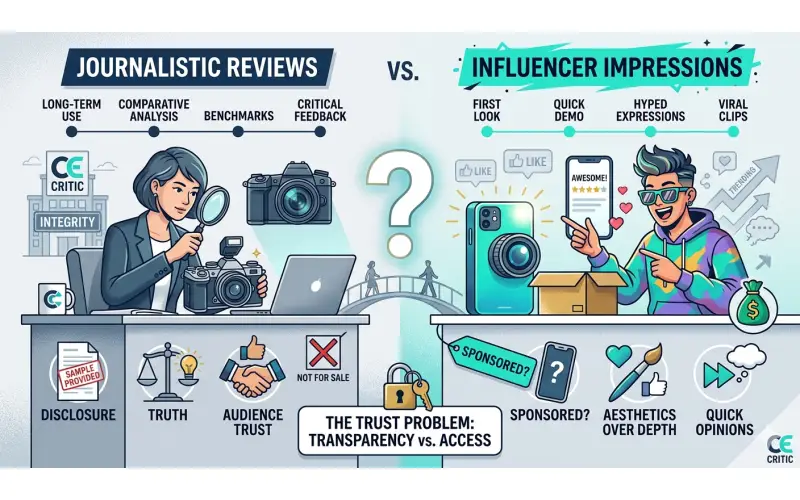
The real issue today isn’t that press trips or review units exist. It’s that the line between journalist and influencer has become blurred. On social media, anyone can present themselves as an authority. A camera, a good aesthetic, and a confident tone can create the appearance of expertise. But there’s a difference between:
- Experiencing a product
- And reviewing a product
A true review requires:
- Extended use
- Comparative analysis
- Understanding of category benchmarks
- Willingness to critique, even when it’s uncomfortable
An influencer might walk into a store, film a product for 10 minutes, and declare it “the best.” A reviewer will live with that same product for weeks, uncover its flaws, and explain where it actually fits in the market. That distinction matters. And increasingly, it’s getting lost.
The Integrity Question
Let’s address the elephant in the room: Can reviewers be bought? In some corners of social media, yes. Sponsored content exists. Paid placements exist. Undisclosed partnerships exist. But in professional journalism, the answer is far more straightforward: Reputable reviewers cannot be bought, because their credibility is their entire business. A journalist who consistently bends their opinion for access or relationships doesn’t last. Audiences catch on. Trust erodes. And once that’s gone, it’s almost impossible to rebuild. This is why long-standing publications and respected reviewers follow strict practices:
- Clear disclosure when products are provided
- Separation between editorial and advertising
- Independence in scoring and conclusions
Even when a company advertises with a publication, ethical walls exist between those teams. Because if the audience doesn’t trust the review, the platform itself loses value.
The Misunderstanding of “Free”
There’s also a misconception that receiving a product for review is equivalent to personal gain. In reality, for many reviewers, these products are tools. They’re used, tested, documented, and often:
- Returned to the manufacturer
- Passed along internally
- Given away with permission
- Donated to charity
- Kept to review updates and newer versions
Selling review units is widely considered unethical in professional circles. The product exists to be evaluated, not monetized.
Why This Matters More Than Ever
The modern consumer faces an overwhelming amount of information. Search for any product and you’ll find:
- Dozens of YouTube videos
- Hundreds of blog posts
- Endless social media opinions
But not all of these are equal. Some are:
- First impressions dressed up as reviews
- Sponsored content without disclosure
- Surface-level takes lacking real testing
And when everything looks like a “review,” it becomes harder to know what to trust. This is where skepticism becomes essential.
What to Look For in a Real Reviewer
If you’re trying to separate signal from noise, here are a few things that matter:
1. Transparency
Do they clearly state how they got the product?
Are they open about attending press events or receiving samples?
2. Depth of Testing
Do they spend time with the product or just show it?
3. Comparative Context
Do they explain how it stacks up against competitors?
4. Consistency
Are their opinions aligned over time or constantly shifting?
5. Critical Thinking
Do they highlight flaws, or is everything always “amazing”?
Red Flags to Watch For
On the flip side, there are signs worth questioning:
- “Best of” lists filled with unexpected or inconsistent picks
- Overly positive coverage with no meaningful criticism
- Lack of disclosure about how products were obtained
- Content that feels more like a sales and marketing pitch than analysis
These don’t automatically mean something is wrong, but they should prompt a closer look.
The Role of CE Critic
This entire conversation is exactly why platforms like CE Critic exist. The goal isn’t just to aggregate reviews, it’s to elevate the ones that matter.
That means focusing on:
- Professional reviewers who actually test products
- Publications with a track record of integrity and depth
- Real users who provide meaningful, experience-based feedback
And just as importantly, filtering out:
- Surface-level content
- Influencer-style impressions without testing
- Noise disguised as expertise
Because the end goal is simple: Make it easier for people to make informed decisions.
The Responsibility on Both Sides
Ethics in tech reviewing isn’t just about reviewers, it’s about audiences too.
Reviewers have a responsibility to:
- Be transparent
- Be honest
- Maintain independence
But audiences have a responsibility to:
- Evaluate sources critically
- Understand how the system works
- Recognize the difference between access and influence
Because not every free product equals bias. And not every polished video equals expertise.
Final Thoughts
Press trips and review samples aren’t new. They’ve been part of journalism for decades. What’s changed is perception. In a world where content is everywhere, trust has become harder to earn, and easier to lose.
Yes, the system isn’t perfect.
Yes, there are bad actors.
But there are also countless reviewers who take their responsibility seriously, who don’t see trips as vacations, who don’t treat products as perks, and who genuinely care about helping people make better decisions. Those are the voices worth paying attention to. And if you’re ever unsure? Look for the ones who do the work. They’re usually the hardest to fake.