By: Dipin Sehdev
For the last few years, the AV receiver market has felt oddly stagnant. Soundbars exploded in popularity. TVs became thinner. Streaming became dominant. And somewhere along the way, the traditional AV receiver, the heart of the home theater, started feeling less like a mainstream product and more like something reserved for enthusiasts willing to spend thousands. Yamaha’s new RX300A and RX500A are an attempt to change that. Announced as part of Yamaha’s 2026 home theater lineup, the two new receivers focus on something the industry desperately needs right now: accessible Atmos. Not $2,000 flagship receivers packed with every possible feature, but reasonably priced products that finally bring modern gaming support, Dolby Atmos, 8K compatibility, and simplified setup to buyers who may still be using a five-year-old soundbar or an aging entry-level AVR. And honestly, this is probably the right move. The reality is that most people don’t need a 13-channel monster receiver with rack ears and balanced outputs. They need something affordable that works with a PS5, Xbox Series X, Apple TV 4K, and modern streaming apps without becoming a setup nightmare. That’s exactly where the RX300A and RX500A land.
Yamaha’s Strategy Is Clear
These receivers are designed to close the widening gap between soundbars and traditional home theater systems. “The RX300A and RX500A close the gap between soundbars and true AV receiver-based home theater,” said Alex Sadeghian, director of marketing for consumer audio at Yamaha. “They include all the essential tech you need to build a modern home theater with phenomenal sound at an accessible price point.” That quote matters because it highlights something happening across the industry: Consumers want immersive sound, but they don’t necessarily want complexity. And Yamaha seems to understand that.
The new receivers include:
- Dolby Atmos
- HDMI 2.1
- 4K/120Hz gaming support
- 8K passthrough
- VRR and ALLM
- Simplified setup
- Modernized UI
- Bluetooth Multipoint
These are table-stakes features in 2026. But surprisingly, many affordable AV receivers still lack some combination of them.
Yamaha RX300A and RX500A Specs, Pricing, and Availability
| Model | Channels | Dolby Atmos | DTS:X | HDMI 2.1 | Gaming Features | Streaming | MSRP | Availability |
|---|---|---|---|---|---|---|---|---|
| Yamaha RX300A | 5.2 | Yes | DTS Virtual:X | 4K/120Hz, 8K/60Hz | VRR, ALLM | Bluetooth 5.3 | $399.95 | June 2026 |
| Yamaha RX500A | 7.2 | Yes | Yes | 4K/120Hz, 8K/60Hz | VRR, ALLM | AirPlay 2, Spotify Connect, Google Cast, Qobuz, TIDAL | $599.95 | September 2026 |
| Yamaha YHT-4970U | 5.1 Bundle | Yes | DTS Virtual:X | 4K/120Hz, 8K/60Hz | VRR, ALLM | Bluetooth 5.3 | $699.95 | July 2026 |
The RX300A Is the More Important Product
The RX500A is arguably the better receiver overall. More channels. Better streaming. DTS:X. Network audio. But the RX300A is probably the more important product. Why? Because it finally modernizes Yamaha’s entry-level lineup in a meaningful way. At $399, this is essentially the spiritual successor to the RX-V385, but with features that actually matter in today’s ecosystem.
That includes:
- Dolby Atmos
- Dual subwoofer outputs
- HDMI 2.1
- 4K/120Hz support
- 8K passthrough
- VRR
- Bluetooth Multipoint
That’s a massive leap for buyers coming from older receivers. More importantly, Yamaha is clearly trying to make setup less intimidating. The updated on-screen UI and guided setup process are small additions that matter more than spec-sheet enthusiasts usually admit. Because for mainstream buyers, usability matters just as much as audio quality now.
AV Receivers Have a User Experience Problem
This is something the home theater industry rarely talks about honestly. AV receivers are often terrible products for normal people. Not in performance. In experience. The menus are outdated. Setup can feel archaic. HDMI handshakes still break. Input naming is confusing. Room correction systems intimidate casual users. Meanwhile, soundbars became wildly successful because they solved one thing: simplicity. Yamaha’s redesign suggests the company finally understands this. The front panel is cleaner. The UI is simplified. Scene buttons make switching activities easier. Automatic room calibration remains intact. This sounds basic, but it’s necessary. Because if AV receivers want to survive another decade, they need to stop behaving like enthusiast-only hardware.
Gaming Is Finally Front and Center
One of the more notable shifts here is Yamaha leaning harder into gaming support. That matters because gaming is now one of the biggest drivers of home theater upgrades.
The RX300A and RX500A both support:
- 4K/120Hz
- VRR (Variable Refresh Rate)
- ALLM (Auto Low Latency Mode)
- HDMI 2.1
In other words: These receivers are finally ready for PS5, Xbox Series X, and high-refresh-rate PC gaming. That sounds obvious in 2026, but receiver manufacturers were surprisingly slow getting here.
The inclusion of these features at $399 is especially important because budget-conscious gamers are often forced into compromises:
- Cheap soundbars
- TV speakers
- Older AVRs without HDMI 2.1
The RX300A fixes that problem.
The RX500A Feels Like the Sweet Spot
While the RX300A will likely sell in larger numbers, the RX500A feels like the better long-term buy for enthusiasts.
For an extra $200, you get:
- 7.2 channels
- DTS:X
- Wi-Fi and Ethernet
- AirPlay 2
- Google Cast
- Spotify Connect
- TIDAL Connect
- Qobuz Connect
- More flexible Atmos layouts
That’s a meaningful upgrade path. And importantly, Yamaha kept the pricing relatively sane. In a market where mid-range receivers increasingly creep toward four figures, $599 feels refreshingly reasonable.
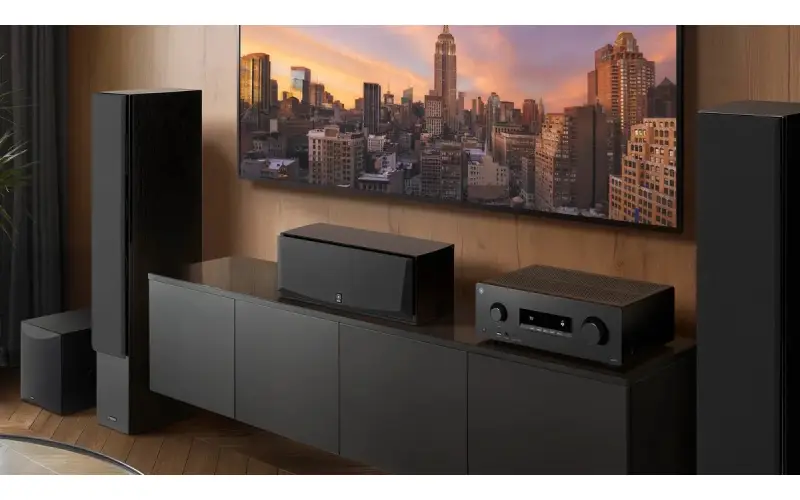
Yamaha’s Design Refresh Actually Matters
The visual redesign is subtle, but it’s part of a larger trend. AV receivers have looked basically identical for 20 years:
- giant knobs
- tiny screens
- endless buttons
- black boxes
Yamaha’s new industrial design doesn’t reinvent anything, but it modernizes the category enough to feel less intimidating. The cleaner front panel and simplified controls make these products look more approachable, especially for buyers transitioning from soundbars. That’s important because aesthetics matter now.
Consumers care about:
- living room integration
- minimalism
- ease of use
- cable management
Traditional AV companies ignored that shift for too long.
Yamaha’s Secret Weapon Is Reliability
There’s another reason Yamaha still matters in this space: people trust the brand. That sounds boring, but reliability is underrated in home theater. A lot of consumers simply want:
- stable HDMI performance
- good sound
- simple setup
- long-term durability
Yamaha has historically been very good at that. And while Denon, Marantz, Onkyo, Sony, and Pioneer continue competing aggressively on features, Yamaha’s reputation for consistency still carries weight.
The Bigger Picture
The AV receiver market isn’t dead. But it is evolving. The future likely looks like this:
- soundbars dominate mainstream buyers
- AV receivers become more lifestyle-friendly
- immersive audio becomes standard
- gaming support becomes mandatory
- usability matters as much as performance
Yamaha’s RX300A and RX500A aren’t revolutionary products. But they are smart products. And honestly, that might matter more right now. Because for years, AV receivers felt like they were being designed primarily for people already inside the hobby. These feel designed for people trying to get into it. That’s a very different, and very important, shift.
The Bottom Line
Yamaha’s new receivers won’t redefine home theater. But they do something arguably more important: they modernize entry-level AVRs without making them prohibitively expensive.
The RX300A is likely to become one of the easiest recommendations for:
- first-time Atmos buyers
- gamers
- people upgrading older receivers
- users moving beyond soundbars
Meanwhile, the RX500A offers enough flexibility and streaming support to satisfy more serious home theater users without entering flagship pricing territory. Most importantly, Yamaha seems to understand that the future of AV receivers isn’t just about sound quality anymore. It’s about experience. And finally, the industry is starting to catch up to that reality.