By: Dipin Sehdev
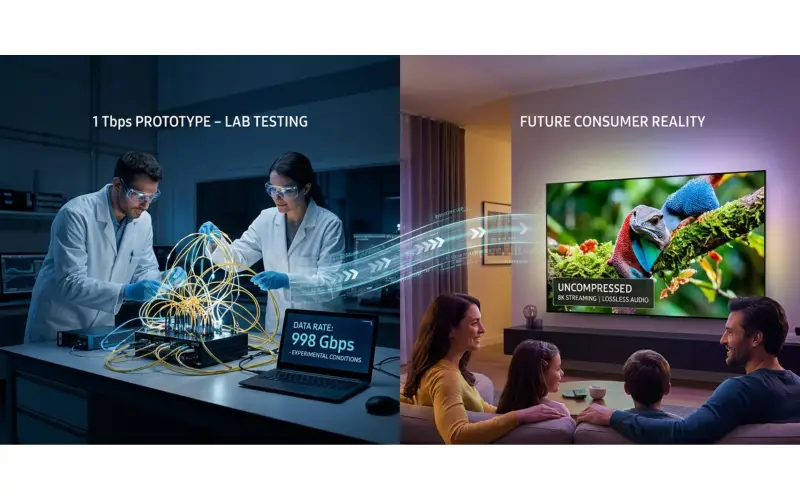
Every so often, a headline comes along that sounds like science fiction. This is one of them. Researchers have demonstrated internet speeds approaching 1 terabit per second (Tbps)—that’s roughly 1,000 Gbps, or about 100 times faster than what most high-end home connections offer today. On paper, it’s transformative. At that speed, you could download entire 4K movie libraries in seconds, stream 50,000,000 uncompressed cinema-quality videos simultaneously, and fundamentally change how data moves across the internet. But before we get carried away, there’s an important reality check: This is still lab testing.
Lab Speeds vs Real World Reality
What’s been achieved here is undeniably impressive, but it’s also controlled. These speeds are typically demonstrated under highly specific conditions:
- Short distances
- Specialized fiber infrastructure
- Ideal environmental variables
- Custom hardware not available to consumers
In other words, this isn’t something you’ll be signing up for next year. Or likely even this decade. The gap between lab breakthroughs and consumer deployment is often measured in years, sometimes decades. Still, that doesn’t mean it’s irrelevant. Far from it.
Why This Actually Matters
Even if 1 Tbps internet doesn’t reach your home anytime soon, the implications are significant. For years, internet infrastructure has been playing catch-up with content quality. Streaming services compress video aggressively to make it deliverable over today’s networks. That’s why even the best streaming services still don’t match Blu-ray quality, let alone uncompressed video. But if speeds like this become viable? That changes everything. We could move toward a world where:
- Uncompressed 4K (and even 8K) video becomes streamable
- Streaming quality rivals, or surpasses, physical media
- Latency drops dramatically for cloud gaming and real-time applications
In short: bandwidth would no longer be the bottleneck.
The Short-Term Reality: Data Centers First
Before this ever reaches your living room, it will likely transform something else: Data centers. Ultra-high-speed networking has immediate applications in:
- Cloud infrastructure
- AI model training and deployment
- Enterprise data transfer
- Backbone internet routing
These are environments where cost is less of a barrier and performance gains translate directly into business value. So while consumers may not see 1 Tbps soon, companies like Amazon, Google, and Microsoft almost certainly will, behind the scenes.
The Long-Term Hope: Raising the Baseline
If there’s a realistic consumer takeaway, it’s not that we’ll all get 1 Tbps. It’s that the baseline could rise.
Right now:
- Many households still operate on 100–300 Mbps
- Gigabit internet (1 Gbps) is considered premium
But if infrastructure continues to evolve, we could see:
- 1 Gbps become the standard minimum
- Multi-gig connections (2–10 Gbps) become more common
- Better consistency and lower latency across networks
That alone would dramatically improve everyday experiences.
The Streaming Bottleneck
To understand why this matters, you have to look at how much bandwidth today’s content actually requires. Here’s where things get interesting. Because not all “4K” is created equal.
Bandwidth Requirements: Physical vs Streaming
Blu-ray (4K UHD Disc)
- Bitrate: ~50–100 Mbps (peaks higher)
- Audio: Lossless Dolby TrueHD / DTS-HD MA (~3–6 Mbps)
- Total: ~60–120 Mbps
This is the gold standard for home video quality.
Streaming Services (Compressed)
| Service | 4K HDR Bitrate | Audio Format | Estimated Total |
|---|---|---|---|
| Netflix | 15–25 Mbps | Dolby Atmos (compressed) | ~20–30 Mbps |
| Amazon Prime Video | 12–20 Mbps | Dolby Atmos (compressed) | ~15–25 Mbps |
| Apple TV+ | 20–40 Mbps | Dolby Atmos (higher quality) | ~25–50 Mbps |
| Disney+ | 15–25 Mbps | Dolby Atmos | ~20–30 Mbps |
| Hulu | 10–16 Mbps | Limited Atmos support | ~12–18 Mbps |
| Sony Core (Bravia Core) | 30–80 Mbps | DTS:X / Atmos | ~40–100 Mbps |
The Gap Is Still Massive
Even the best streaming services fall short of Blu-ray.
- Compression reduces detail
- Artifacts appear in dark scenes
- Audio is often lossy instead of lossless
Sony Core is the closest attempt to bridging that gap, pushing bitrates much higher, but it’s still not fully uncompressed.
Now imagine what happens if bandwidth stops being a constraint.
A Future Without Compression?
If ultra-high-speed internet becomes widely available, streaming could evolve dramatically:
- Lossless video streaming becomes viable
- Full-quality Dolby Vision and HDR without compromises
- True lossless audio (Dolby TrueHD, DTS:X) delivered directly
That would effectively eliminate one of the biggest advantages of physical media. No discs. No downloads. Just pure quality on demand.
Why We’re Not There Yet
Even if the network can handle it, there are other challenges:
- Storage and delivery costs for massive files
- Content delivery networks (CDNs) scaling globally
- Device limitations (TVs, streamers, decoding hardware)
- Business models built around efficiency, not excess
Streaming companies optimize for scale and profit. Higher quality means higher costs. And right now, only enthusiasts are demanding Blu-ray-level quality from streaming.
The Bigger Picture
So where does that leave us? This 1 Tbps breakthrough isn’t about what you’ll get next year. It’s about what becomes possible over time. It signals a shift where:
- Infrastructure begins to outpace content demands
- Quality ceilings start to rise
- New formats and experiences become viable
And perhaps most importantly: It challenges the assumption that compression is inevitable.
The Bottom Line
Yes, 1 Tbps internet is exciting. But it’s also early. For now, it lives in labs and probably data centers. Still, the direction is clear.
In the short term, expect improvements behind the scenes, faster cloud services, better infrastructure, more efficient networks. In the long term? There’s a real possibility that:
- Gigabit becomes the baseline
- Streaming quality rivals physical media
- And maybe, finally, we stop compromising on quality just to make content deliverable
Because when bandwidth is no longer the limitation, the entire industry has to rethink what’s possible. And that’s where things get interesting.