By: Dipin Sehdev
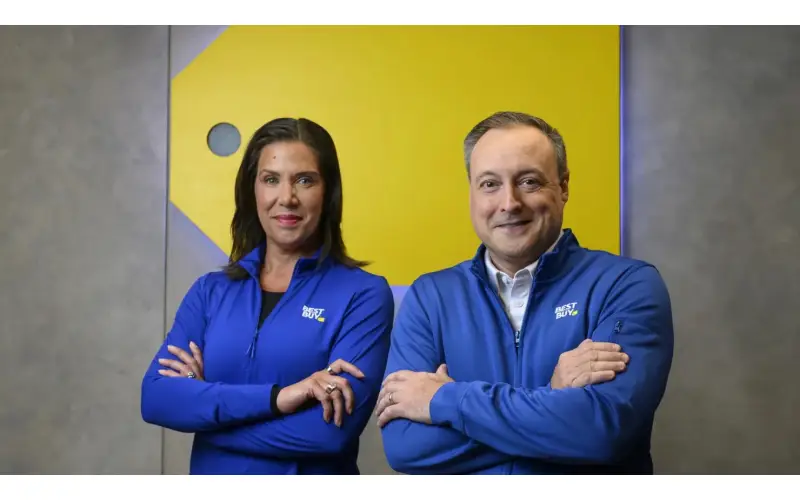
Best Buy has a new chief executive. But if you were expecting a reset, or even a meaningful shift in direction, this isn’t that moment. Instead, the company has chosen continuity. Jason Bonfig, a 27-year veteran who has quietly risen through the ranks, will replace Corie Barry as CEO later this year. It is, in many ways, the most predictable outcome possible for a company that finds itself stuck between past success and an uncertain future.
A Change That Doesn’t Feel Like One
Leadership transitions often signal a pivot, new ideas, new strategies, a break from what isn’t working. That’s not what this looks like. Bonfig is not an outsider brought in to challenge Best Buy’s thinking. He is the thinking. As chief customer, product, and fulfillment officer, he has already been responsible for many of the initiatives the company is betting on: expanding e-commerce, building out its third-party marketplace, and growing its retail media business through Best Buy Ads. He has overseen operations in Canada, managed supply chains, and helped steer the company’s digital transformation. In other words, the future of Best Buy under Bonfig looks very much like its present. That may be comforting internally. It is less reassuring externally.
The Problem Isn’t Leadership—It’s Momentum
To be fair, Corie Barry’s tenure deserves recognition. She guided Best Buy through one of the most volatile periods in modern retail history. During the pandemic, when demand for home electronics surged, the company thrived. Televisions, laptops, appliances, and everything people needed to build a home office or upgrade their living spaces flew off the shelves. But that moment passed. As inflation rose and borrowing costs increased, consumers pulled back on big-ticket purchases. The replacement cycle slowed. Innovation in core categories like TVs and PCs became incremental rather than transformative. And Best Buy, heavily reliant on those categories, began to feel the pressure. The numbers reflect it. Sales have declined in the majority of recent quarters. The stock has struggled to recover. Meanwhile, competitors, both traditional retailers and online giants, have continued to evolve. This is the context Bonfig inherits.
Betting on the Same Playbook
If there is a strategy here, it is one rooted in adaptation rather than reinvention.
Best Buy is leaning into three areas:
- E-commerce and marketplace expansion
- Retail media and advertising
- Positioning for an AI-driven product cycle
These are not unique ideas. They are, in fact, the same plays being run by Amazon, Walmart, and nearly every major retailer trying to extract more value from their customer base. The logic is straightforward. If consumers are buying fewer high-margin devices, you find new ways to monetize their attention. You sell ads. You host third-party sellers. You turn your platform into an ecosystem. Bonfig has been central to building that ecosystem. His promotion suggests the company intends to double down. But there is an underlying question: is that enough?
The AI Bet and Its Limits
Both Barry and Bonfig have pointed to artificial intelligence as the next growth driver. The argument is that AI-enabled devices, smartphones, laptops, wearables, will spark a new upgrade cycle, bringing customers back into stores and onto the website. There is some merit to that. Every major shift in consumer technology has historically driven demand. The smartphone boom. The 4K TV transition. The work-from-home surge. But AI, at least for now, feels different. It is less tangible. Less immediate. More iterative than revolutionary for the average consumer. And Best Buy’s success has always depended on those moments when innovation is obvious, when a customer walks into a store and sees something they didn’t know they needed until that moment. If AI doesn’t deliver that kind of clarity, the boost may be more gradual than transformative.
A Retailer in the Middle
Best Buy’s challenge is structural. It is not a low-cost retailer like Walmart. It is not a platform giant like Amazon. It is not a premium brand in the way Apple controls its own ecosystem. It sits in the middle of a specialty electronics retailer trying to stay relevant in a market where the rules keep shifting. That middle ground is becoming harder to defend. Appliance sales are under pressure. Consumers are trading down. Competitors like Home Depot and Lowe’s are gaining ground in categories Best Buy once dominated. And the broader retail environment remains unpredictable, shaped by tariffs, supply chain constraints, and changing consumer behavior. Bonfig’s appointment does not change any of that.
Stability Over Surprise
There is, of course, an argument for stability. After years of volatility, perhaps what Best Buy needs is not a dramatic overhaul but steady execution. Someone who understands the business deeply. Someone who can refine operations, optimize strategy, and navigate incremental change. Bonfig fits that profile perfectly. But stability comes with a trade-off: it rarely produces breakthroughs. And right now, Best Buy feels like a company that could use one.
The Bigger Question
The real issue is not whether Bonfig is the right leader. By all accounts, he is experienced, capable, and deeply familiar with the company’s operations. The question is whether Best Buy, as it currently exists, has a path back to meaningful growth. Because leadership alone cannot solve a problem rooted in market dynamics.
If consumer demand for big-ticket electronics remains soft…
If innovation in core categories continues to slow…
If competitors keep redefining what retail looks like…
Then even the most competent leadership may struggle to move the needle.
The Bottom Line
Best Buy’s CEO transition feels less like a turning point and more like a continuation. Jason Bonfig represents the company’s current strategy, not a departure from it. His promotion signals confidence in the direction Best Buy is already heading. For now, that means more focus on digital expansion, advertising, and operational efficiency, paired with a cautious optimism around AI-driven demand. But for consumers and observers looking for something new, something bold, something that redefines what Best Buy could be… This isn’t it. At least, not yet.