By: Dipin Sehdev
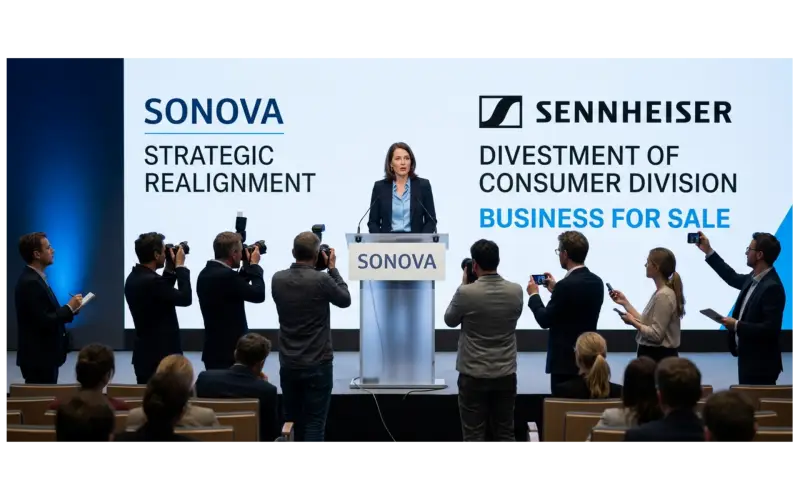
Sennheiser is up for sale, again. And while that headline is going to catch a lot of people off guard, it probably shouldn’t. Sonova, the Swiss hearing care giant that acquired Sennheiser’s consumer division in 2022 for roughly €200 million, is now preparing to divest the business. The reasoning is straightforward on paper: Sonova wants to double down on its core strengths, medical hearing aids and cochlear implants, and sees consumer audio as a mismatch in terms of growth cycles, distribution, and long-term strategy. That’s the official version. The reality is a bit more familiar if you’ve been watching how deals in this industry, and frankly, most industries, get structured.
The Five-Year Clock
A lot of acquisitions like this are built around a fairly predictable financial model. Whether it’s private equity, a strategic buyer, or a hybrid structure, these deals are often financed with a combination of cash and debt. And that debt usually comes with a timeline. Call it a five-year clock. The idea is simple: acquire a brand, improve margins, expand distribution, extract synergies where possible, and then exit, either through a sale, a merger, or occasionally an IPO. The goal isn’t necessarily to hold forever. It’s to create value within a defined window. So when Sonova steps in, acquires Sennheiser’s consumer business, and then moves to sell it a few years later, it fits a pattern we’ve seen time and time again. It may feel abrupt from the outside, but structurally, it’s almost expected. That doesn’t make it any less disruptive.
A Brand in Motion
The Sennheiser name still carries serious weight. In the audiophile world, products like the HD 600, HD 650, and HD 800 series are foundational. For many in the consumer and professional space, they’re reference points. Entire categories have been built around them. Even in the more mainstream space, the Momentum line has kept Sennheiser relevant in a market dominated by Apple, Samsung, Google, Sony, and Bose. That brand equity doesn’t disappear just because ownership changes. But it does raise a bigger question: what happens when a company changes hands every few years? Consistency becomes harder. Long-term product roadmaps get interrupted. Strategy shifts depending on who’s holding the keys. And in audio, especially at the high end, consistency matters.
The Split Personality
Part of what makes this situation unique is that Sennheiser isn’t entirely up for sale. The original Sennheiser family still owns the professional division, the side of the business that handles microphones, broadcast gear, and studio equipment. What’s being sold is the consumer arm, which operates under license using the Sennheiser name. That split has always been a bit unusual. It creates two versions of the same brand, moving in parallel but not always in sync. On one hand, you have a legacy-driven, engineering-focused pro division. On the other, a consumer business that has to compete in a fast-moving, trend-driven market where wireless, ANC, and app ecosystems matter just as much as sound quality. Sonova tried to bridge that gap, positioning consumer audio as an extension of its hearing expertise. In practice, the overlap wasn’t as strong as expected. Different customers. Different timelines. Different expectations.
Why the Exit Makes Sense
From Sonova’s perspective, the decision is logical. The company is aiming for significant growth, targeting six billion Swiss francs in revenue by 2030/3, and wants to focus its resources where it sees the most opportunity. Consumer audio doesn’t fit neatly into that vision. The development cycles are faster. The competition is intense. Margins can be volatile. And unlike medical devices, there’s less long-term predictability. So the consumer division gets reclassified as a business unit held for sale. Clean, efficient, and very much in line with how these strategies typically play out.
What It Means for Consumers
In the short term, not much changes. Sennheiser has been clear: product development continues, warranties remain intact, and day-to-day operations are unaffected. If you’re using a pair of Momentum headphones or an HD 660S2, nothing suddenly stops working. That’s usually how these transitions go. The real impact tends to show up later, once a new owner comes in and starts making decisions about direction, investment, and positioning. The bigger question is who that new owner will be. Will the consumer division go back to the Sennheiser family?
The Next Chapter
There are a few obvious possibilities.
A large consumer electronics company could step in, looking to add a respected audio brand to its portfolio. We’ve seen this before—Bose acquiring McIntosh Group, for example, or Harman (under Samsung) building out its ecosystem of brands like JBL, AKG, and Mark Levinson. Private equity is another option, though that often brings us back to the same cycle: buy, optimize, sell. There’s also the possibility of a more strategic buyer, someone who understands the heritage of the brand and wants to build on it rather than reshape it entirely. Whoever it is, they’re not just buying a product line. They’re buying decades of credibility.
The Bigger Picture
This isn’t happening in isolation. The audio industry has been consolidating for years, with brands getting folded into larger groups that can handle everything from manufacturing to distribution to software ecosystems. In some ways, it’s a sign of strength. There’s real value in these brands, and companies are willing to invest in them. At the same time, it creates a tension between short-term financial goals and long-term brand building. Sennheiser sits right in the middle of that tension.
Not the End—Just Another Turn
For all the headlines, this doesn’t feel like an ending. It feels like another chapter. The brand is still strong. The products still resonate. And there’s no shortage of companies that would see value in owning a name like Sennheiser. The real question isn’t whether someone will buy it. It’s what they’ll do with it once they do. Because at some point, if a company is passed from owner to owner every few years, you have to ask how it builds something lasting. That’s the part that’s still unresolved. And it’s the part worth watching.