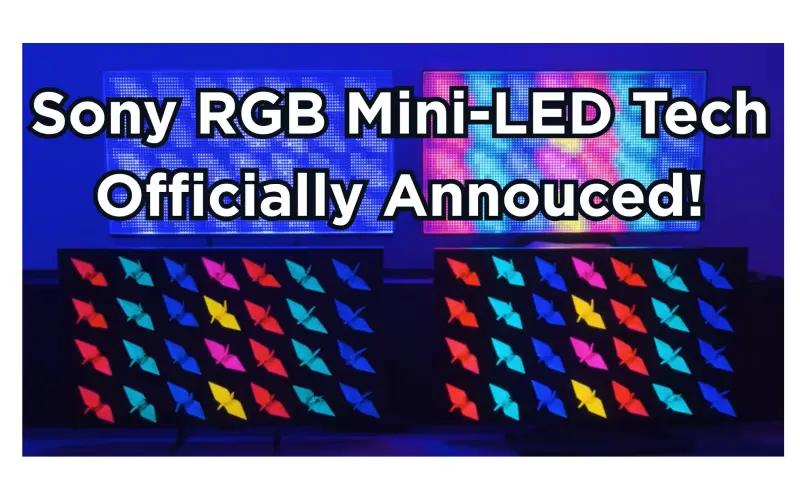
Image: Courtesy of CalebRated
By: Dipin Sehdev
This is what 20 years of patience looks like. Sony didn’t rush to market with RGB Mini LED. It didn’t slap a new label on existing tech and ship it early. Instead, it waited, and now it’s stepping in with “True RGB”, a name that is less about novelty and more about intent. Because in classic Sony fashion, this isn’t about being first. It’s about being right. And before we get carried away, it’s worth grounding this in reality.
The Hype Is Real… But So Is the Unknown
There’s no question this is exciting. RGB Mini LED is the biggest LCD evolution we’ve seen in years, with nearly every major manufacturer pushing some version of it in 2026, from Samsung’s Micro RGB to Hisense’s RGB Evo and LG’s Micro RGB lineup. Sony's entering the space with its own spin, backed by its mastering monitor processing, is a big deal.
But here’s the truth:
We haven’t seen these TVs in real-world environments yet.
- No full reviews
- No calibration data
- No long-term testing
- No side-by-side comparisons in actual homes
Right now, everything we’ve seen is:
? Controlled demos
? Lab conditions
? Highly curated content
That’s not the same thing as real-world performance. So yes—the excitement is justified, and I am very excited. But so is the skepticism to make sure Sony delivers on its promise of True RGB.
What Sony Is Actually Doing Differently
Sony’s pitch with True RGB is all about refinement.
Where competitors focus on:
- Smaller LEDs
- More LEDs
- Higher peak brightness
Sony is focused on:
- LED density (how tightly packed they are)
- Processing algorithms (borrowed from pro monitors)
- Color accuracy and intent
That last point is critical. Sony doesn’t just want brighter TVs, It wants TVs that match what creators see in production studios with color accuracy and depth.
The Bigger Shift: RGB Mini LED Is Now a Battlefield
What makes Sony’s timing interesting is that it’s walking into a war that has already started.
2026 is shaping up to be the year where: RGB Mini LED vs OLED vs Advanced Mini LED (like TCL’s SQD) becomes the central fight in TVs. And unlike previous years, there’s no clear winner yet.
The 2026 RGB Mini LED Landscape (So Far)
Here’s how things are shaping up across brands:
| Brand | Model / Series | Tech Branding | Key Differentiator | Status |
|---|---|---|---|---|
| Sony | Bravia (TBD) | True RGB | Processing from mastering monitors, dense LED control | Not released |
| Samsung | R95H / Micro RGB lineup | Micro RGB | Focus on brightness, large sizes (up to 130”) | Expected 2026 |
| LG | MRGB95 (Micro RGB evo) | Micro RGB evo | AI processing + large format sizes | Announced |
| Hisense | UR9 / UR8 / 116UXS | RGB Mini LED / RGB Evo | Adds cyan channel for wider color (110% BT.2020) | Launching 2026 |
| TCL | RM9L / RM7L | RGB Mini LED | Focus on value + large formats | Announced |
| Hisense (flagship) | 116UXS | RGB + Cyan variant | Extreme color volume + premium positioning | Prototype/limited |
Every major brand is now investing heavily in RGB-based backlighting, with multiple implementations competing simultaneously.
The Key Differences in RGB Implementation
This is where things get messy and where Sony is trying to differentiate.
Not all RGB Mini LED TVs are created equal.
1. Standard RGB Mini LED (Most brands)
- Red, Green, Blue LEDs
- Improved brightness + color vs traditional Mini LED
2. Enhanced RGB (Hisense RGB Evo)
- Adds a cyan element
- Expands color gamut beyond standard RGB
- Claims up to 110% BT.2020 color space
3. Micro RGB (Samsung / LG)
- Focus on smaller LED structures
- Emphasis on precision + scalability
4. Sony “True RGB”
- Focus on processing + density over LED size
- Emphasis on:
- Color accuracy
- Viewing angles
- Blooming control
Sony is essentially saying: It’s not about the hardware alone, It’s about how you use it
Why This Could Be a Big Deal
If Sony delivers on its claims, True RGB could:
- Reduce blooming more effectively than competitors
- Improve off-angle viewing (a traditional LCD weakness)
- Deliver more reference-level color accuracy
And potentially: Close the gap between OLED and LED in meaningful ways. That’s the long-term promise.
But Let’s Be Honest About What Happens Next
Right now, we are still in the “demo phase” of RGB Mini LED. And history tells us:
- Early demos often look incredible
- First-gen products often have trade-offs
- Real-world performance is where things get exposed
We’ve seen this before with:
- Early Mini LED
- Early OLED brightness claims
- First-gen QD-OLED
So the real test isn’t what Sony showed. It’s what happens when:
- Reviewers get units
- Calibration experts measure performance
- Real content is tested across environments
Final Thought: This Isn’t About One Company
This isn’t just a Sony story. It’s a turning point for the entire TV industry. RGB Mini LED is no longer a niche experiment. It’s the next battleground.
And now:
- Samsung is pushing scale
- Hisense is pushing innovation
- LG is pushing integration
- TCL is pushing value
- Sony is pushing accuracy
That’s what makes this moment so interesting. Not just the technology. But the philosophies behind it. Now we wait and more importantly, we watch.