By: Dipin Sehdev
When the news first broke earlier this year, it caught a lot of people off guard. TCL, one of the fastest-growing TV manufacturers in the world, was stepping in to take over a majority stake in Sony’s TV business. For many, it felt like a seismic shift. Sony, a brand synonymous with premium TVs and industry-leading processing, is handing over control? Now, with the deal officially signed, the picture is clearer. And while the long-term implications could be massive, the short-term reality is simple: Nothing changes in 2026. 2027 is when things get interesting.
The Deal, Finalized
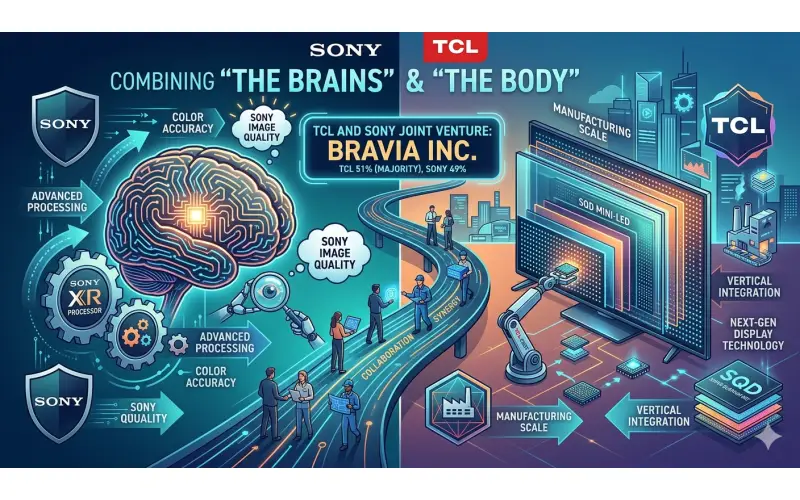
Sony and TCL have formally agreed to create a new joint venture called Bravia Inc.
- TCL will own 51% (majority stake)
- Sony will retain 49%
- The company will be headquartered in Tokyo
- Sony veteran Kazuo Kii will serve as CEO
This is a structural shift. TCL is now the majority owner of Sony’s TV business on paper. But operationally, Sony is still deeply embedded in leadership, design, and product direction, at least for now. The venture is expected to begin operations in April 2027, pending regulatory approvals.
What TCL Is Actually Taking Over
TCL is stepping into a much broader slice of Sony’s home entertainment ecosystem. Under Bravia Inc., the following areas will be combined:
Consumer Products
- Sony Bravia TVs
- Future display technologies and product development
Commercial Displays (B2B)
- Professional flat panel displays
- LED display solutions for businesses
Projection
- Sony’s high-end home theater projectors (some of the best in the industry)
Audio
- Home theater systems
- Audio components tied to Sony’s TV ecosystem
Manufacturing & Supply Chain
- Sony’s manufacturing subsidiaries (including Malaysia operations)
- Potential transfer of additional production assets in China
In short: TCL is inheriting the infrastructure behind it.
Why This Happened
Making TVs is hard. Making great TVs is even harder. Sony has long been known for its best-in-class image processing, color accuracy, and motion handling. In fact, Sony TVs regularly win industry “shootouts” where accuracy matters most. But Sony has one major disadvantage: It doesn’t make its own panels at scale. Unlike Samsung (with Samsung Display) or TCL (with CSOT), Sony relies on third-party panel suppliers—primarily LG Display for OLED and others for LCD. That creates challenges:
- Higher costs
- Less control over supply
- Limited ability to scale competitively
TCL, on the other hand, has the opposite advantage:
- Massive manufacturing scale
- Vertical integration
- Panel innovation through TCL CSOT
This partnership is, in many ways, complementary. Sony brings the brains. TCL brings the body.
The Real Opportunity: Technology Synergy
This is where things get exciting. TCL has been pushing aggressively into new display technologies, especially Mini-LED and its latest innovation: SQD (Super Quantum Dot) Mini-LED.
We’ve already seen what TCL can do on its own:
- Up to 10,000 nits brightness
- Massive dimming zones
- Near 100% BT.2020 color coverage
Now imagine that hardware paired with Sony’s processing.
- Sony’s XR processor + TCL’s SQD panels
- Better tone mapping
- More accurate color reproduction
- Superior motion handling
That combination could produce something genuinely special. Because historically, Sony’s biggest limitation hasn’t been its processing, it’s been the panels it has access to. This partnership potentially removes that bottleneck.
What About OLED?
There’s been some speculation that this move could signal Sony stepping away from OLED. I don’t think that’s the case. If anything, the opposite might happen. TCL’s panel division, CSOT, is actively investing in next-generation OLED technologies, including inkjet-printed OLED. While TCL hasn’t traditionally sold OLED TVs, it’s deeply involved in developing them. So instead of Sony losing OLED, we might see:
- New OLED panels coming from TCL’s ecosystem
- Greater control over OLED supply
- Potentially more competitive OLED pricing
It’s early, but the idea that Sony could eventually leverage TCL-backed OLED panels isn’t far-fetched.
Short-Term Reality: No Changes in 2026
If you’re expecting immediate changes, don’t. Sony’s 2026 lineup will look… like Sony.
- Same branding
- Same processing philosophy
- Same general positioning
That’s because Bravia Inc. doesn’t officially begin operations until April 2027. Everything before that is essentially business as usual.
2027 and Beyond: Where It Gets Interesting
This is where the real story begins. By 2027, we could start seeing:
1. More Competitive Pricing
Sony has historically struggled in the mid-range and budget segments.
TCL excels here.
Expect:
- More aggressively priced Sony-branded TVs
- Better value propositions
- Stronger competition against Samsung and LG
2. New Panel + Processing Combos
The biggest upside is technical:
- TCL panels + Sony processing
- Potential hybrid display strategies (SQD, RGB, OLED)
- Faster iteration cycles
3. Shared Development Resources
Combining engineering teams could lead to:
- Faster innovation
- Better calibration tools
- Improved software experiences
4. Expanded Global Scale
TCL’s manufacturing footprint and distribution reach could help Sony:
- Scale production more efficiently
- Compete in emerging markets
- Reduce costs across the board
The Risk
Of course, not everyone is celebrating this move. There’s a real concern that Sony could lose some of what makes it special:
- Its obsessive focus on accuracy
- Its premium positioning
- Its independence in design philosophy
When you introduce scale and cost efficiency into the equation, there’s always a risk of compromise. The challenge for Bravia Inc. will be balancing:
- Sony’s identity
- With TCL’s operational efficiency
The Bottom Line
This deal is bigger than it looks. TCL taking a 51% stake in Sony’s TV business isn’t just a financial move, it’s a strategic realignment of the TV industry. But it’s not an overnight transformation. 2026 will feel familiar. 2027 is where we start to see the impact. And if things go right? We could end up with something the industry hasn’t quite seen before: TCL’s cutting-edge display technology combined with Sony’s best-in-class processing. If that happens, the real winners won’t be Sony or TCL. It’ll be consumers. For now, though, we wait.