By: Dipin Sehdev
For years, desktop audio has lived in an odd space. PC gamers demanded immersion, remote workers needed clarity, and content creators wanted accuracy—yet most desktop speaker systems sat somewhere between “cheap plastic” or “studio monitors that cost more than the computer they’re connected to.” With more people than ever working from home and more gaming happening on compact desk setups, the market has been craving something powerful, polished, and affordable.
Klipsch seems to have heard that call.
The brand’s ProMedia line is legendary in PC audio circles. For many people in the early 2000s, ProMedia speakers were their first taste of real sound—horn-loaded clarity, surprising output, and a signature tuning that punched far above their size. Twenty-six years later, Klipsch is finally revisiting that legacy with a fully modern redesign: the ProMedia Lumina.
This isn’t just an update. It’s the first major evolution of one of the most iconic desktop speaker systems ever made—and it’s clearly tuned for today’s hybrid lifestyle. From Zoom meetings to late-night gaming sessions to creating content, Klipsch is positioning the Lumina as the new “default” option for anyone who wants great sound on their desk without building a full hi-fi system.
And based on the specs and feature set alone, the Lumina might be the speaker system to watch.
Reinventing a Classic for Modern Desks
At its core, the ProMedia Lumina stays true to the Klipsch identity. You get horn-loaded tweeters, strong nearfield performance, and a real subwoofer instead of the small passive boxes many competitors include. But nearly every other piece of the system has been modernized.
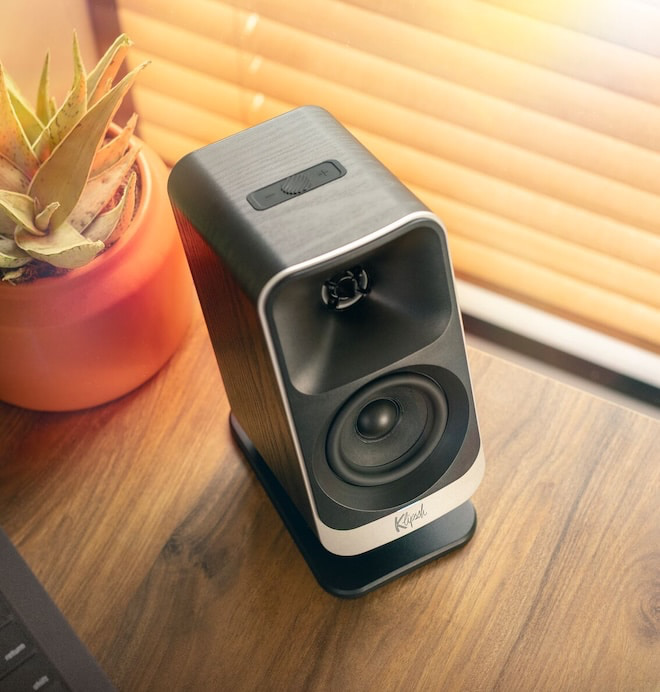
To start, the satellite speakers use a patented MicroTractrix® horn, redesigned with a wider profile to deliver more controlled dispersion at close range. Nearfield listening—just a few feet from the speakers—is notoriously tricky for traditional horns, but Klipsch has clearly engineered these for desktop use.
Each satellite pairs a 1-inch tweeter with a 3-inch midrange driver, giving the system more midrange detail than single-driver desktop speakers can offer. For video calls, this means clearer voices. For gaming, cleaner positional audio. For music, a more full-bodied, dynamic presentation.
The 6.5-inch side-firing subwoofer has also been completely rethought. Instead of a wide, boxy design, Klipsch uses a slim, tall cabinet that fits cleanly beside a desk or under it. It includes a rear cable-management alcove (a small detail, but a very good one) and an adjustable gain knob that lets users dial in the exact amount of weight they want in their low end.
Where many PC speakers in this price range rely on inflated specs or tiny “subwoofers” that merely bump mid-bass, Klipsch is clearly aiming for real low-frequency reach. For gaming explosions, cinematic sound mixes, or bass-heavy tracks, that matters.
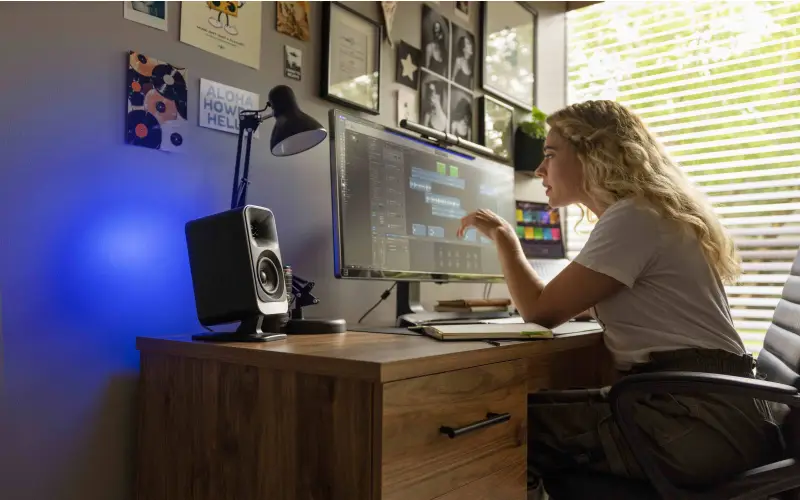
Designed for Hybrid Life: Gaming, Work, Creation
One of the biggest shifts in 2025 is how people use their desktops. The average desk setup now needs to do everything:
-
Work calls during the day
-
Gaming at night
-
Music streaming anytime
-
Content editing for creators
-
Movie watching on monitors instead of TVs
-
Background audio while remote working
Klipsch leans into this versatility with a connectivity feature set that solves the number one complaint about most PC speakers: limitations.
The ProMedia Lumina supports:
-
Bluetooth 5.3 for quick audio hand-offs
-
USB-C audio for laptops and Windows desktops
-
3.5mm analog for universal compatibility
This means the system can instantly move between a gaming PC, a work laptop, and a phone without the tangled mess of inputs many desktop systems require.
Then there are the sound-shaping modes:
-
Music Mode
-
Movie Mode
-
Virtual Surround Mode (not gimmicky—actually useful in nearfield gaming)
-
Night Mode for apartments or late-night sessions
Add a six-band EQ, and users can tailor the system to their particular desk setup or personal taste.
Control Apps for Mobile and PC — A Big Step Forward
Perhaps the most modern update: the Lumina is fully controllable from both mobile devices and Windows PCs.
Through the Klipsch Connect Plus mobile app, users can access:
-
Light modes
-
EQ adjustments
-
Volume control
-
Night mode
-
Firmware updates
-
Troubleshooting guides
But the standout addition is the Klipsch Control App for Windows, giving users desktop-level control without picking up a phone. This includes:
-
Screen React (ambient lighting based on screen colors)
-
Dynamic Lighting (syncs with RGB ecosystems)
-
Audio controls
-
System configuration
Having native PC control is genuinely important—especially for gamers and remote workers who spend most of their day at their desktop. It's the kind of feature that makes this system feel like a true 2026-era product rather than a simple speaker refresh.
Lighting That Complements, Not Distracts
Instead of going for aggressive gamer-grade RGB, Klipsch incorporates six ambient LEDs into each satellite with:
-
Five ambient Light Modes
-
Music-reactive lighting
-
Screen-based color sampling
-
Sync capability with other RGB ecosystems (Windows 11+)
Rather than drowning your desk in neon light, Klipsch uses soft glow effects that feel more in line with modern productivity setups. This means the Lumina fits into multiple environments—gaming battlestations, minimalist home offices, and content creator studios alike.
Specs, Price & Availability
|
System Type: |
2.1 desktop speaker system |
|
Power: |
100W RMS (200W peak) |
|
Satellites: |
1" tweeter + MicroTractrix® horn, |
|
|
3" midrange driver |
|
Subwoofer: |
6.5" side-firing driver, slim ported design |
|
Frequency Range: |
40Hz–20kHz (–6dB) |
|
Max Output: |
98dB SPL |
|
Connectivity: |
USB-C, Bluetooth 5.3, 3.5mm Aux |
|
Controls: |
Vol +, Vol –, Multifunction button |
|
Apps: |
Klipsch Connect Plus (mobile), |
|
|
Klipsch Control App (Windows) |
|
Sound Modes: |
Music, Movie, Virtual Surround, |
|
|
Night Mode, 6-band EQ |
|
Lighting: |
5 ambient Light Modes, RGB sync, |
|
|
Screen React, music-reactive lighting |
|
Extras: |
Auto-on/off, 0–20° adjustable tilt stands, |
|
|
reverse charging (5V/2A) |
|
Dimensions: |
Satellites – 9.75" × 6.5" × 4" |
|
Subwoofer – |
14" × 6" × 13.875" |
|
Materials: |
ABS satellite enclosures, MDF subwoofer |
|
Price: |
$379.99 (US) |
|
Availability: |
Available now (US); EU/UK Jan 2026 (€399) |

A System Built for Today’s Desktop Culture
The ProMedia Lumina may not compete with multi-thousand-dollar studio monitors or full bookshelf systems, but that’s not the point. Klipsch is aiming directly at the rapidly growing audience of:
-
hybrid remote workers
-
PC gamers
-
content creators
-
students
-
apartment dwellers
-
desk-focused music listeners
It’s a demographic that wants:
-
Better sound than cheap PC speakers
-
Less effort than a full amplifier + passive speaker setup
-
Simplicity, versatility, and daily usability
-
A price point that makes sense
At $379, the ProMedia Lumina lands in a sweet spot: not disposable, not extravagant.
And with CE Critic reviewing more desktop-audio products than ever, the Lumina is absolutely shaping up to be a system to watch. If performance lives up to these specs, it could be one of the most appealing desktop speaker releases of the year.
Final Thoughts
Klipsch had a lot to live up to with the ProMedia reboot, and the Lumina reads like a thoughtful modernization rather than a nostalgia cash-in. The company seems to understand today’s desktop audio landscape: more PC gaming, more remote work, more nearfield listening, and more expectations from users who want their desk setups to be purposeful, stylish, and immersive.
The ProMedia Lumina checks all the right boxes—strong acoustics, modern connectivity, clever software, and a design that fits today’s hybrid lives.
If the real-world performance matches the engineering, this could be one of the standout 2.1 desktop systems of the year—and a strong contender for an impressive CE Critic Score once full reviews drop.