By: Dipin Sehdev
Samsung is finally starting to pull back the curtain on its 2026 OLED lineup, and on the core stuff, the early read is exactly what most of us expected: these TVs look very good.
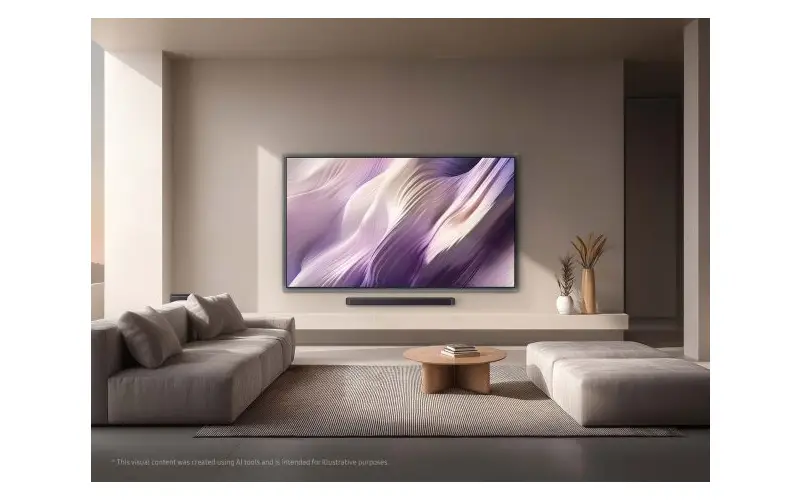
The surprise is not that Samsung’s OLEDs are brighter, faster, or more feature-packed. The surprise is the design direction. At a moment when so many TV makers are racing toward “invisible” hardware — thinner frames, lower-profile edges, less visual presence — Samsung is going the other way with the flagship S95H. The new FloatLayer design is not trying to disappear. It is trying to make a statement. It is part OLED, part wall art, part premium object. And whether you love it or hate it, it is at least saying something in a category that too often defaults to safe minimalism.
That is what makes Samsung’s 2026 OLED launch more interesting than a routine annual refresh. Yes, the company has the expected three-tier stack, S95H, S90H, and S85H, but the lineup now feels more intentionally segmented. The S95H is the design-led halo model. The S90H is the performance-value play. And the S85H is the cleanest entry point for buyers who just want OLED without climbing into Samsung’s top pricing tier. All three are rolling out now in the U.S. through Samsung and retail partners.
Samsung 2026 OLED lineup: specs, availability, and price
| Model | Sizes | Key panel / gaming specs | Audio / design highlights | Availability | Price |
|---|---|---|---|---|---|
| Samsung S95H | 55, 65, 77, 83 in. | 4K OLED, 165Hz VRR, OLED HDR Pro, NQ4 AI Gen3, Glare Free, 4 HDMI 2.1 on TV | FloatLayer metal-bezel design, Art Store, Wireless One Connect Ready, 4.2.2ch / 70W / OTS+ | Available now |
55" $2,499.99; 65" $3,399.99; 77" $4,499.99; 83" $6,499.99 |
| Samsung S90H | 42, 48, 55, 65, 77, 83 in. | 4K OLED, 165Hz VRR, OLED HDR+ on most sizes, NQ4 AI Gen3, Glare Free, 4 HDMI 2.1 | LaserSlim design, 2.1ch / 40W on most sizes, OTS Lite | Available now |
42" $1,399.99; 48" $1,599.99; 55" $1,999.99; 65" $2,699.99; 77" $3,699.99; 83" $5,299.99 |
| Samsung S85H | 48, 55, 65, 77, 83 in. | 4K OLED, 120Hz VRR, OLED HDR, NQ4 AI Gen2, glossy panel, 4 HDMI 2.1 | More traditional design, 2.0ch / 20W, OTS Lite | Available now |
48" $1,199.99; 55" $1,499.99; 65" $1,999.99; 77" $2,799.99; 83" $4,499.99 |
The S95H is the real headline and not just because it is bright
The S95H is the set that tells you what Samsung thinks premium OLED should look like in 2026. Samsung says it is using OLED HDR Pro, 165Hz Motion Xcelerator, Glare Free, and the NQ4 AI Gen3 Processor, while also bringing Art Store access to OLED for the first time. That matters because it pulls Samsung’s OLED range closer to the lifestyle logic that has long defined The Frame: the TV is no longer just a panel, it is décor.
And this is where Samsung’s design gamble gets interesting. The FloatLayer bezel is not subtle. It intentionally gives the S95H a more framed, object-like presence on the wall. In a market where LG often wins points for disappearing elegance, Samsung is trying to make the TV feel curated. That is a different pitch. It suggests the company sees OLED buyers not just as image obsessives but as people who want the television to carry aesthetic weight in the room.
There is also the connectivity twist, which is one of the strangest and most niche-great features in the category right now: up to eight HDMI inputs on the S95H. Out of the box, the TV itself has four HDMI 2.1 inputs. But because it is Wireless One Connect Ready, adding Samsung’s optional Wireless One Connect box can effectively bring the total to eight HDMI 2.1 inputs. That is overkill for most people. It is absolutely a niche use case. But for power users with multiple consoles, high-end PCs, AV gear, and external media hardware, it is still the kind of “good to have” feature that makes Samsung look like it is thinking beyond the average setup.
The S90H may still end up being the smart buy
If the S95H is the showpiece, the S90H feels like the model most people will actually want. It keeps the 165Hz support, the NQ4 AI Gen3 processor, and the same general high-end gaming DNA, but at meaningfully lower prices. Samsung also brought Glare Free to the S90H this year, which will be a genuine win for bright-room viewers, even if some purists still prefer the punch and richness of a traditional glossy OLED finish.
That last point matters more than spec sheets make it seem. OLED buying is increasingly about trade-offs in surface treatment and room conditions, not just raw panel quality. Matte or matte-like anti-glare approaches can make a TV far more usable in daylight, but they can also slightly change how blacks appear under ambient light. So the S90H is not just “the cheaper S95H.” It is a different living-room proposition. It is Samsung saying that premium OLED can be practical, not just pristine.
The S85H is simpler — and that is the point
The S85H is the least flashy model here, but it may also be the easiest one to understand. It gives you OLED’s basic strengths — perfect blacks, wide viewing angles, and strong movie performance — without Samsung trying to turn it into a design object or a gaming monster. It sticks to 120Hz, uses the NQ4 AI Gen2 processor, and keeps a more conventional glossy finish. That will make it a more comfortable fit for buyers who want Samsung OLED without paying for the extra ambition of the upper tiers.
Samsung vs LG: the real OLED fight of 2026
Sony remains the big wild card. We still do not know exactly what Sony will do with OLED this year, and that uncertainty makes the 2026 early fight feel especially centered on Samsung and LG. LG, for its part, already made a loud statement with the G6 and C6, opening U.S. preorders in March with aggressive pricing and a familiar strengths package: Dolby Vision, Dolby Atmos, strong gaming support, and a clear split between flagship and mainstream tiers.
The immediate contrast is philosophical. Samsung is leaning harder into design identity and anti-glare practicality, but it still refuses to support Dolby Vision. LG continues to treat Dolby Vision and Dolby Atmos as baseline premium credentials while emphasizing brightness, gaming, and webOS personalization. That alone will shape plenty of buying decisions this year. If you care about Dolby Vision, Samsung remains a non-starter. If you care more about Samsung’s specific OLED presentation, gaming stack, or the new design direction, the S95H and S90H suddenly look very compelling.
Samsung OLED vs LG OLED (2026)
| Brand / Series | Sizes | Peak gaming spec | HDR format support | Design angle | Starting price |
|---|---|---|---|---|---|
| Samsung S95H | 55–83 in. | 4K 165Hz, G-SYNC, FreeSync Premium Pro | HDR10 / HDR10+ / HLG, no Dolby Vision | FloatLayer, art-forward, Wireless One Connect Ready | $2,499.99 |
| Samsung S90H | 42–83 in. | 4K 165Hz, G-SYNC, FreeSync Premium Pro | HDR10 / HDR10+ / HLG, no Dolby Vision | Glare Free, LaserSlim | $1,399.99 |
| Samsung S85H | 48–83 in. | 4K 120Hz | HDR10 / HDR10+ / HLG, no Dolby Vision | Traditional glossy OLED | $1,199.99 |
| LG G6 | 55–97 in. | 4K 165Hz VRR on most sizes | Dolby Vision, Dolby Atmos | Gallery-style, flagship evo OLED | $2,499 |
| LG C6 | 42–83 in. | 4K 165Hz | Dolby Vision, Dolby Atmos | Slim mainstream OLED | $1,399 |
LG availability began in March 2026 via preorder and retail rollout. Samsung says its 2026 OLED lineup is rolling out now.
The bigger takeaway
The safest conclusion right now is that Samsung’s OLED lineup looks stronger than expected not because the panels are better in some vague annual-upgrade way, but because the company finally seems more confident about what each model is supposed to be. The S95H is not just the best one; it is the one with a point of view. The S90H is the practical enthusiast pick. The S85H is the clean entry model.
And that design confidence matters. Samsung is not hiding the TV anymore. It is styling it. In a category where premium often means thinner, darker, and quieter, that is a notable shift. Whether buyers embrace it is another question. But for now, Samsung has done something rare in TVs: it has made the flagship look like it wants to be seen.
The remaining question is Sony. If Sony answers with a serious OLED move, this gets even more interesting. But until then, the 2026 OLED story belongs to two companies: LG, which is still making the case for familiar premium excellence, and Samsung, which is trying to make OLED feel just a little more like art.