By: Dipin Sehdev
Marantz has spent decades earning its reputation the slow, hard way: consistent engineering, conservative design choices, and a sound signature that prioritizes refinement over fireworks. So when the company introduces a new reference-level processor and amplifier, it’s not about chasing trends—it’s about tightening the screws on what already works.
The newly announced Marantz AV 30 11.4-channel AV preamplifier and AMP 30 six-channel power amplifier are the latest additions to the brand’s high-end home theater lineup, and they slot neatly between the flagship AV 10/AMP 10 and the more accessible AV 20/AMP 20 combinations. On paper, everything looks exactly as you’d hope from Marantz. And speaking personally, as someone who has relied on Marantz processors in my own home theater for years, this is a release I’m watching closely with more than casual interest.
Designed Like a Marantz, Inside and Out
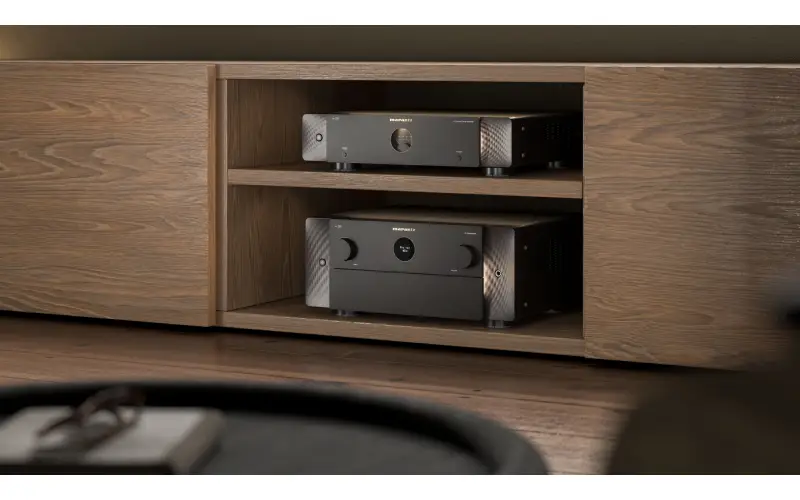
Visually, the AV 30 and AMP 30 lean into Marantz’s modern reference aesthetic. The iconic porthole display returns, flanked by a clean fascia with subtle side illumination that can be adjusted or disabled. The AV 30 adds a fold-down front panel to hide less frequently used controls, which keeps the front view uncluttered—something Marantz has gotten very good at in recent generations.
Even the remote control reflects that attention to real-world use, with backlighting designed for dark theater rooms rather than bright living spaces. It’s understated, but intentional.
Both units are designed and manufactured at Marantz’s Shirakawa Audio Works facility in Japan and tuned by the brand’s Sound Master—details that still matter to buyers in this segment.
AV 30: Processing Power Without Excess
At the heart of the AV 30 is a dual-core Analog Devices SHARC DSP platform, paired with high-quality 32-bit DACs. This gives the processor enough headroom to decode and process everything from high-resolution two-channel audio to full immersive formats without strain.
Supported formats include Dolby Atmos, IMAX Enhanced, DTS:X, and AURO-3D, covering essentially every relevant immersive standard currently in circulation. The AV 30 supports up to 11.4 channels of processing, with output handled by Marantz’s discrete HDAM SA-2 analog preamp stage, available via both RCA and balanced XLR connections.
Room correction is handled by Audyssey MultEQ XT32, included out of the box with a calibration microphone. For those who want to go further, Dirac Live, Dirac Bass Control, and Dirac Active Room Treatment (ART) are available as paid upgrades, with support for up to four independent subwoofers. That flexibility is increasingly important as multi-subwoofer layouts become more common in high-performance rooms.
Video connectivity is equally forward-looking. The AV 30 includes seven HDMI 2.1 inputs, all capable of 8K/60Hz or 4K/120Hz, along with three HDMI outputs. The on-screen interface is sharp, responsive, and refreshingly functional—more tool than toy.
Streaming is handled via HEOS, with native support for Roon Ready, Spotify Connect, TIDAL Connect, Qobuz Connect, AirPlay 2, and Bluetooth. Whether you’re using it as a theater brain or a serious music hub, the AV 30 doesn’t feel compromised.
AMP 30: Flexible Power, Marantz-Style
Rather than chasing channel count for marketing purposes, the AMP 30 takes a more deliberate approach. It’s a six-channel power amplifier, rated at 200 watts per channel into 8 ohms (1 kHz, 0.05% THD, two channels driven). That’s enough clean power to handle demanding speakers without turning into a space heater.
More interesting is how configurable it is. Pairs of channels can be bridged into 400-watt BTL outputs, allowing up to three high-power channels if your system calls for it. Alternatively, users can bi-amp up to three speakers, which makes the AMP 30 particularly appealing as a front-stage amplifier in larger systems.
Both XLR and RCA inputs are included, and the amplifier is designed to run cool and quietly—traits Marantz has quietly excelled at for years.
In practical terms, the AMP 30 makes a lot of sense as a modular building block. It can anchor a smaller reference system on its own, power the front stage of a CINEMA 30–based setup, or integrate seamlessly with the AMP 10 (16-channel) or AMP 20 (12-channel) in more ambitious theaters.
Expectations Are High—for Good Reason
I’ll admit my bias upfront: I’ve lived with Marantz processors long enough to trust their consistency. They may not always be the flashiest on spec sheets, but they tend to age well—and that’s what matters in this category.
Everything about the AV 30 and AMP 30 suggests careful evolution rather than reinvention. The feature set is comprehensive, the architecture is sound, and the flexibility is there for both current and future systems. If the sonic performance lives up to what Marantz has delivered in recent years, these could be easy recommendations once reviews land.
Pricing and Availability
Both components are scheduled to be available January 2026 from selected retailers.
-
Marantz AV 30 (11.4-channel AV Preamplifier):
$4,000 USD | €4,000 | £3,500 -
Marantz AMP 30 (6-channel Power Amplifier):
$4,000 USD | €4,000 | £3,500
Marantz isn’t chasing volume here—it’s reinforcing its position where it already performs best. On paper, the AV 30 and AMP 30 look like exactly what long-time Marantz users would hope for. Now we wait for the listening tests to confirm it.