By: Dipin Sehdev
Panasonic has announced a sweeping strategic partnership with Shenzhen Skyworth Display Technology Co. Ltd., one of the world’s largest television manufacturers. On the surface, this is a straightforward business realignment: Skyworth will handle manufacturing, sales, marketing, and logistics across key regions, beginning with Europe, while Panasonic retains brand oversight, audiovisual processing expertise, and joint development control over top-end OLED models.
But the timing and context make this announcement far more significant than a routine partnership.
The television industry is changing rapidly. Making a TV is hard, and making money doing it is getting harder every year.
And Panasonic knows it.
A Different Era for TV Manufacturing
Last month, Sony and TCL announced their own partnership, another sign that traditional Japanese TV brands are increasingly relying on Chinese manufacturing powerhouses to remain competitive. Sharp, Toshiba, and Pioneer have already faded from global relevance. The old guard is shrinking.
Panasonic’s move isn’t surprising, but it is symbolic.
Building televisions at scale today requires massive panel procurement leverage, vertically integrated supply chains, and tight control over SoC (system-on-chip) sourcing. Panasonic historically bought OLED panels from LG Display and relied on off-the-shelf SoC solutions from companies like MediaTek. That approach gave Panasonic flexibility and often excellent image processing, but it also meant higher production costs.
As a result, Panasonic TVs tended to be more expensive than similarly specced competitors.
In a market where brands like TCL, Hisense, Samsung, and LG aggressively push pricing down while increasing panel brightness and gaming features, that pricing gap becomes difficult to justify.
This partnership is Panasonic’s answer.
What the Deal Actually Means
Under the agreement, Skyworth will manufacture Panasonic-branded televisions and lead sales, marketing, and logistics in Europe. The partnership will roll out region by region, including the U.S. market.
Panasonic will continue to control its AV processing technology and quality assurance standards. The companies will jointly develop top-end OLED models, ensuring that Panasonic’s picture processing heritage doesn’t disappear entirely.
Effective April 1, 2026, Panasonic’s Entertainment Division will also reintegrate into Panasonic Corporation, signaling an effort to consolidate resources and strengthen consumer operations long term.
Skyworth brings scale. Panasonic brings brand equity and processing expertise.
At least, that’s the formula on paper.
OLED Continues...For Now
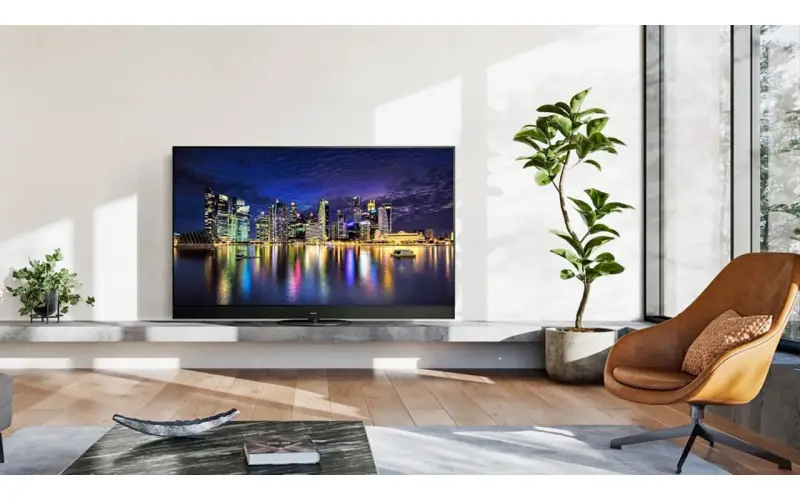
Panasonic confirmed that its OLED lineup will continue. However, the 2026 launch event revealed only one new OLED model: the Z85C/Z86C. Last year’s higher-end Z95B (95% CE Critic Score) and Z90B models remain in the lineup as carryovers.
Panasonic also demonstrated two OLED prototypes, including one featuring LG Display’s latest Tandem WOLED panel — the same next-generation panel found in LG’s flagship G6 series. These remain concept-level products for now, but Panasonic indicated that additional announcements are expected later this year.
That’s encouraging. It suggests Panasonic’s technology arm still has room to innovate.
And that matters.
Because Panasonic’s reputation was never built on panel manufacturing dominance, it was built on processing. Historically, Panasonic TVs excelled in color accuracy, film reproduction, and professional calibration support. Hollywood colorists often favored Panasonic reference displays.
The hope now is that this DNA survives the manufacturing shift.
Not Inherently Bad, But Not Risk-Free
To be clear, this type of partnership isn’t inherently negative.
In fact, it may be necessary.
Margins in the TV business are razor-thin. Panel costs fluctuate wildly. Semiconductor supply chains remain volatile. Software ecosystems require ongoing investment. Marketing budgets are massive. Without manufacturing scale, competing globally is extraordinarily difficult.
Skyworth is currently one of the world’s largest OLED TV producers and has deep panel sourcing relationships with LG Display. That alone gives Panasonic access to cost efficiencies it simply could not achieve independently.
From a business perspective, the logic is sound.
But time will tell.
We’ve seen this movie before. Panasonic once exited the U.S. TV market entirely before making a return. Survival is not guaranteed.
The concern isn’t that Panasonic TVs will suddenly become bad. It’s that over time, differentiation could erode if too much control shifts toward the manufacturing partner.
That’s the tightrope.
The Industry Is Consolidating
The Sony/TCL partnership announced last month reinforced a clear trend: legacy brands are increasingly leaning on Chinese manufacturing giants.
Chinese manufacturers now control massive panel output, advanced Mini LED backlight production, and vertically integrated component supply. They can iterate faster, ship faster, and price more aggressively.
If Panasonic had continued buying panels and off-the-shelf SoCs without scale leverage, its pricing disadvantage would only widen.
In that context, this partnership looks less like surrender and more like survival strategy.
What We’ll Be Watching
Several key questions remain:
-
Will Panasonic retain meaningful control over image processing pipelines?
-
Will premium OLED development continue at the high end?
-
Can Panasonic hit competitive pricing without diluting brand perception?
-
Will the European market respond?
Panasonic has stated that after-sales support will remain intact for all TVs sold up to March 2026 and beyond. That continuity is important.
But product identity is everything in this space.
The television market is now one of the most competitive consumer electronics categories in existence. Innovation cycles are fast. Price pressure is constant. Marketing noise is overwhelming.
If Panasonic wants to reclaim a double-digit market share in Europe, it will need to offer something distinct and let customers know their TVs will be supported long into the future.
A Hope for Innovation
Personally, I hope Panasonic’s technology division continues to push boundaries.
The prototypes shown at launch suggest there’s still ambition. The Tandem OLED demonstration shows access to cutting-edge panel tech. Panasonic’s historical expertise in calibration and processing could still differentiate its premium models.
More competition is always good for consumers.
But survival requires execution.
Panasonic has reinvented itself before. The question now is whether this new model represents a long-term revival or a gradual fading.
It’s not inherently bad.
But in today’s TV industry, standing still is not an option.
Time will tell whether Panasonic-branded televisions thrive under this new partnership — or become another chapter in the consolidation of a once fiercely independent industry.