By: Dipin Sehdev
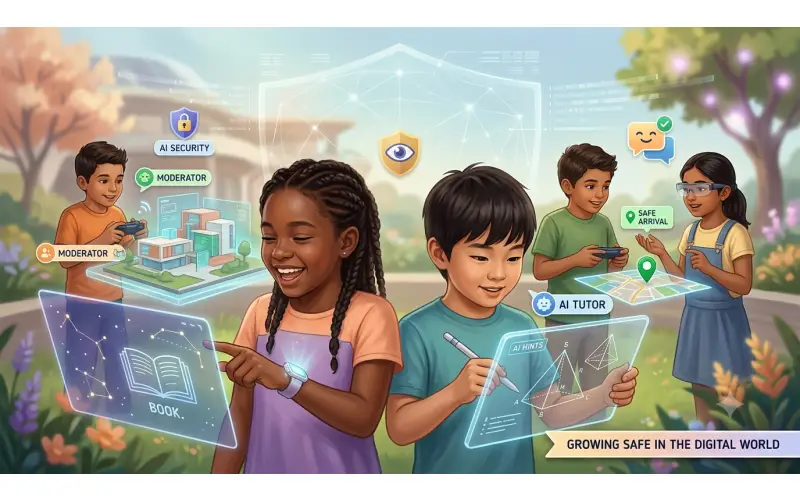
The profound irony of modern parenting is that the technologies collecting the most intimate data on our children are often the ones we trust the most. The tablet helping a first-grader learn to read; the smartwatch confirming a middle-schooler arrived safely; the AI tutor explaining algebra more patiently than an exhausted parent ever could. None of these tools are inherently malicious. They are remarkable, sci-fi achievements. The existential concern isn’t that children are using technology. It is that childhood itself is becoming measurable.
For decades, corporate surveillance focused on what adults bought. Today, the data economy measures how children learn, communicate, play, and interact. This loss of privacy rarely happens in one catastrophic breach; it is surrendered incrementally, one permission request at a time. One app requests microphone access; a school platform requires a cloud login; a gaming account asks for location data "to improve gameplay."
Individually, these requests seem benign. Collectively, they assemble a permanent, hyper-detailed portrait of a child's life. Even as someone who works in tech, I find navigating this landscape overwhelming. If those of us who build and manage these systems struggle to police them, how can we expect the average parent to?
The AI Shift: From Smart Devices to Synthetic Relationships
When smartphones arrived nearly two decades ago, they changed how we communicate. Artificial intelligence is shifting something deeper: how children think, learn, and form relationships.
Millions of students now use generative AI to unpack homework, draft essays, and simulate dialogue. The educational promise is immense, the democratization of an infinitely patient tutor. Yet AI introduces unprecedented ethical questions. What happens when a ten-year-old spends half their formative years conversing with a synthetic entity? Should children form emotional attachments to AI companions, and who owns the logs of those deeply personal conversations?
The immediate concern for families isn't whether AI will replace future jobs, but whether it is already replacing deeply human experiences. Will a child ask a chatbot about friendship or mental health before turning to a parent or teacher?
The solution is not a blanket ban, which only alienates the digital native. Instead, digital literacy must co-exist with vigilance. Parents need to sit down and use these tools alongside their children, treating AI as an unpredictable utility rather than an absolute authority.
Classroom Ecosystems and the Illusion of Oversight
For many families, the largest technology vendor in their life is actually their local school district. Walk into any modern classroom and the tech stack is ubiquitous: assignments are submitted via Canvas, reading metrics are tracked via specialized software, and communication is funneled through platforms like Google Classroom or Microsoft Teams.
While these tools streamline education, a critical question remains largely unaddressed: Exactly what information is being collected about these students, and where does it go?
Most parents know where to find the school calendar, but few have ever seen the district’s student privacy policy. They shouldn't have to hunt for it. School districts should publish an annual Digital Transparency Report explicitly detailing:
-
Every third-party platform authorized for student use.
-
The exact data types collected and retained.
-
Whether student data is being utilized to train proprietary AI models.
As education becomes inherently digital, schools must evolve from passive consumers of technology into aggressive defenders of student privacy.
When Games Transcended Entertainment
One of the greatest misconceptions adults still hold is treating video games purely as entertainment. For today’s youth, gaming environments like Roblox, Minecraft, and Fortnite are the new town squares. They are social networks, marketplaces, and chat rooms masquerading as virtual worlds.
Consequently, the legacy framework of evaluating a game, "Is this content too violent?" is obsolete. The modern journalist or parent must ask: "Who can interact with my child within this ecosystem?"
Features like unmoderated voice chat, direct messaging, and digital marketplaces mean parents are no longer just monitoring screen time; they are managing complex social environments. While gaming hardware manufacturers have built robust parental dashboards, the burden of configuration still falls entirely on the home. Technology companies frequently absolve themselves by claiming, "We provide the tools." But managing an entire domestic digital ecosystem has become one of the most grueling unpaid jobs in modern society.
The Five Blind Spots of Modern Digital Parenting
To effectively manage this ecosystem, families must move past common operational errors:
-
The Social Media Hyper-Focus: Privacy isn’t just an Instagram or TikTok issue. It applies to every connected vacuum, smart speaker, and educational app.
-
Trusting Factory Defaults: Out-of-the-box settings are optimized for data collection, not data protection. Optional privacy guardrails must be manually enabled.
-
Passive School Compliance: Assuming a school district has properly vetted a platform's long-term data retention policies is a mistake. Parents must actively audit what their classrooms deploy.
-
The "Too Young to Care" Delay: Digital identity management begins long before a teenager gets their first smartphone. A child's data profile is built from early childhood.
-
The One-and-Done Talk: Technology updates monthly; parental boundaries cannot remain static. Privacy must be an ongoing household dialogue.
The Path Forward: A Right to Be Forgotten
As data accumulation accelerates, we must confront a legislative necessity: the legal "Right to Be Forgotten" for minors.
Children make mistakes, parents post compromising milestones, and AI models continuously scrape the web. A sixteen-year-old should possess the legal mechanism to purge the digital footprints of their early childhood. Childhood shouldn't be treated as a permanent corporate data ledger.
The internet has fundamentally shifted, and parenting must shift alongside it. The primary threat to our children’s digital autonomy isn't one rogue company stealing data; it is hundreds of platforms quietly logging fractions of their lives every day.
This is not a call for panic, but for active participation. The most effective parental control in existence is not an app, an encryption protocol, or a firewall. It is a conversation. Technology will continue to evolve at an exponential rate, and our relationship with our children must remain sophisticated enough to match it.