By: Dipin Sehdev
I have used Google Nest products for years, and for the most part, I have enjoyed the experience. The cameras work well, the app is familiar and the ecosystem has been relatively easy to live with. But my relationship with cloud-connected smart-home products has been getting more complicated. Subscription costs keep going up. At the same time, the amount of information companies collect from devices inside our homes, and the growing appetite to use consumer data to improve AI systems, has made me increasingly uncomfortable with sending everything to somebody else’s servers.
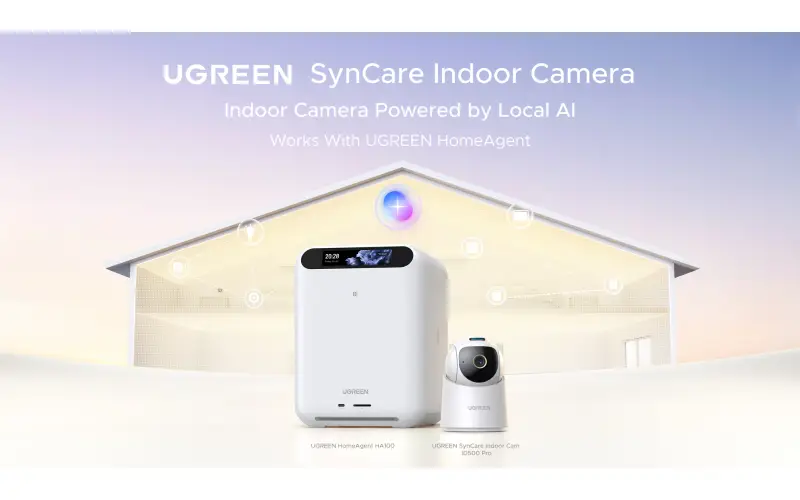
That is particularly true with cameras. An indoor security camera can see some of the most private moments in a household. It can see your children, your routines, when you leave home and when you return. I had already started looking for an alternative to Nest when UGREEN asked if I wanted to test its new HomeAgent ecosystem. I jumped at the opportunity. The proposition behind the UGREEN HomeAgent HA100 immediately appealed to me: keep the video locally, process more of the intelligence locally and remove the recurring subscription that has become almost standard with cloud-based security systems. After spending time with the HomeAgent HA100 and SynCare ID500 Pro indoor camera, my conclusion is pretty simple.
I love this system.
It is not finished. The software needs refinement, and some of UGREEN’s bigger AI ambitions are clearly still works in progress. But the fundamentals are already good enough that I would highly recommend it, particularly to someone who wants to move away from a cloud-dependent camera ecosystem. And the most exciting part may be that this feels like the beginning rather than the finished product.
Why HomeAgent Is Different
UGREEN is trying to build more than another security-camera platform. HomeAgent combines local storage, local AI processing, camera management and broader smart-home control into a hub that sits inside the home. Core storage, security and automation functions can operate on the local network without requiring a monthly storage subscription. That distinction matters. Most smart-home cameras are designed around the assumption that cloud infrastructure is part of the product. Video gets uploaded. Intelligence gets processed remotely. Advanced features frequently require subscriptions.
UGREEN is reversing much of that relationship. With the HA100, the server is yours. The storage is yours. Your camera footage can remain inside your home, and UGREEN is building its AI features around processing that information locally. The HA100 can manage security cameras, recognize people, vehicles, pets and packages, generate event summaries and support keyword-based searches of recorded footage. UGREEN is also building the system around Matter, giving HomeAgent a path to work with compatible products outside its own ecosystem. CE_Critic_LG_Privacy_Impact_Rep…
That was the theory. What mattered to me was whether it was actually pleasant to use. Mostly, it is.
Setup Was Much Easier Than I Expected
UGREEN provided the HomeAgent server along with the drive I used for storage, so my first step was installing the drive. If the idea of opening a server and installing storage sounds intimidating, it should not. Getting the drive into the HA100 was remarkably straightforward. UGREEN has made the process accessible enough that I think even someone with very little experience installing computer hardware could follow it without much trouble. Once the hardware was assembled, getting the HA100 connected and running took me about five minutes.
Then came the updates. A lot of updates. That did not surprise me because I was testing HomeAgent through UGREEN's beta software. There were several rounds of updates as the hardware and app got themselves current, but nothing went wrong and the system remained stable throughout the process. For a first-generation smart-home platform running beta software, that was encouraging.
The SynCare ID500 Pro Was Just as Easy
My next step was adding the SynCare ID500 Pro indoor camera. Again, the setup process was simple. One small thing I immediately appreciated was the power cable. UGREEN gives you a genuinely useful amount of cable, which makes camera placement much easier than products that force you to position the camera based on the nearest outlet.
Once connected to HomeAgent, the ID500 Pro quickly became the part of the system I used most. The camera is responsive. Video loads quickly. Remote access worked as expected throughout my testing. Most importantly, it did not feel like I was making a major usability sacrifice to gain local storage. That is important because privacy-focused products sometimes ask consumers to accept a worse experience in return for greater control.
HomeAgent does not feel that way. The original HomeAgent announcement included three SynCare cameras: the ID500 Pro indoor model I tested, the OD600 Pro PoE outdoor model and the OD800 Pro battery-powered outdoor camera. All are designed around HomeAgent's local video storage and AI capabilities rather than treating the camera as an isolated product.
The Camera Is Fast and Auto Tracking Is Excellent
The ID500 Pro can pan and tilt from within the app, and UGREEN also provides automatic subject tracking. I really like the tracking. When the camera identifies movement, it can follow the subject through the room rather than leaving you with a static view of one section of the space. It is one of those features that immediately makes sense once you use it.
I was also impressed with how quickly I could pull up the feed. One concern I had moving away from Nest was responsiveness. A security camera can have every privacy feature imaginable, but none of that matters if opening the live view requires staring at a loading indicator. That has not been my experience with the ID500 Pro. The video feed feels snappy, and I was able to remotely access the camera without problems.
That combination local storage without making remote viewing feel compromised is important.
The App Is Good, but It Needs Work
This is where my criticism starts. UGREEN's app is functional and generally easy to understand, but navigation needs refinement. Again, I need to put a large asterisk beside this criticism because I am using beta software. But right now, it takes too many taps to get to the camera. Once I am there, navigating through recorded clips and getting to the exact video I want can also feel more cumbersome than it should.
Nest has had years to refine this experience. You open the app, get to your cameras and quickly understand what happened. UGREEN needs to get closer to that level of immediacy. For a security system, the camera feed should probably be one of the easiest things in the entire app to reach. If I get an alert because something happened in my house, I should not have to think about where the camera controls live. That is software, though. And software can be fixed. The important part is that once I reached the camera, the underlying experience was good.
Then There Is Uliya
UGREEN is also building its own voice and AI assistant called Uliya.
First, I have a minor complaint. I still have no idea how I am supposed to pronounce it. Even at UGREEN's press event, I heard different employees pronounce the name differently. If the company wants consumers speaking a wake word to an AI assistant, giving that assistant a name people are not immediately sure how to say seems like an unnecessary hurdle. Naming aside, the ambition behind Uliya is interesting.
HomeAgent is intended to let users interact with cameras and smart-home devices conversationally. UGREEN has demonstrated examples such as asking about camera events, creating automations and receiving voice notifications when something happens around the home. The platform can also use local AI to identify people, vehicles, pets and packages and search recorded footage based on keywords.
In theory, that could eventually make HomeAgent function something like a locally processed Alexa for your house. In practice, I am not there yet.
The HA100 Is Not Going in My Living Room
Part of UGREEN's vision assumes that HomeAgent itself can become part of the smart-home interaction. That creates a physical-design problem for me. I actually think the HA100 looks very good and has great industrial design. UGREEN has designed something much more attractive than a typical NAS or home server. I would not be embarrassed to have it sitting somewhere visible.
But I also do not want it in my living room. It is still a relatively substantial piece of hardware. It would be difficult to hide inside many media consoles, and if you place it out in the open, it becomes another noticeable object in the room. That matters if UGREEN wants Uliya to behave like Alexa. Amazon can put Alexa throughout a house because an Echo Dot is small and inexpensive enough to place in almost any room.
HomeAgent is fundamentally different. It is a server first in my mind with an AI assistant built-in. I want that server somewhere sensible for networking and storage. That is not necessarily the same place where I want to talk to a voice assistant. UGREEN may eventually solve this with satellite speakers, microphones or other HomeAgent devices throughout the house. But as it exists today, I do not think the HA100 itself is an ideal replacement for the distributed voice assistants people already use.
Uliya Wasn't Ready for Me Yet
I also could not get Uliya to consistently work the way I wanted during testing. That would normally be a bigger criticism.
Here, I am giving UGREEN some latitude because I was explicitly testing prerelease beta software. HomeAgent's AI and voice capabilities were always going to be among the least mature parts of a first-generation platform. Even when UGREEN introduced the system, it was clear that the company viewed these features as something that would become more capable through software and updated local AI models over time. So I am holding judgment on Uliya until I test the finished release.
The underlying concept is still compelling. If UGREEN can eventually give me useful natural-language control without sending everything happening inside my house to a remote AI server, I want that. It just needs to work consistently.
Coming From Nest Changes My Perspective
My experience with HomeAgent is heavily influenced by where I am coming from. Google Nest has been good to me.
I am familiar with it. The cameras work. The software is mature. But the subscription model has become increasingly difficult for me to justify. More importantly, my priorities around privacy have changed. I increasingly want fewer companies storing information about what happens inside my home. HomeAgent does not magically eliminate every privacy concern simply because it uses local processing. It is still a connected product. UGREEN still has an enormous responsibility to secure the platform, maintain the software and be transparent about anything that leaves the local network. Local does not automatically mean secure. But it does fundamentally change who controls the information.
UGREEN's local-first architecture is designed to keep camera footage, storage and more of the AI processing inside the home rather than making cloud infrastructure the default. There is also no monthly storage fee required for those core functions. For me, that is a meaningful difference.
This Is Exactly Where Local AI Makes Sense
I have become increasingly skeptical of companies adding “AI” to products simply because AI is the industry's current favorite feature. HomeAgent is different. This is one of the places where local AI has a very obvious purpose. There can be hours of security footage sitting on a drive. Instead of manually scrolling through it, software can identify people, vehicles, pets or packages. It can summarize events. Eventually, the goal is to let users search that footage conversationally.
UGREEN is trying to do that processing on hardware inside your home. That is useful AI. It is solving a real problem while simultaneously reducing one of the major privacy concerns created by cloud-based AI. I want to see much more of this direction from the smart-home industry. There is also a clear upgrade path of switching out the AI in the system as technology grows, so there could be updated for many years.
HomeAgent Can Become More Than a Camera System
The other reason I am enthusiastic about HomeAgent is that I am not buying into a product that necessarily ends with one indoor camera. UGREEN is positioning HomeAgent as a broader smart-home platform.
Matter support means compatible third-party products can potentially become part of the system, allowing UGREEN to coordinate automations across devices from different manufacturers. That matters for anyone who already owns a smart home. Nobody wants to replace every light, sensor, lock and thermostat simply because they changed platforms. If UGREEN can make HomeAgent the intelligence layer sitting above those devices, the system becomes considerably more interesting. The company also plans additional outdoor SynCare cameras and more powerful HomeAgent hardware. This really does feel like version one of something much larger.
UGREEN HomeAgent HA100 and SynCare ID500 Pro Review: The Verdict
This is one of those reviews where my criticisms do not really change the recommendation. I would highly recommend HomeAgent. UGREEN has gotten the difficult part right. The HA100 was easy to set up. The ID500 Pro has been fast and reliable. Local video storage removes the subscription pressure I have become increasingly tired of, and keeping more of the AI processing inside the home gives me substantially more confidence about using an indoor security camera.
The app needs refinement. Uliya needs more time. UGREEN needs to prove that it can build the ecosystem it has promised. But those are the kinds of problems I would rather see in a first-generation product. They can improve through software. The foundation is already here.
UGREEN entered the smart-home market with an ambitious idea: instead of making consumers send more of their homes into the cloud, bring the storage and intelligence back inside the house. That was the part of HomeAgent that caught my attention when I first saw the system at UGREEN's launch event, and it remains the platform's biggest advantage after using it.
Coming from Nest, I expected moving toward a local-first system to involve compromises. So far, the biggest surprise is how few compromises I feel like I have made. For me, that is what makes HomeAgent exciting. It gives me most of what I liked about a modern connected-camera system while giving me back something increasingly valuable: Control over my own data.
Pricing and Availability
UGREEN has revised pricing for the HomeAgent lineup ahead of its Kickstarter launch, lowering the cost of both the HA100 and HA100 Pro while keeping the same promotional discount structure for early supporters.
The HomeAgent HA100 now carries an MSRP of $1,599, down from $1,799. Its 50% Super Early Bird price has been reduced from $899 to $799, while the 40% Early Bird price is now $959 instead of $1,079.
The more powerful HomeAgent HA100 Pro has also received a substantial price cut. Its MSRP drops from $5,999 to $5,399. The Super Early Bird price falls from $2,999 to $2,699, while the Early Bird price is reduced from $3,599 to $3,239.
Pricing for the MasterAgent MA100 and other products in the HomeAgent ecosystem remains unchanged.
UGREEN is also adding incentives for customers who have already placed a deposit. Buyers who complete a purchase of the HA100 or HA100 Pro will receive one SynCare ID500 Pro camera. MasterAgent MA100 deposit holders who complete their purchase will receive four 8TB hard drives.
The Kickstarter launch date has also been moved from Oct. 27 to Nov. 17, 2026.
Find all the details here.
Disclosure: UGREEN provided the HomeAgent HA100, storage and SynCare ID500 Pro used for this review. CE Critic maintained full editorial control over the review and its conclusions.