By: Dipin Sehdev
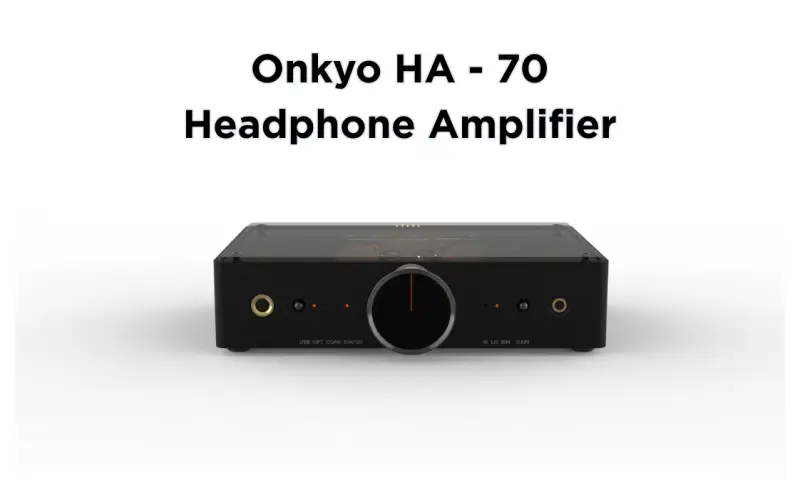
Onkyo is getting serious about personal audio. The company has introduced the HA-70 Premium Hi-Fi Headphone Amplifier, a $649.99 desktop component built around a fully balanced architecture, dual ESS SABRE DACs, high-resolution USB playback and enough gain flexibility to handle everything from sensitive in-ear monitors to 600-ohm headphones.
On paper, it looks excellent. More importantly, the HA-70 feels like another sign that Onkyo is back to listening closely to what enthusiasts actually want. That has been one of the more encouraging developments around the brand lately. Rather than simply leaning on its history, Onkyo appears to be building products around how people are actually using audio equipment today. The HA-70 is a good example. Headphone listening is no longer just something people do when they cannot use speakers. For plenty of enthusiasts, a serious headphone system is the system. And with a fully balanced signal path, dual ESS ES9039Q2M DACs, PCM support up to 768 kHz and three gain stages, Onkyo is clearly not treating the HA-70 like an accessory.
At $649.99, it also lands in an interesting part of the market. That is not entry-level money, but the specification sheet suggests Onkyo is aiming higher than the price might initially suggest. If the execution matches the hardware, the HA-70 could end up competing with more established enthusiast DAC/headphone amplifiers from brands such as Chord rather than simply with mainstream desktop amps.
We will need to hear it before making that call. But on paper, Onkyo has my attention.
A Fully Balanced Architecture From DAC to Headphones
The foundation of the HA-70 is its fully balanced signal path. Onkyo says each audio channel receives its own dedicated DAC and amplifier stage, maintaining a balanced architecture from digital conversion through the headphone output. The advantage of that approach is primarily separation and noise control. Keeping the left and right channels electrically independent can improve channel separation while reducing common-mode noise and interference. In a well-executed design, that can contribute to a cleaner background, stronger stereo imaging and better dynamic stability. That is particularly relevant with headphones, where subtle noise and channel imbalance can be easier to notice than they are through loudspeakers in a room.
Onkyo is clearly positioning the HA-70 around transparency rather than added coloration. The company says the design is intended to preserve the integrity of the recording while delivering greater clarity, detail and soundstage. Those are claims we will want to test, but the underlying architecture is promising.
Dual ESS ES9039Q2M DACs Are a Serious Starting Point
Onkyo is using two ESS ES9039Q2M SABRE DACs inside the HA-70. That means each channel gets its own dedicated converter rather than sharing a single stereo DAC. The ES9039Q2M is a modern high-performance DAC platform, and pairing two of them with a fully balanced analog stage gives Onkyo considerable flexibility in how it manages channel separation, noise and output. Of course, the DAC chip itself does not determine how a product sounds. Power supply design, clock implementation, analog output stages and overall circuit layout matter just as much.
But it is encouraging to see Onkyo start with a premium converter rather than trying to build a $650 headphone amplifier around a compromised digital section. The HA-70 is being designed as a complete digital-to-analog and amplification platform, not simply as an amplifier with a USB input added to the back.
It Supports PCM Up to 768 kHz and DSD256
The digital section is built around an XMOS XU316 USB interface. Through USB-C, the HA-70 supports PCM playback up to 768 kHz and DSD256 using DoP. That is considerably beyond what most commercially available music actually requires. Even high-resolution streaming services generally top out at 24-bit/192 kHz, and much of the music people listen to remains at 44.1 or 48 kHz. But supporting those higher rates gives the HA-70 plenty of headroom for locally stored hi-res libraries and more specialized playback setups. More importantly, Onkyo is not artificially limiting the digital platform. If you are building a desktop system around Roon, Qobuz, local FLAC files or another high-resolution source, the HA-70 should have more than enough digital capability.
Three Gain Levels Make More Sense Than Chasing Maximum Power
One of the smartest design choices may be the three-stage gain system.
The HA-70 includes:
-
Ultra Low Gain for sensitive IEMs
-
Low Gain for lower-impedance headphones
-
High Gain for demanding high-impedance headphones
Onkyo says the amplifier can accommodate headphones with impedances up to 600 ohms. That range matters becuase it gives the amp versitlity. A powerful headphone amplifier is not automatically a good amplifier for sensitive in-ear monitors. Too much gain can make volume adjustment difficult and potentially expose noise that would be inaudible with less sensitive headphones. Conversely, an amp optimized around IEMs may struggle to provide enough voltage for demanding high-impedance headphones. Giving users three distinct gain ranges is a much better solution than simply advertising a huge output number and hoping it works for everything. It also makes the HA-70 more attractive as a single device for enthusiasts who own multiple headphones.
Onkyo Is Giving It Plenty of Connectivity
The HA-70 is designed to operate as more than a USB DAC connected to a laptop. Connectivity includes USB-C, optical and coaxial digital inputs, RCA connections and balanced XLR outputs. That gives the HA-70 flexibility to sit at the center of a larger desktop or personal Hi-Fi system. A computer can feed it over USB. A streamer or disc player can connect digitally. Traditional analog equipment can use RCA. And the balanced XLR outputs allow the HA-70 to feed compatible downstream equipment.
That last point makes the product especially interesting. The HA-70 does not necessarily have to live exclusively as a headphone amplifier. Depending on how Onkyo implements its output controls, it could also serve as the digital front end of a compact desktop or powered-speaker system.
Onkyo HA-70 Specifications
| Specification | Onkyo HA-70 |
|---|---|
| Product Type | Premium DAC / Headphone Amplifier |
| Architecture | Fully balanced |
| DACs | Dual ESS ES9039Q2M |
| USB Interface | XMOS XU316 |
| Maximum PCM | Up to 768 kHz |
| DSD | Up to DSD256 via DoP |
| Headphone Compatibility | Up to 600 ohms |
| Gain Settings | Ultra Low, Low, High |
| USB | USB-C |
| Digital Inputs | Optical, Coaxial |
| Analog Connectivity | RCA |
| Balanced Output | XLR |
| Chassis | Aluminum |
| Dimensions | 180 x 141 x 46 mm |
| U.S. Price | $649.99 |
| Availability | Spring 2027 |
The Size Is Another Part I Like
The HA-70 measures just 180 x 141 x 46mm. That is small enough to fit comfortably on a desk without dominating the workspace. This is important because personal Hi-Fi equipment can get ridiculous quickly. A separate DAC, headphone amplifier, power supply and streamer can turn a clean desk into an equipment rack before you know it.
Onkyo seems to be trying to deliver serious component-level performance without requiring that kind of footprint. The aluminum chassis also gives the HA-70 a more traditional Hi-Fi feel than many compact desktop DACs. It looks like a piece of audio equipment rather than a computer accessory.
This Could Be a Very Interesting Chord Mojo Alternative
The price is what makes the HA-70 especially interesting. At $649.99, Onkyo is putting it within striking distance of enthusiast DAC/headphone amplifiers that have developed serious followings over the years. The obvious comparison for me is something in the Chord Mojo class. Chord has built an excellent reputation around products such as the Mojo 2 by focusing heavily on conversion quality, low noise and headphone performance. Onkyo is taking a very different technical approach, but the buyer could be similar: someone who wants a high-quality DAC and headphone amp that sits well above mass-market audio but does not require moving into multi-thousand-dollar desktop components.
The HA-70 gives you dual ESS DACs, a fully balanced architecture, high-resolution USB support, three gain stages and considerably broader desktop connectivity. That does not mean it will outperform a Mojo or any other established competitor. Specs do not tell us that. Listening will. But the hardware Onkyo is offering for $649.99 suggests this is not a product that should automatically be compared only with similarly priced mainstream headphone amplifiers. There is enough here that I think it deserves to be evaluated against more ambitious competition.
Onkyo Feels Like Onkyo Again
That may be the part of this announcement I find most encouraging. Onkyo has been around for 80 years, and for a long time the name meant something very specific to audio enthusiasts. It meant serious Hi-Fi engineering that was still accessible enough to reach a broader audience. The HA-70 feels like it fits naturally within that idea. It is not trying to reinvent headphones. It is not loaded with AI features or unnecessary software. It is a DAC. It is a headphone amplifier. It has serious connectivity. It supports a huge range of headphones. And Onkyo appears to have spent its engineering budget on the parts that should actually affect performance.
That is exactly what I want to see.
A Good Match for the New Klipsch Stratos Headphones
The timing is also interesting because Premium Audio Company has just introduced the new Klipsch Stratos HP-2 and HP-3 wired headphones. Those headphones are designed to work with everything from portable sources to dedicated headphone amplification, and Klipsch specifically points to the HA-70 as an example of a higher-end pairing. That creates the beginnings of a broader personal-audio ecosystem across the Klipsch and Onkyo brands.
The Stratos HP-2 starts at $999.99. The semi-open HP-3 costs $1,199.99. Pair either with the $649.99 HA-70 and you have a serious personal listening system sitting well below the cost of many flagship headphone rigs. Whether they work especially well together will be something worth testing.
Price and Availability
The Onkyo HA-70 Premium Hi-Fi Headphone Amplifier will be available in the U.S. in spring 2027. Suggested retail price is $649.99. That puts it in an increasingly competitive part of the personal-audio market, but the specification sheet gives Onkyo a compelling story. Dual ESS ES9039Q2M DACs. Fully balanced architecture. XMOS XU316 USB. PCM to 768 kHz. DSD256. Three-stage gain. Support for headphones up to 600 ohms. And enough connectivity to function as the centerpiece of a serious desktop system.
For $649.99, that is a lot of hardware.
On Paper, Onkyo Got This Right
We still need to hear it. That is always the caveat with audio equipment. A beautiful specification sheet can tell you that an engineer had the right ingredients. It cannot tell you whether the finished product sounds good. But the ingredients here are very encouraging. And more broadly, I like what I am seeing from Onkyo. The company feels engaged again. It feels like it is listening to enthusiasts and looking at where the market is actually going rather than simply recycling what worked 10 years ago.
Personal Hi-Fi is growing. Wired headphones are having a moment again. High-resolution music is widely available. And there is a growing audience that wants better sound at a desk without building an entire two-channel system around it. The HA-70 looks designed specifically for that customer. If Onkyo gets the execution right, $649.99 could make this one of the more interesting headphone amplifiers to arrive in 2027.
I am excited to hear it.