By: Dipin Sehdev
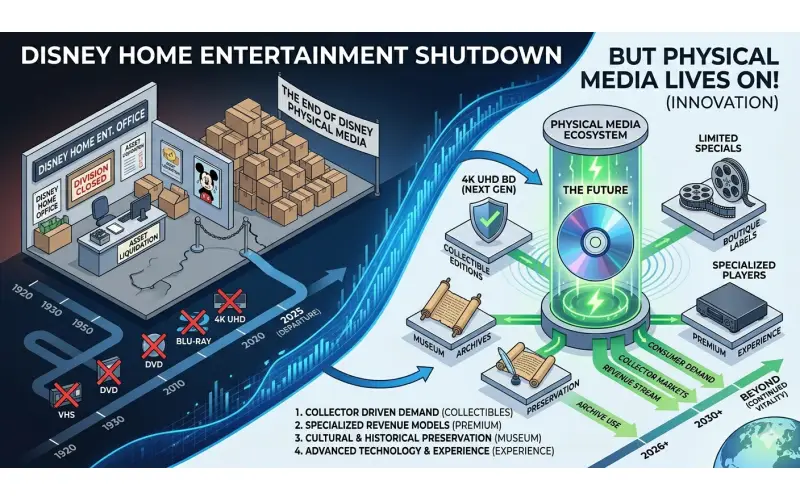
For years now, the narrative has been the same: physical media is fading, streaming is the future, and discs are becoming relics of a previous era. But every now and then, something happens that reminds you that the story isn’t fully written yet. This is one of those moments. Japanese companies I-O Data and Verbatim Japan have announced an expanded commitment to keeping Blu-ray alive, doubling down not just on discs, but also on the hardware ecosystem that supports them. At a time when companies like Sony and others have stepped back from parts of the Blu-ray market, this move feels less like maintenance and more like resistance. And for those who still care about ownership, quality, and permanence, it’s genuinely good news.
Why This Still Matters
If you’re someone who values physical media, you already understand the appeal.
- You own the content
- It can’t be removed overnight
- Quality is consistent and uncompromised
Streaming, for all its convenience, still comes with trade-offs:
- Compression
- Licensing issues
- Content disappearing from libraries
Blu-ray, especially 4K UHD Blu-ray, remains the gold standard for home viewing. And despite declining mainstream demand, the format still serves critical audiences:
- Collectors
- Cinephiles
- Archivists
- Anime fans (particularly in Japan)
The fact that companies are still investing in it signals something important: There is still real demand for high-quality, physical ownership.
The Bigger Concern: Capacity Limits
But while it’s encouraging to see Blu-ray being preserved, there’s a bigger issue looming: Capacity. Modern films are getting bigger, both visually and technically.
We’re now entering an era where:
- Dolby Vision is evolving (Dolby Vision 2)
- HDR grading is more complex
- Bitrates are increasing
- Audio formats like Dolby Atmos and DTS:X demand more bandwidth
Take Avatar: Fire and Ash as an example. That film is expected to require a BD-100 (100GB triple-layer disc) just to deliver its 4K version at proper quality. That’s already pushing current Blu-ray limits.
We’re Reaching the Ceiling
Current 4K Blu-ray formats include:
- BD-66 (66GB, dual-layer)
- BD-100 (100GB, triple-layer)
BD-100 is effectively the ceiling of consumer Blu-ray today. And we’re already hitting it. That creates a problem. Because as content evolves, storage needs will continue to grow—but the format isn’t scaling at the same pace.
What Companies Need to Do Next
If Blu-ray is going to survive, and more importantly, evolve, manufacturers need to push beyond simply maintaining supply. They need to expand the technology. Here are the most realistic paths forward:
1. Higher Capacity Discs (BD-200 and Beyond)
The most obvious step is increasing storage capacity. There have already been experimental formats like:
- BD-128 (quad-layer)
- BD-200 (multi-layer)
These could:
- Reduce compression needs
- Enable true high-bitrate 4K (or even 8K)
- Support future HDR formats like Dolby Vision 2 without compromise
The challenge? Manufacturing complexity and cost. But if demand from premium collectors exists, there’s a real case to bring these formats to market.
2. Better Codecs and Efficiency
Another approach is smarter compression. Newer codecs (or refinements of HEVC) could:
- Maintain quality at lower bitrates
- Extend the life of BD-100
But there’s a trade-off: Blu-ray’s entire appeal is minimal compression. So this path has limits.
3. Hybrid Physical + Digital Models
This is where things get interesting.
Imagine:
- You buy a Blu-ray
- It includes the full physical version
- But also unlocks a higher-capacity digital version
This could:
- Extend beyond disc limitations
- Combine ownership with flexibility
- Future-proof purchases
We’ve seen early versions of this with digital codes, but it’s not fully integrated. There’s room to do this much better.
4. New Optical Formats
The most ambitious option is a next-generation optical format entirely.
Something beyond Blu-ray.
Something built for:
- 200GB+ capacity
- Modern HDR formats
- High frame rate content
This is unlikely in the short term—but if physical media is to remain relevant long-term, it may eventually be necessary.
Why Companies Are Still Investing
The partnership between I-O Data and Verbatim Japan highlights something important: Blu-ray isn’t just about movies.
It’s also about:
- Data backup
- Archival storage
- Enterprise use cases
And in Japan especially:
- Recording TV
- Building personal media libraries
The success of products like the BD Reco drive shows that demand still exists—not just nostalgically, but functionally.
The Streaming Reality Check
This also comes at a time when streaming still hasn’t solved its biggest problem:
Quality.
Even in 2026:
- Streaming bitrates are far below Blu-ray
- Audio is often compressed
- Visual consistency varies
So while streaming wins on convenience, Blu-ray still wins on:
? Fidelity
And until that changes, physical media remains relevant.
The Editorial Take
This news is encouraging, but it’s also incomplete. Keeping Blu-ray alive is important. But preserving it isn’t enough. If companies want physical media to remain viable, they need to:
- Innovate
- Expand capacity
- Adapt to modern content demands
Because the reality is: Movies are evolving faster than the format that stores them
The Bottom Line
It’s great to see companies like I-O Data and Verbatim stepping up to keep Blu-ray alive. For collectors and enthusiasts, that matters. But the bigger question is what comes next.
With films like Avatar: Fire and Ash already pushing the limits of BD-100, and technologies like Dolby Vision 2 on the horizon, the pressure is building. Blu-ray has survived this long because it delivered something streaming couldn’t: Quality you can own. Now it needs to evolve again before it becomes limited not by demand, but by capacity.