By: Dipin Sehdev
After more than two decades of redefining how people watched television, TiVo has officially stopped selling its DVRs, marking the end of an era for one of the most iconic devices in home entertainment history.
The company confirmed to Variety that as of October 1, 2025, it has fully exited the hardware business, ending production and sales of its DVRs and related accessories. “TiVo no longer manufactures hardware, and our remaining inventory is now depleted,” the company said in a statement. “We are very proud of the TiVo DVR legacy, and the great experience TiVo has always provided lives on in our TiVo OS for Connected Televisions.”
For millions of TV fans, the TiVo name was once synonymous with control, convenience, and—perhaps most importantly—freedom from rigid broadcast schedules. At its peak, TiVo was so influential that “to TiVo” became a verb, shorthand for recording a show to watch later. It wasn’t just a product; it was a cultural phenomenon.
The DVR That Changed Everything
When the original Series 1 TiVo launched in March 1999, it was nothing short of revolutionary. The set-top box, co-developed with Philips, allowed viewers to pause live television, rewind, and record shows automatically based on viewing preferences. For households accustomed to programming VCRs or missing episodes entirely, TiVo felt like science fiction.
The interface was smooth, intuitive, and friendly—a far cry from the clunky menus of cable boxes at the time. Users could set up recordings weeks in advance, skip commercials, and even pause live sports. It was TV on your terms, and it forever changed how people interacted with their screens.
The industry initially panicked. Executives feared that the ability to fast-forward through commercials would devastate the ad-driven TV model. “We’re in trouble, and we shouldn’t ignore the fact that it’s right around the corner,” then–Fox Entertainment President Gail Berman warned in 2003. But the doomsday scenario never materialized. Networks eventually embraced TiVo and its competitors as they realized DVRs often boosted loyalty—viewers who recorded shows were more likely to keep up week after week.
In 2006, the Television Academy recognized TiVo with an Interactive TV Emmy Award for “seamlessly connecting consumers to the digital entertainment they want, where and when they want it.”
From Innovator to Underdog
As the 2000s rolled on, TiVo’s innovation was gradually absorbed into the mainstream. Cable and satellite companies began embedding DVR functionality directly into their set-top boxes, often bundled with subscriptions. Consumers no longer needed to buy a separate device or pay for TiVo service.
By the 2010s, TiVo shifted its focus toward licensing its software and interface technology to service providers around the world. The company also developed the TiVo OS, a connected television platform that powers smart TVs from brands like Sharp and several European manufacturers.
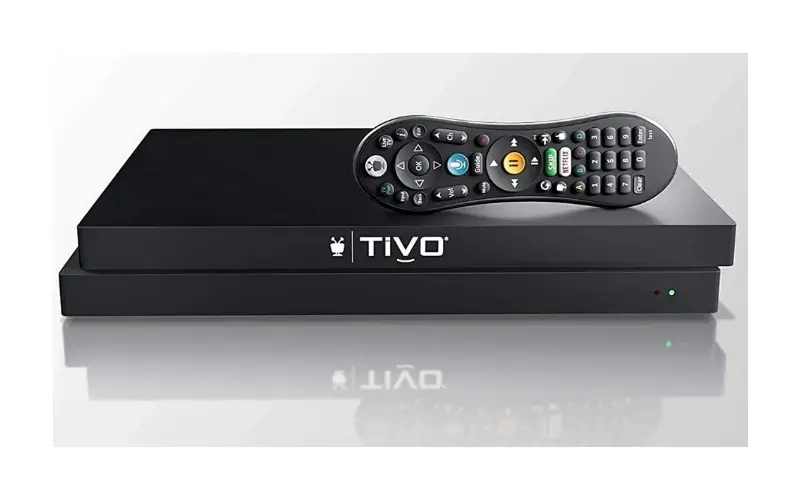
Still, TiVo continued to serve a loyal base of enthusiasts—cord cutters, AV hobbyists, and long-time fans—who preferred owning their recordings rather than relying on cloud storage. The company’s last DVR, the TiVo Edge, launched in October 2019, represented the pinnacle of its hardware journey.
Available in two versions—one for cable users and one for over-the-air antenna viewers—the Edge supported 4K Dolby Vision HDR, Dolby Atmos audio, and massive 2TB hard drives with up to six tuners. It could also integrate popular streaming apps like Netflix and Hulu. Manufactured by Arris, the TiVo Edge proved that TiVo could still build powerful, forward-thinking home entertainment tech—but the market had already moved on.
The Streaming Tidal Wave
The rise of Netflix, Hulu, Disney+, and Apple TV+ didn’t just change TV—it rewrote the rules entirely. By the early 2020s, streaming had become the default way people consumed entertainment. Instead of recording shows, viewers could simply access vast on-demand libraries hosted in the cloud.
“Time-shifting” TV became irrelevant when everything was available anytime, anywhere. Even cable companies began offering cloud-based DVRs, removing the need for physical storage or local hardware.
Adding to TiVo’s troubles were regulatory changes, including the phasing out of CableCARD technology, which had long been essential for integrating TiVo devices with cable systems. Without that compatibility, TiVo’s hardware business became nearly impossible to sustain.
The writing was on the wall. TiVo quietly discontinued the antenna version of its Edge DVR in early 2024, followed by the Mini LUX and TiVo Stream 4K later that year. By September 2025, sales of the final remaining product—the TiVo Edge for cable—were halted.
Support Continues, Legacy Lives On
While TiVo has ceased production, the company promises ongoing support for existing customers, including those who invested in lifetime service plans. Owners of TiVo devices can still use their DVRs, access recordings, and receive technical support for the foreseeable future.
The brand’s focus is now firmly on software and partnerships, particularly its TiVo OS for connected TVs and its DTS AutoStage in-car entertainment platform. In many ways, TiVo’s spirit survives—not as a box under your TV, but as the interface running it.
The End of an Era, but Not the End of TiVo’s Influence
TiVo’s exit from hardware isn’t just the end of a product line—it’s the closing of a chapter in television history. Few devices have had such a profound impact on how we consume media. TiVo didn’t just record TV; it redefined viewer agency. It gave audiences control and changed expectations forever.
Even in 2025, people still say, “I’m going to TiVo that show,” despite the fact that few still own the hardware. The brand became shorthand for the very concept of recording, joining the likes of Google and Xerox as verbs of the digital age.
And yet, in a poetic twist, the very innovation TiVo helped pioneer—on-demand, personalized, time-independent entertainment—eventually made it obsolete. The company’s new mission, powering smart TVs through TiVo OS, reflects that evolution. In a streaming-first world, TiVo’s technology has shifted from being what you connect to your TV to what your TV runs on.
A Legacy Worth Remembering
For a generation of viewers, TiVo was the friendly face of the future. It turned complex technology into something simple and joyful. It made “appointment TV” optional. It taught us to expect convenience, personalization, and freedom.
Now, as the DVR quietly disappears from store shelves, it’s worth remembering how much of our modern streaming experience owes to TiVo’s early vision. The company may no longer sell the sleek silver boxes that once defined an era, but its DNA runs through nearly every streaming interface and content recommendation system today.
TiVo changed television forever—and in a way, it’s still doing so, just from behind the screen.