By: Dipin Sehdev
ULTRALOQ has launched a new generation of smart locks built around two emerging access technologies: ultra-wideband and digital wallet credentials. The new lineup includes the ULTRALOQ Bolt Mission, Bolt Pro and Latch 5 Pro. All three are Matter Certified, while the Bolt Pro and Latch 5 Pro also support Aliro, the Connectivity Standards Alliance’s new standardized approach to digital access credentials. The most interesting model is the $299.99 Bolt Mission. ULTRALOQ describes it as the industry’s first UWB-enabled smart lock, and what makes it different from most existing smart locks is not simply that it can unlock automatically. It is how it decides when to unlock. Most Bluetooth-based auto-unlock systems work primarily by determining that an authorized phone is nearby. Bolt Mission combines Bluetooth Low Energy discovery with UWB ranging, radar-based presence sensing and local decision-making to determine not only whether a phone is close, but whether the person carrying it is actually approaching the door from outside.
That distinction could solve one of the biggest problems with traditional proximity-based smart locks.
What Makes Bolt Mission Different
The appeal of auto-unlock is obvious. Walk toward your front door with groceries, a child or a dog leash in your hands and the door can be ready before you reach it. The challenge has always been making that convenience predictable. Bluetooth is effective at detecting nearby devices, but proximity alone does not provide particularly precise information about where a device is located or which direction it is moving. UWB changes that. Ultra-wideband can provide much more precise ranging and spatial awareness than Bluetooth alone. ULTRALOQ says Bolt Mission uses that information to measure both distance and direction as an authorized user approaches. The lock then combines that information with built-in radar and local logic.
Instead of operating on a simple rule such as “authorized phone detected nearby,” Bolt Mission is designed to understand something closer to “the authorized user is outside and approaching the front door.” ULTRALOQ says that allows it to distinguish an arrival from normal movement inside the home. That is the part of Bolt Mission that makes the product genuinely interesting. Smart locks have had automatic unlocking for years. UWB gives manufacturers a way to make that feature substantially more location-aware.
It Is More Than UWB Alone
ULTRALOQ is not relying on one radio to make the system work. Bolt Mission uses Bluetooth Low Energy to discover the authorized phone, UWB for precise ranging and direction, and radar to detect activity around the door. The company says the radar helps keep the lock alert when needed while conserving power when activity is not present. The decision logic between the phone and lock is processed locally, according to ULTRALOQ, rather than requiring a cloud service to determine whether the door should open. That local-processing approach is particularly important for a product controlling physical access to a home. There is also no separate hub required for UWB auto-unlock. Users need a compatible UWB-enabled smartphone and the Xthings Home app running in the background. Remote smart-home access is a separate matter. ULTRALOQ says connecting the lock through Matter over Thread requires a compatible Thread border router, such as certain Apple TV or HomePod models when using Apple Home.
The Phone Can Stay in Your Pocket
The practical goal is to remove the interaction entirely. Users do not need to open an app, enter a PIN or touch the lock for UWB auto-unlock. That is an important difference from NFC-based smart locks. An NFC or digital wallet lock can be extremely convenient, but the user still has to intentionally bring a phone or wearable close to the reader. Bolt Mission is designed to recognize the approach and unlock without that final tap. The trade-off is that this requires considerably more sensing and decision logic. That is why the combination of UWB, Bluetooth and radar is arguably more important than the UWB badge by itself.
There Is an Important Phone Compatibility Limitation
There is one significant caveat. Although UWB is available on flagship phones from Apple, Samsung and Google, ULTRALOQ’s current support documentation says Bolt Mission’s UWB Auto Unlock works with compatible Apple iPhones at this time. That means the broader promise of UWB is ahead of the current device compatibility. ULTRALOQ lists UWB-equipped phones from multiple manufacturers, but customers should verify that the actual auto-unlock feature is supported on their specific phone before buying the lock. That is particularly important at $299.99, because UWB auto-unlock is the feature that most clearly separates Bolt Mission from less expensive smart locks.
Bolt Mission Still Has Conventional Backup Options
ULTRALOQ has not made the lock dependent entirely on hands-free access. Bolt Mission also supports PIN codes, app control, NFC access and a traditional physical key. That matters because even the most sophisticated smart lock still needs sensible fallback options. The lock also supports Matter over Thread and is designed to work with major smart-home platforms including Apple Home, Google Home, Amazon Alexa and Samsung SmartThings. ULTRALOQ lists AES 128-bit encryption and says the lock has been tested to ANSI and BHMA standards. The manufacturer also says Bolt Mission can run for up to eight months on eight AA alkaline batteries, with a rechargeable lithium battery option designed to extend runtime further. As always, real-world battery life will depend on usage, radio activity and environmental conditions.
Bolt Pro Takes a Different Approach
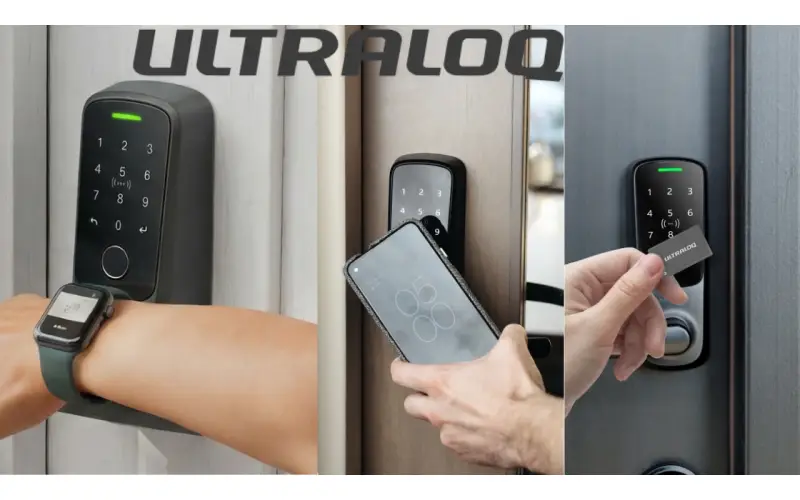
The $269.99 Bolt Pro is less focused on automatic entry and more focused on turning the phone or smartwatch into a traditional digital key. The important technology here is Aliro. Aliro 1.0 was released by the Connectivity Standards Alliance in February 2026 as a standardized credential and communications framework for mobile access. The goal is to create a common system that works across mobile wallets and access-control products rather than requiring every lock manufacturer to develop an entirely proprietary digital-key system. Apple, Google and Samsung are among the major ecosystem companies supporting Aliro. In practical terms, it is intended to bring the experience consumers already know from contactless payments and digital car keys to doors. With Bolt Pro, an authorized device can be tapped against the lock to unlock it without opening the ULTRALOQ app.
Aliro Could Be More Important Than Any One Lock
Aliro may end up being the most consequential technology in this entire product announcement. Smart locks have historically suffered from fragmentation. One lock works with one application. Another requires a proprietary account. Another has NFC but only through a manufacturer's own credential system. Aliro is designed to standardize the credential layer. That means a digital house key can live in the same type of mobile wallet people already use for payment cards, airline passes and increasingly vehicle keys. The Connectivity Standards Alliance says Aliro is intended for residential homes as well as offices, universities, hotels and other access-control environments. If adoption grows, choosing a smart lock could eventually become less about whether a particular manufacturer has a good app and more about whether the lock supports an interoperable digital credential. That is a much healthier direction for the category.
Bolt Pro Gives Users Multiple Ways In
Aliro is only one of the Bolt Pro's access methods. The deadbolt also supports fingerprint recognition, PIN codes, app control and a physical key. That flexibility makes sense for a household. One person may prefer using a phone or smartwatch. Another may use a fingerprint. Children can be assigned PINs. A cleaner, family member or temporary visitor can receive separate access. The appeal is not simply eliminating a metal key. It is allowing each person to use the access method that makes the most sense for them. ULTRALOQ says digital credentials can be stored in compatible mobile wallets, with the company specifically highlighting Apple Wallet and Samsung Wallet in its announcement. As with any newly standardized platform, wallet and device support should be checked before purchase because Aliro compatibility is still developing across ecosystems.
Latch 5 Pro Brings the Same Idea to Lever Locks
The Latch 5 Pro extends Aliro-based digital access beyond the front-door deadbolt. It is intended for doors that use lever hardware, such as side entrances, home offices, garage-entry doors, rentals and shared spaces. It supports digital wallet credentials, fingerprint access and PIN codes while also adding Matter compatibility. ULTRALOQ's current product page lists the Latch 5 Pro at $199.99, although the launch information provided by the company lists a $249.99 MSRP. That price discrepancy is worth noting for shoppers and may reflect current promotional or updated retail pricing. The product page also says Samsung Wallet support is available now, while Apple Wallet and Google Wallet support are listed as coming later. That illustrates one of the realities of buying into a new standard early: certification does not necessarily mean every wallet and device combination is available on day one.
ULTRALOQ Next-Generation Smart Lock Specifications
| Feature | Bolt Mission | Bolt Pro | Latch 5 Pro |
|---|---|---|---|
| Lock type | Deadbolt | Deadbolt | Lever lock |
| MSRP | $299.99 | $269.99 | $249.99 announced |
| Primary technology | UWB hands-free access | Aliro digital key | Aliro digital key |
| UWB | Yes | No announced | No announced |
| Radar sensing | Yes | No announced | No announced |
| Hands-free approach unlock | Yes | No | No |
| Digital wallet access | NFC/access options | Yes | Yes |
| Aliro Certified | No announced | Yes | Yes |
| Fingerprint | No | Yes | Yes |
| PIN access | Yes | Yes | Yes |
| App control | Yes | Yes | Yes |
| Physical key | Yes | Yes | Not specified in announcement |
| Matter Certified | Yes | Yes | Yes |
| Apple Home | Yes | Yes | Yes |
| Google Home | Yes | Yes | Yes |
| Samsung SmartThings | Yes | Yes | Yes |
| Separate hub needed for UWB unlock | No | N/A | N/A |
| Thread border router for Matter remote access | Yes, where required by platform | Platform dependent | Platform dependent |
| Availability | Available now / broader retail in October | October retail rollout | October retail rollout |
Matter and Aliro Solve Different Problems
It is also worth separating Matter from Aliro because the two standards do different jobs. Matter is primarily about smart-home interoperability. It allows a lock to participate in an ecosystem alongside lights, thermostats and other connected devices. Aliro is about the credential used to gain physical access. A Matter-compatible lock can work with Apple Home or Google Home without necessarily supporting a standardized digital key in Apple Wallet or Samsung Wallet. An Aliro-compatible lock is intended to standardize that credential experience. The combination of the two is what makes Bolt Pro and Latch 5 Pro noteworthy. Matter connects the lock to the home. Aliro connects the user's identity and credential to the lock.
SmartThings Adds More Automation
ULTRALOQ says Bolt Pro and Latch 5 Pro can also integrate with Samsung SmartThings. That allows unlocking the door to become a trigger for broader household automations. A specific family member arriving home could potentially unlock the door with a digital key while SmartThings turns on lights or changes the thermostat. Separate household members can also maintain their own digital credentials. That is the kind of interoperability Matter and Aliro are ultimately supposed to enable: the lock becomes less of an isolated gadget and more of a secure access point within the broader home.
The Real Innovation Is Knowing Intent
Of the three locks, Bolt Mission is still the one that stands out. There are already plenty of smart locks that can detect a phone. There are plenty that support PINs, fingerprints, NFC or app-based unlocking. The harder problem is determining intent. Is the authorized person actually coming through the door? Are they walking past it? Are they standing on the other side of the wall?Are they already inside the house? A system that understands precise location and direction has the potential to answer those questions much more reliably than conventional Bluetooth proximity. That is why UWB is such an interesting technology for smart locks. It is not merely another wireless protocol. It gives the lock spatial information. Adding radar and local decision-making on top of that is what gives Bolt Mission the potential to feel substantially different from today's typical auto-unlock systems. Whether it works reliably enough in real homes will be the important test.
Pricing and Availability
ULTRALOQ says the new lineup will be available online through The Home Depot beginning in October. The company lists the Bolt Mission at $299.99 and Bolt Pro at $269.99. The Latch 5 Pro was announced at $249.99, although ULTRALOQ's own store currently shows the model at $199.99. The locks are also available through ULTRALOQ directly, with broader retail availability expanding in October. For consumers, the choice ultimately comes down to how they want their front door to behave. Bolt Pro and Latch 5 Pro make the phone or wearable into a key. Bolt Mission tries to eliminate the act of using a key altogether. If its UWB and radar system can reliably distinguish simply being nearby from actually coming home, that may be the most meaningful smart-lock advancement in this new lineup.