By: Dipin Sehdev
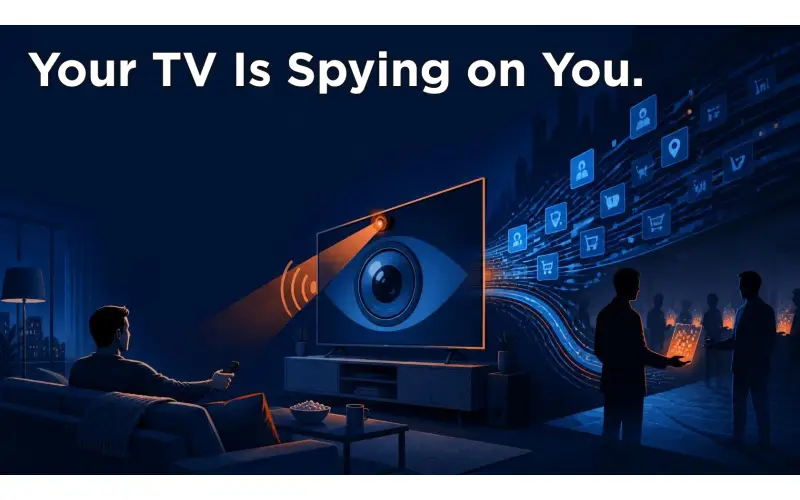
There is a lot about the latest Gamers Nexus investigation into LG smart TVs that should make consumers uncomfortable. The microphones. The Automatic Content Recognition technology. The network scanning. The advertising infrastructure built around understanding what is happening inside a household.
But the part that bothers me most is that none of this is really new.
We have been talking about smart televisions collecting information about their owners for more than a decade. There have been regulatory complaints. There have been lawsuits. There have been multimillion-dollar settlements. And somehow, in 2026, we are still having essentially the same conversation. Only now the technology is considerably more sophisticated.
The latest Gamers Nexus investigation, conducted with Level1Techs and independent security researchers, found LG televisions capable of scanning local networks, identifying unrelated connected devices, collecting viewing information and, in certain test scenarios, capturing audio from microphones connected to the television. Researchers were also able to retrieve plain-text voice transcriptions and demonstrate audio capture while a television appeared to be off.
That should bother anyone who owns a smart television. For me, though, the biggest issue is no longer simply that these devices collect data. It is how little meaningful control consumers appear to have over what happens after they bring one into their home.
The Problem Is the Deception
Companies can make a legitimate argument that some television data collection serves useful purposes. A smart TV needs to communicate with streaming services. Casting features need to discover devices. Voice assistants need microphones. Recommendation engines need some understanding of what users are watching. There is also an enormous advertising business built around connected television. I understand all of that.
What I have a much harder time accepting is the idea that consumers have meaningfully agreed to everything happening behind the screen simply because they clicked through a privacy policy. That isn't meaningful consent. And the Gamers Nexus findings are particularly troubling because even turning things off does not necessarily mean the television stops communicating.
Researchers examining LG firmware reported that after opting out of tracking, the TV could still authenticate with LG when it booted and send an online beacon when it connected to the network. The opt-out communication itself reportedly included the television's MAC address. That does not mean every piece of information continues to be collected after an opt-out. Gamers Nexus noted that some post-opt-out communication was minimal. But it exposes the larger problem.
What exactly does "off" mean?
If I disable advertising tracking, what stops?
If I decline ACR, what stops?
If I disable voice recognition, what stops?
If I reject the privacy agreements, what stops?
A consumer should not need Wireshark, decompiled firmware and a cybersecurity researcher sitting next to them to answer those questions.
Your TV Can See Far Beyond the TV
One of the most unsettling findings involved LG televisions scanning the local network. During its investigation, Gamers Nexus reported that a television continuously searched the LAN and identified at least 38 devices, including computers, phones, smartwatches, network hardware and thermostats. Researchers said the TV could obtain information including display names, signal strength, MAC addresses and internal network information.
The investigation also reported discovering Samsung phones, Pixels, iPhones, smartwatches and thermostats on the test network. There can be legitimate reasons for a television to discover devices on a network. Casting is one. Media sharing is another. Smart-home interoperability is another. But when a television company also operates a sophisticated advertising business that talks about extending campaigns across devices in a household, those capabilities deserve much more scrutiny.
Gamers Nexus cited LG advertising executives discussing first-party ACR data and the ability to extend advertising campaigns to mobile devices within a household. That is where the "ick" becomes much stronger for me. I bought a television. I did not buy a household surveillance platform. And I certainly didn't intend to give the television permission to inventory everything else sitting on my network.
We Need to Be Careful About the Bluetooth Claim
There is an important distinction worth making here. I have seen discussion suggesting televisions may use phones or Bluetooth devices as another path to transmit information. The material I reviewed supports extensive local-network discovery and cross-device advertising ambitions. It does not establish that an LG television secretly jumps onto a nearby phone through Bluetooth specifically to exfiltrate collected data. That distinction matters. The confirmed behavior is already concerning enough. We don't need to exaggerate it.
What we can say is that the television can have visibility into an ecosystem of devices far beyond the television itself, and LG's advertising business has publicly discussed extending its reach into other household devices. That should be enough to demand answers.
The Microphone Is Where This Becomes Personal
Then there is the audio. Gamers Nexus reported retrieving voice information from LG televisions and finding plain-text transcriptions of speech. The investigation also showed situations where background conversations were captured while the voice system remained active after a command. LG has disputed the characterization that its televisions collect, record or store ambient conversations, saying voice recognition is an optional, user-initiated feature used to fulfill requests.
Gamers Nexus' testing told a more complicated story. In one example, researchers reported that the television continued capturing speech from people in the room who were not addressing the TV and did not realize it was listening. Researchers also demonstrated that access to different audio devices connected to the television could potentially create additional listening paths, including microphones associated with USB cameras and other hardware.
And this is where the issue changes for me. I cover the consumer-electronics and television industry. I spend a tremendous amount of time looking at what manufacturers are building, where the market is going and what consumers think about these products. And before any of that, I am a parent.
The possibility that a device sitting in my living room could capture conversations involving my children bothers me far more than a company knowing which football game I watched.
Children aren't reading these agreements.
They aren't clicking "accept."
Their friends aren't consenting.
The babysitter isn't consenting.
The grandparents who come over for dinner aren't consenting. Yet they are all potentially within range of microphones attached to a powerful internet-connected computer sitting in the middle of the room.That is a fundamentally different privacy question.
Children Make This Even More Complicated
There are already federal protections surrounding children's information. The FTC has said an audio file containing a child's voice can constitute personal information under the Children's Online Privacy Protection Act. COPPA generally regulates certain collection of information from children under 13 by covered online services.
That does not automatically mean LG or another television company violated COPPA. Whether COPPA applies depends on the circumstances, including what type of service is involved and whether the operator has knowledge that information is being collected from a child. But the legal uncertainty itself should make people uncomfortable.
In 2015, the Electronic Privacy Information Center filed a complaint with the FTC regarding Samsung's voice-enabled smart TVs. EPIC alleged that the televisions' voice-recording practices were unfair and deceptive and specifically raised COPPA concerns involving the collection of children's voices. That was 11 years ago. We are still dealing with this.
This Is Not an LG Problem
LG is receiving most of the attention right now because Gamers Nexus investigated LG. That should not turn this into an anti-LG story. The television industry has had privacy problems for years. Samsung has faced scrutiny. Vizio has faced scrutiny. Sony, TCL and Hisense have faced scrutiny. Roku has faced privacy and data questions. This is an industry problem.
In December 2025, the Texas attorney general sued LG, Samsung, Sony, Hisense and TCL, alleging that the companies unlawfully collected television viewing information through Automatic Content Recognition technology.
Samsung reached an agreement with Texas in February requiring express consent before ACR viewing data can be collected from Texas consumers, along with clearer disclosures. LG reached its own agreement in May. Under that agreement, LG committed to providing clearer disclosure about viewing-data collection and a simpler mechanism for opting out. If five major television manufacturers can become the subject of regulatory action involving fundamentally similar technology, we shouldn't pretend changing the logo on the front of the television automatically solves the problem.
We Were Warned About This Years Ago
Vizio provides perhaps the clearest historical example. In 2017, Vizio agreed to pay $2.2 million to settle charges brought by the Federal Trade Commission and the New Jersey attorney general. Regulators alleged that Vizio installed software on approximately 11 million televisions that collected viewing information without consumers' knowledge or consent. According to the FTC, the system captured second-by-second information about what appeared on the television, including content from cable boxes, DVDs, over-the-air broadcasts and streaming devices.
The FTC also alleged that the viewing information could be combined with demographic information including age, income, marital status, household size, education and home ownership. The settlement required affirmative consent and stronger disclosures. Again, that happened in 2017. So when someone tells me today's controversy is simply consumers suddenly discovering how smart TVs work, I don't buy that explanation. Consumers have been raising these concerns. Privacy advocates have raised them. Regulators have raised them. Courts have dealt with them. The industry kept going.
ACR Is More Powerful Than Most People Realize
Automatic Content Recognition is one of the technologies at the center of this discussion. In simple terms, ACR can identify what is being displayed on a television. That can be incredibly valuable to advertisers. It can help determine whether you saw a particular program, advertisement or piece of content. And it isn't necessarily limited to the TV's built-in Netflix app. Depending on implementation, ACR can identify content coming from HDMI-connected devices.
Gamers Nexus reported observing ACR activity while its LG television was being used with HDMI. That distinction is important because a lot of people assume:
"I use an Apple TV, so LG doesn't know what I'm watching."
Or:
"I use a Blu-ray player."
Or:
"I use a cable box."
ACR potentially changes that equation because it is recognizing what hits the screen rather than relying solely on the app that delivered it. That is an enormously valuable advertising tool. It is also an extraordinarily powerful surveillance capability if consumers don't have meaningful control over it.
The Business Model Explains a Lot
Modern television economics are very different from the television business of 20 years ago. Manufacturers don't necessarily stop monetizing you when the television leaves the store. Smart-TV operating systems can generate revenue through advertising, content partnerships, FAST channels, recommendations and audience data.
Gamers Nexus highlighted just how significant that business can become. The investigation pointed to Vizio's historical financials, where the company's hardware business operated on extremely thin margins while its advertising and platform operation produced much stronger margins. Walmart's acquisition of Vizio also underscored the value of the television as an advertising platform. The panel is no longer the entire product. Your attention has value. Your viewing habits have value. Your household has value. Your other devices may have value. That changes the incentive structure. Selling a TV makes money once. Advertising to the household can make money repeatedly.
And Consumers Are Starting to Notice
This is where CE Critic Intelligence makes this story considerably more interesting. The question isn't simply whether consumers are angry. The question is whether this controversy is actually changing what they plan to buy. The early answer appears to be yes.
According to CE Critic Intelligence Engin, LG television purchase consideration fell from 68.1% before the Gamers Nexus investigation to 59.0% afterward. That is a 9.1% point decline. At the same time, consumers modeled as unlikely to buy or actively avoiding LG increased from 15.9% to 24.8%.
LG Consumer Sentiment Before and After the Investigation
|
Metric |
Before |
After |
Change |
|
Likely / considering LG |
68.1% |
59.0% |
-9.1 pts |
|
Unlikely / avoiding LG |
15.9% |
24.8% |
+8.9 pts |
|
Positive LG sentiment |
73.5% |
55.8% |
-17.7 pts |
|
Neutral LG sentiment |
14.9% |
14.6% |
-0.3 pts |
|
Negative LG sentiment |
11.6% |
29.6% |
+18.0 pts |
|
Privacy-related conversation |
4.0% |
25.4% |
+21.4 pts |
|
Privacy lowers LG purchase likelihood |
2.5% |
14.8% |
+12.3 pts |
|
Net sentiment |
+61.9 |
+26.2 |
-35.7 pts |
Source: CE Critic Intelligence Engine
That distinction is important. CE Critic Intelligence did not simply count negative comments. The methodology specifically separates general outrage, jokes and negative commentary from actual purchase-intent behavior. A statement has to contain a buying consequence, abandoning a purchase, switching brands, returning a TV or removing LG from consideration, before it is treated as lost purchase intent.
That makes the 9.1% decline much more important than a social-media sentiment number. These are consumers closer to actually spending money. Privacy Went From Background Noise to a Purchase Barrier Before the Gamers Nexus investigation, privacy appeared in about 4% of LG-related discussion. Afterward? 25.4%.
Even more importantly, privacy was modeled as actively reducing LG purchase likelihood in just 2.5% of discussion before the story. That increased to 14.8% afterward. That's the number television manufacturers should be paying attention to. People complain about companies every day. Most complaints don't change purchases. This appears to be different.
The CE Critic Intelligence analysis found bottom-of-the-funnel consumers who were actively considering LG televisions and then said they were pausing, abandoning or redirecting those purchases after learning about the privacy investigation.
One prospective buyer quoted in the dataset had been deciding between an LG C6H and G6 before asking whether Samsung's S95H should now be the alternative. Another said the Gamers Nexus findings had given them pause about future LG purchases. Those are not abstract privacy complaints. Those are potential lost sales.
LG's Bigger Problem Is Trust
The CE Critic Intelligence reveals an even more interesting divide. Consumers still appear to believe LG makes excellent televisions. The modeled trust score for LG hardware and picture quality only moved from 87% to 84%. But trust in webOS and software dropped from 58% to 36%.
Trust in privacy and data practices collapsed from 51% to 27%. CE Critic Intelligence describes this as a hardware/software trust fracture. That may be the best way to describe what is happening. People didn't suddenly decide LG OLED panels look bad. They didn't suddenly decide LG forgot how to build televisions. They are questioning whether they trust the computer behind the panel. That is an entirely different problem.
Some People May Still Buy LG and Disconnect It
The privacy backlash may also create a second problem for television companies. Consumers don't necessarily have to abandon the hardware. They can abandon the smart platform.
CE Critic Intelligence found that, in post-investigation discussion, approximately:
- 7.8% indicated plans to disconnect or keep an LG television offline.
- 6.1% indicated plans to use external streaming hardware instead.
- 5.1% explicitly removed or avoided LG from consideration.
- 0.9% discussed potentially returning or selling an LG television.
Those categories overlap and should not be added together. That creates an interesting outcome. A consumer might still buy an LG OLED because they love the picture. Then they connect an Apple TV. Disconnect webOS. Block the TV from the internet. And essentially turn a $3,000 smart television back into a display. LG keeps the panel sale. But the consumer has rejected the software ecosystem.
For an industry increasingly interested in recurring advertising and platform revenue, that could matter almost as much as losing the original sale.
Samsung and Sony May Benefit But They Aren't a Privacy Escape Hatch
Among consumers reconsidering LG, Samsung is currently the strongest named alternative in the CE Critic Intelligence model at 31%. Sony follows at 24%. TCL accounts for 11%, Hisense 9%, Philips 8%, Panasonic 6% and Roku-branded TVs 3%. But those numbers come with an enormous caveat. About 39% of post-investigation privacy discussion explicitly recognizes that smart-TV tracking and ACR are not unique to LG.
That's important. Switching from LG to Samsung may change the television. It doesn't necessarily solve the underlying industry problem. Neither does switching to Sony, TCL or Hisense. That is precisely why regulators have investigated multiple manufacturers.
Families Are Thinking About This Differently Too
CE Critic Intelligence also found that the nature of the privacy discussion is changing. This isn't just: "My television knows what show I'm watching." Consumers are increasingly talking about what the television may know about the entire household. About 5.7% of post-investigation LG purchase-related discussion involved concerns surrounding families, children, microphones, private rooms or other household devices.
Within the privacy-specific subset, that rises to approximately 22%. Explicit mentions of children and minors remain smaller, roughly 1% to 2% of total post-story discussion, but those comments carry disproportionately strong emotional reactions.
That mirrors my reaction exactly. There is something fundamentally different about tracking what I watch and potentially capturing what happens in the room where my family lives.
Turning Everything Off Should Mean Off
This is where I think regulation should become incredibly simple. Consumers shouldn't need 40 pages of legal language. They need a few clear questions.
Do you want viewing recognition enabled?
Yes or no.
Do you want your viewing information used for advertising?
Yes or no.
Do you want that information shared with third parties?
Yes or no.
Do you want microphone-based voice services enabled?
Yes or no.
And if the consumer says no, the answer should actually mean no for that category.
No deceptive menus.
No buried switches.
No "select all" buttons designed to encourage users to accept optional tracking along with required terms.
Gamers Nexus criticized LG's interface for what it characterized as dark patterns, including how tracking-related options are presented and where privacy controls are located.
The investigation reported that some agreement screens presented multiple terms with a "select all" option highlighted even when every agreement was not required for the feature the user was trying to access. That's exactly the kind of design that destroys trust.
If tracking is genuinely beneficial to consumers, manufacturers shouldn't need to trick people into enabling it.
Government Has Not Kept Up
I also think we need to be honest about government. Technology moves much faster than legislation. ACR. Cross-device advertising. Persistent device identifiers. Voice transcription. Local network discovery. AI-generated household profiles. These aren't topics most consumer privacy laws were written around. It is tempting to reduce that problem to the age of politicians. I don't think that's quite fair.
There are older lawmakers who understand technology extremely well and younger ones who don't. The bigger issue is that the people writing and enforcing these laws need enough technical expertise to understand what these systems actually do.
If lawmakers don't understand the difference between a television storing an app preference and a television continuously fingerprinting what appears on the screen, how are they supposed to regulate it effectively? If they don't understand how MAC addresses, local network discovery and cross-device advertising work, how can they understand whether a consent screen meaningfully protects consumers?
That expertise gap matters. And enforcement that arrives years after a technology enters millions of homes isn't enough. The Vizio settlement came in 2017. Samsung's voice privacy controversy dates back to 2015. Five major TV manufacturers were still being sued over ACR practices in 2025. We are not moving quickly enough.
Consumers Need to Make a Big Stink About This
So what actually changes things? Pressure. Consumers should contact their state attorneys general. They should contact members of Congress. They should contact federal regulators. They should file complaints. They should ask television manufacturers direct questions. And they should make purchase decisions based partly on how companies handle privacy. I intend to make a big stink about it. Because if consumers stay quiet, there is little economic incentive for anything to change.
The television industry has already demonstrated how valuable viewing and advertising data can become. Taking some of that value away may be one of the strongest messages consumers can send.
This Is Bigger Than LG
I want to be extremely clear about that. LG deserves scrutiny because of what Gamers Nexus uncovered. It deserves questions about network discovery. It deserves questions about voice functionality. It deserves questions about ACR. It deserves questions about its advertising business and what happens after consumers opt out.
But Samsung deserves scrutiny. Sony deserves scrutiny. Roku deserves scrutiny. TCL deserves scrutiny. Hisense deserves scrutiny. Every television platform collecting data inside someone's home deserves scrutiny.
The worst outcome from this investigation would be consumers deciding:
"LG is bad. I'll buy another smart TV and everything is fixed."
It isn't. LG is simply the company whose system received one of the deepest public examinations we've seen so far.
The Early Consumer Data Should Terrify the Industry
CE Critic Intelligence's current analysis covers only the first few days after the Gamers Nexus story. The report estimates the immediate LG purchase-consideration decline at approximately 9%, with a reasonable modeled range of roughly 6% to 13% points. Confidence is currently described as moderate because the after period runs only from Sept. 6 through Sept. 9.
The reputational damage is already here. Net sentiment fell 35.7%, compared with a 9.1% decline in purchase consideration. That tells us most angry consumers haven't abandoned LG. At least not yet.
We Need a New Specification on the TV Box
We spend an enormous amount of time comparing televisions. Brightness. Black levels. Color volume. Refresh rates. HDR formats. Processing. Gaming features. HDMI bandwidth. Maybe we need to add another category.
Privacy.
How much information does the TV collect? Is ACR enabled by default? What happens when it is disabled? Does the television scan other devices on the network? Does it contain always-listening microphones? Where is voice data processed? How long is it retained? Who receives it?
Can the television function fully without agreeing to advertising-related tracking? And can consumers verify that "off" actually means off? Those questions deserve to become part of how televisions are evaluated.
Because the television isn't just a screen anymore. It is a computer. It has microphones. It has network access. It can recognize what appears on the screen. It can interact with other devices. And increasingly, it has AI.
That means the privacy standards surrounding televisions need to become dramatically stronger, not weaker. You paid for the television. It sits inside your home. Your children sit in front of it. Your family talks around it. Your phones and computers share a network with it.
You should not have to wonder whether you are still the customer. Or whether, somewhere along the way, you became the product.