By: Dipin Sehdev
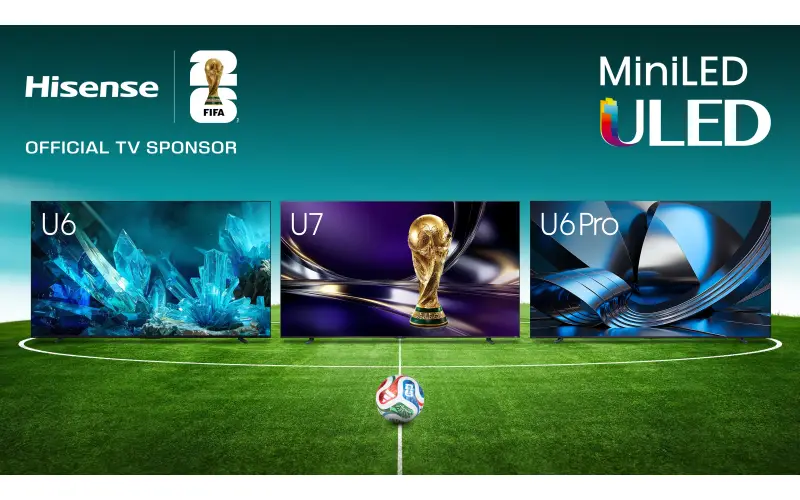
Hisense has officially announced its 2026 ULED MiniLED TV lineup, focusing on the models that arguably matter the most for the company’s business: the U6 Series and U7 Series. While the TV industry tends to spotlight ultra-premium models with cutting-edge panel technology, the reality is that most consumers buy televisions in the mid-range performance tier. For Hisense, that sweet spot is the ULED lineup. These TVs are the bread and butter of the Hisense portfolio, delivering MiniLED performance and premium features at prices that remain accessible to a wide audience. The company’s upcoming RGB MiniLED Series will serve as its flagship tier, but the U6 and U7 are the models most shoppers will actually bring home. And for 2026, Hisense is expanding the lineup to make it easier for consumers to find a TV that fits both their budget and viewing habits.
A Lineup Built for How People Watch Today
Hisense says its latest TVs were designed around how households actually use their televisions. Large screens are increasingly becoming the centerpiece of home entertainment spaces, whether for streaming movies, watching live sports, or hosting friends for major events. With the FIFA World Cup 2026 set to take place across North America, the company is also positioning its new TVs as ideal viewing platforms for sports fans. James Fishler, Chief Commercial Officer at Hisense USA, says demand for larger displays continues to grow:
“The data's clear – people are gravitating toward larger screens and they're using them to bring people together,” Fishler said. “We’re focused on making sure the features that define the viewing experience are accessible across the board.”
That philosophy is clearly visible in the new ULED lineup.
U7 Series: A Big-Screen Sports Machine
At the top of the ULED lineup sits the U7 Series, which Hisense describes as the performance leader for mainstream buyers. The U7 is designed to deliver features typically found in higher-end TVs, including strong motion performance, high brightness, and immersive audio. It’s also one of the most ambitious mid-range TVs in terms of screen size. The lineup now scales all the way up to a massive 116-inch display, turning the television into a centerpiece for large rooms and home theater setups. Under the hood, the U7 uses Hi-QLED MiniLED Pro technology paired with Full Array Local Dimming and the company’s Hi-View AI Engine Pro. The expected results are improved contrast control, brighter highlights, and deeper blacks compared to traditional LED TVs. For sports and gaming, the U7 includes a native 165Hz refresh rate, which should help keep fast action smooth and responsive. Hisense also includes a audio system for a mid-range TV, with 50W 2.1.2-channel sound featuring Dolby Atmos support.
U6 Series: MiniLED for the Masses
Below the U7 sits the U6 Series, which remains one of Hisense’s most important models. The U6 is designed to bring MiniLED technology to a broader audience at lower prices.
This year the lineup expands to include two variations:
• U6 Pro (U6SF Pro)
• U6 (U6SF)
The U6 Pro sits between the standard U6 and the U7, adding more advanced processing and performance features while keeping prices below the U7 tier. Personally, I’m particularly interested in how the U6 Pro compares with the U7, since that’s where many buyers will likely find the best balance between performance and price. The standard U6 focuses on delivering strong everyday viewing performance, while the U6 Pro pushes closer to enthusiast territory. All U6 models feature MiniLED backlighting, quantum dot color, and AI-driven picture processing. Hisense has also added an integrated subwoofer, helping deliver fuller sound without requiring an external audio system.
Hisense ULED MiniLED Lineup Comparison
| Model | U6 | U6 Pro | U7 |
|---|---|---|---|
| Backlight | MiniLED | MiniLED | MiniLED Pro |
| Local Dimming | Full Array | Full Array | Advanced Full Array |
| Processor | Hi-View AI Engine | Hi-View AI Engine Pro | Hi-View AI Engine Pro |
| Refresh Rate | Up to 120Hz | Up to 144Hz | Up to 165Hz |
| Color Technology | Quantum Dot | Quantum Dot | Hi-QLED Quantum Dot |
| Audio | Dolby Atmos | Dolby Atmos + Subwoofer | 50W 2.1.2 Dolby Atmos |
| Smart Platform | Fire TV | Fire TV | Google TV / Fire TV |
| Screen Sizes | 55"–100" | 55"–100" | Up to 116" |
| Position | Entry MiniLED | Mid-tier MiniLED | Performance MiniLED |
Performance vs Value
This three-tier structure gives Hisense a very clear product ladder.
U6
The entry point for MiniLED technology, offering strong everyday performance for streaming and general TV viewing.
U6 Pro
The performance sweet spot for many buyers, adding more processing power and motion capabilities.
U7
A higher-performance model aimed at sports fans, gamers, and viewers looking for a more premium experience.
If you’re comparing the lineup, the real decision point may end up being U6 Pro vs U7. That’s where the performance improvements start to become noticeable, particularly for motion handling and brightness.
Gaming and Motion
Gaming continues to be an important feature category for modern TVs. The U7 leads here with its 165Hz refresh rate, which should provide smoother motion for both gaming and fast sports action. The U6 Pro and U6 still offer strong gaming capabilities, though with slightly lower refresh rate ceilings. Combined with MiniLED backlighting, the TVs should deliver solid HDR performance across a wide range of content.
Pricing and Availability
Hisense is launching the lineup in phases.
| Model | Availability | Starting Price |
|---|---|---|
| U7 Series | Available now | $1,299 MSRP |
| U6 Pro | Coming in the coming weeks | TBD |
| U6 Series | Rolling out soon | TBD |
The U7 is currently available through Best Buy, with additional versions expected to arrive at Amazon and other retailers. The U6 models will follow shortly as the lineup expands.
The TVs Most People Will Actually Buy
It’s easy to get caught up in flagship TVs that push the boundaries of display technology. But for companies like Hisense, the real story often lives in the mid-range lineup. The U6 and U7 series are the TVs that most households will realistically consider. They offer a balance of price and performance that makes large-screen home entertainment more accessible. And with sizes now stretching up to 116 inches, Hisense is clearly betting that bigger screens will continue to dominate living rooms. For many buyers in 2026, the choice may come down to a simple question: Do you go with the value-focused U6, the performance-focused U7, or find the middle ground with the U6 Pro? That’s exactly where Hisense wants the conversation to be.