By: Dipin Sehdev
TCL is making a fascinating bet in 2026: while much of the TV industry is loudly selling RGB TV as the next big thing, TCL is refusing to treat RGB as the automatic flagship answer. Instead, it is pushing two futures at once. One is RGB Mini-LED, which uses red, green, and blue LEDs directly in the backlight. The other is TCL’s preferred route at the top end: SQD Mini-LED, short for Super Quantum Dot Mini-LED, which keeps a single-color Mini-LED backlight architecture but pairs it with upgraded quantum-dot and color-filter tech to chase higher brightness, tighter light control, and richer color. That is why the X11L sits at the summit of TCL’s 2026 range, not the RGB-based RM9L.
And honestly, after seeing these sets in person at CES, I get why TCL thinks it has an argument. This is one of those years where video and spec sheets only tell half the story. You can watch ten YouTube walk-throughs and still miss what these TVs are actually doing with brightness, color volume, and highlight control. On a show floor, the X11L looks almost absurdly punchy. It is the kind of TV that makes every other bright-room display look like it has the parking brake on.
First Came TCL X11L
The headline set is the TCL X11L, and it is already selling in the U.S. in 75-, 85-, and 98-inch sizes for $6,999.99, $7,999.99, and $9,999.99. TCL says it reaches up to 10,000 nits and up to 20,736 dimming zones, with a 144Hz panel, four HDMI 2.1 ports, Wi-Fi 6, Google TV, and Bang & Olufsen audio. TCL’s official product page lists the company’s TSR AI Processor, while outside reporting has tied the model’s next-gen HDR ambitions to MediaTek’s Pentonic 800, a premium 4K TV SoC built for VRR displays up to 165Hz.
That last point matters, because the X11L is one of TCL’s 2026 sets getting Dolby Vision 2 Max via software update. That is important not just as a spec bullet, but as a marker of where TCL sees premium LCD heading. Dolby Vision 2 and Dolby Vision 2 Max are positioned as a more advanced HDR pipeline than standard Dolby Vision IQ, and TCL’s own 2026 SQD range is where that support is landing first. The C8L/QM8L is also expected to get Dolby Vision 2 Max. The C7L/QM7L, by contrast, does not have that same clear confirmation, and the RM9L/RM7L RGB models are not the Dolby Vision 2 story this year. If you care specifically about future-facing Dolby support, the safest TCL buys are the X11L and C8L, not the RGB models.
RGB vs SQD Tech Explained
So what exactly is an RGB TV? In simple terms, an RGB Mini-LED TV replaces the more conventional single-color backlight approach with individual red, green, and blue LEDs behind the LCD layer. The upside is obvious: you can generate a very wide color volume at the light-source level, reduce reliance on filtering, and potentially improve efficiency and saturation. TCL says its RGB sets use RGB Precision Dimming and a 3rd-generation semiconductor RGB light-emitting chip to reduce color crosstalk, which has historically been one of RGB backlighting’s toughest engineering problems.
But TCL’s counterargument is clever. It says SQD Mini-LED can get close to RGB’s color advantages while keeping a stronger grip on contrast and blooming control. TCL describes SQD as producing ultra-pure white light with improved stability, and it claims that adjacent zones avoid the sort of color interference that can complicate RGB implementations. In plain English: RGB may win the marketing war because it sounds new, but TCL thinks SQD is the more balanced real-world picture solution, especially if your priorities are peak HDR, local dimming precision, and overall polish rather than just novelty.
That is why the split inside TCL’s range is so interesting. The RM9L is TCL’s halo RGB set, offered in 85-, 98-, and 115-inch sizes, with TCL claiming up to 9,000 nits and huge BT.2020 color coverage. But it is not the flagship. The X11L remains the statement TV. That tells you everything about TCL’s confidence in SQD. The company is not avoiding RGB; it is containing it. TCL wants the market to see RGB as exciting, but it wants the X11L to be seen as superior.
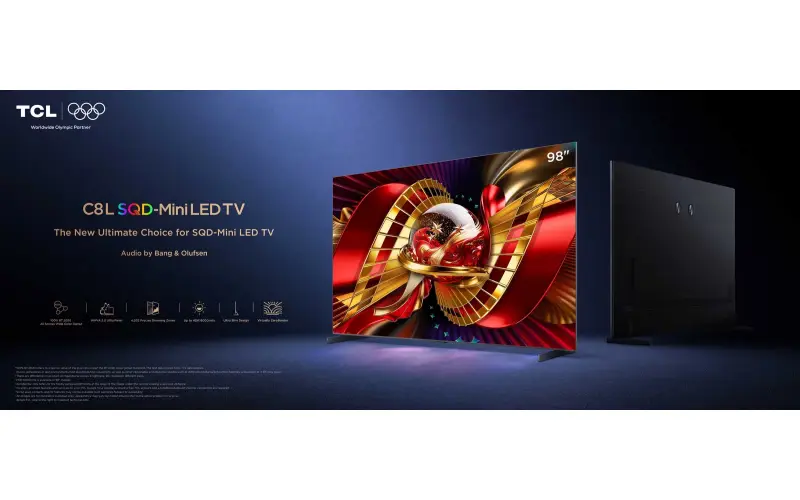
Below that, the C8L/QM8L may end up being the real sweet spot. TCL’s global page lists 55- to 98-inch sizes, up to 6,000 nits, and up to 4,032 dimming zones. It keeps the premium SQD pitch, and reporting around the model suggests it inherits the stronger HDMI and Dolby Vision 2 trajectory that make it a much more future-proof proposition than midrange rivals. It feels like the TV for buyers who want 2026’s “important” TCL technology without paying X11L money.
The C7L/QM7L is where the compromises become more obvious. TCL still promises up to 100% BT.2020, but brightness drops to 3,000 nits, dimming zones are cut back, and outside reporting says you are down to two HDMI 2.1 ports. It is still an appealing set on paper, but it is not the one I would call truly future-proof, especially when Dolby Vision 2 support is still murky.
Then there is the RM7L, the more affordable RGB play. It is important because it shows TCL is not treating RGB as a one-off stunt. But with up to 2,000 nits, smaller zone counts, and no clear Dolby Vision 2 path, it looks more like a technology bridge than a true flagship disruptor.
The final wrinkle is the critical response. The X11L currently carries a 92% CE Critic Score, which is an early sign that TCL’s gamble is resonating. That does not settle the SQD-versus-RGB argument forever. But it does suggest that TCL’s refusal to follow the pack blindly may have produced one of the standout TVs of the year.
Specs, price, and availability grid
| Model | Tech | Sizes | Brightness / zones | Dolby Vision 2 | Chip / processing | Availability | Price |
|---|---|---|---|---|---|---|---|
| TCL X11L | SQD Mini-LED | 75, 85, 98 in. | Up to 10,000 nits; up to 20,736 dimming zones | Yes — Dolby Vision 2 Max via update | TCL lists TSR AI Processor; coverage from FlatpanelsHD/What Hi-Fi ties DV2 support to MediaTek Pentonic 800 | On sale now in North America; unveiled at CES 2026 | $6,999.99 / $7,999.99 / $9,999.99 |
| TCL RM9L | RGB Mini-LED | 85, 98, 115 in. | Up to 9,000 nits; zone figures widely reported at 8,736 / 11,520 / 16,848 | No confirmed Dolby Vision 2 | TCL highlights RGB Precision Dimming and 3rd-gen semiconductor RGB light chip | Announced / rollout by region still pending | TBD |
| TCL C8L / QM8L | SQD Mini-LED | 55, 65, 75, 85, 98 in. | Up to 6,000 nits; up to 4,032 zones | Yes — Dolby Vision 2 Max expected via update | TCL lists TSR AiPQ Processor; reporting links DV2 path to Pentonic 800 | Announced; pricing still not public | TBD |
| TCL C7L / QM7L | SQD Mini-LED | 55, 65, 75, 85, 98 in. | Up to 3,000 nits; up to 2,176 zones | No clear confirmation | TCL lists TSR AiPQ Processor; only 2 HDMI 2.1 ports are broadly reported | Announced; pricing still not public | TBD |
| TCL RM7L | RGB Mini-LED | 65, 75, 85, 98 in. | Up to 2,000 nits; 448 / 600 / 720 / 960 zones | No confirmed Dolby Vision 2 | TCL highlights Google TV with Gemini and RGB Mini-LED light engine | Announced; pricing still not public | TBD |
My Take
RGB TVs are coming in strong in 2026, and Dolby Vision 2 is the other big future-facing story. But the most future-proof TCLs are not necessarily the RGB ones. Right now, the best bets look like the X11L if money is no object, and the C8L/QM8L if you want the smarter long-term buy. TCL has made RGB part of the conversation, but it is still betting that its best answer to the future is SQD. And after seeing these TVs up close, that does not sound crazy at all.