By: Dipin Sehdev
At CES 2026, the tech world may as well update that line to something more fitting:
“Begun, the RGB Mini-LED wars have.”
If there’s one buzzword poised to dominate CES 2026, it’s RGB Mini-LED. Every major TV manufacturer seems to be racing toward the same goal: pushing LCD technology closer than ever to OLED-level performance, particularly where it matters most — black levels, contrast precision, and color purity.
But just like the Clone Wars, appearances can be deceiving. While many brands are using the same terminology, not all RGB Mini-LED implementations are created equal. And that’s exactly why LG’s announcement of the LG Micro RGB evo is so significant — not just for LG, but for the entire TV industry.
Why RGB Mini-LED Is the CES 2026 Buzzword
Mini-LED isn’t new. Manufacturers have spent years increasing zone counts, tightening local dimming algorithms, and pushing peak brightness higher and higher. But the fundamental limitation of traditional Mini-LED has always been the backlight itself.
Most Mini-LED TVs rely on:
-
Blue LEDs with quantum dots, or
-
White LEDs filtered into RGB
This approach works, but it introduces inefficiencies, color contamination, and limitations in how precisely light can be controlled.
RGB Mini-LED flips that model entirely.
Instead of relying on a single color of light and filtering it, RGB Mini-LED uses separate red, green, and blue LEDs in the backlight, dramatically improving:
-
Color purity
-
Gamut coverage
-
Light efficiency
-
Tone mapping accuracy
Earlier this year, we saw the first real wave of this technology arrive:
-
Samsung debuted massive RGB Mini-LED displays
-
Hisense stunned CES 2025 with enormous RGB models
-
TCL quietly rolled out RGB TVs in select markets
-
Sony, while not launching a product yet, spent considerable time explaining its upcoming RGB Mini-LED approach
Now LG has officially entered the fray — and that matters.
LG’s Micro RGB evo: OLED DNA Meets LCD Ambition
LG is best known for OLED. In fact, when people talk about OLED TVs, they’re often really talking about LG Display panels, even when the TV itself carries a different brand name.
That pedigree matters here.
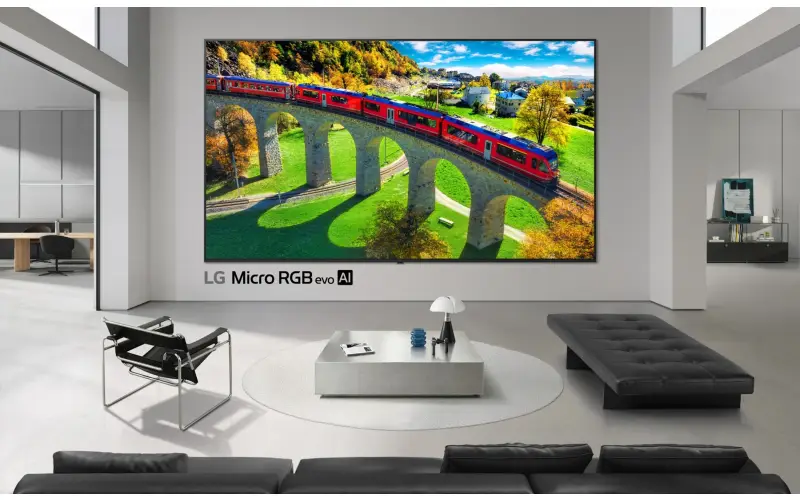
The LG Micro RGB evo is not just another Mini-LED TV. LG is positioning it as something fundamentally different: an LCD display that borrows OLED-grade precision and applies it to RGB backlighting.
According to LG, Micro RGB evo:
-
Uses LG’s smallest individual RGB LEDs to date
-
Applies OLED-derived AI processing to control each RGB backlight cluster
-
Is powered by the α11 AI Processor Gen 3, the same processing lineage used in flagship OLEDs like the G-series
In other words, LG isn’t treating this as “just another LCD.” They’re treating it as an evolution of display technology, informed by over a decade of OLED dominance.
The Black Level Question: OLED’s Last Unchallenged Advantage
For years, display purists have made one argument over and over again:
“OLED wins because black is truly black.”
And they’ve been right.
OLED’s ability to turn individual pixels completely off has made it the gold standard for:
-
Black level depth
-
Shadow detail
-
Perceived contrast
-
HDR realism
Mini-LED, no matter how bright or colorful, has always struggled here. Blooming, haloing, and lifted blacks remain the Achilles’ heel of even the best LCD TVs.
But here’s the critical question CES 2026 may finally answer:
What happens if RGB Mini-LED closes the black-level gap?
LG claims Micro RGB evo combines:
-
Over 1,000 precision dimming zones
-
Micro Dimming Ultra algorithms
-
OLED-grade AI luminance control
If LG can meaningfully suppress blooming while maintaining high peak brightness and near-OLED black levels, we could see the beginning of a real industry shift.
Not the death of OLED — but the end of OLED’s uncontested dominance.
Why This Matters More Coming From LG
Here’s the uncomfortable truth:
LG’s Mini-LED TVs have historically been… underwhelming.
Take the LG QNED92A (2025):
-
73% CE Critic Score
-
Middling local dimming
-
Poor contrast consistency
-
Weak performance compared to competitors at similar price points
Compare that to LG’s OLED lineup:
-
LG G5 OLED — CE Critic Scores in the 90s, Elite Award winner
-
LG C5 OLED — Consistently high-90s scores, category benchmark
LG has been an OLED powerhouse — but a Mini-LED disappointment.
That’s why Micro RGB evo matters so much. This is LG effectively admitting:
“Our old Mini-LED approach wasn’t good enough.”
And that’s a good thing.
Not All RGB Mini-LED Is the Same
As excitement builds, it’s critical to understand that “RGB Mini-LED” is not a single standard.
Key differences across manufacturers include:
-
LED size and density
-
Zone count and layout
-
Dimming algorithms
-
Color management pipelines
-
Processor sophistication
For example:
-
TCL’s RGB TVs boast 5,000+ dimming zones, emphasizing brute force
-
Samsung focuses on brightness and color volume
-
Hisense leans into screen size and spectacle
-
Sony emphasizes color science and tone mapping
-
LG is betting on precision, processing, and black-level control
Same buzzword. Very different philosophies.
LG’s OLED-Inspired Processing Advantage
The α11 AI Processor Gen 3 is central to LG’s strategy.
This processor enables:
-
Dual AI upscaling paths
-
Real-time RGB channel optimization
-
Scene-aware luminance mapping
-
Improved shadow detail without crushing blacks
This matters because RGB Mini-LED generates more raw data than traditional backlights. Without intelligent processing, that data is wasted — or worse, mismanaged.
LG’s OLED processors are already widely regarded as some of the best in the industry. Applying that expertise to RGB Mini-LED could give LG a unique edge competitors may struggle to replicate.
Color Performance: Where RGB Mini-LED Really Shines
LG claims the Micro RGB evo is certified by Intertek for:
-
100% BT.2020
-
100% DCI-P3
-
100% Adobe RGB
That’s not just impressive — it’s borderline absurd for an LCD TV.
If accurate, this places Micro RGB evo among the most color-capable consumer displays ever announced, rivaling professional reference monitors in certain respects.
For:
-
HDR cinema
-
Gaming
-
Color-critical workflows
-
Next-gen content mastering
This level of color purity could be transformative.
OLED vs RGB Mini-LED: A Coming Shift?
Let’s be clear: OLED isn’t going anywhere.
But if RGB Mini-LED can deliver:
-
Near-OLED black levels
-
Significantly higher peak brightness
-
No burn-in concerns
-
Larger sizes at lower cost
Then the conversation changes.
Consumers may no longer default to OLED as the only premium option. Instead, we may see a bifurcation:
-
OLED for absolute contrast purists
-
RGB Mini-LED for brightness, size, and versatility
And that’s a win for consumers.
Sizes, Positioning, and Availability
LG will offer the Micro RGB evo in:
-
100-inch
-
86-inch
-
75-inch
These sizes signal intent. LG isn’t testing the waters — it’s targeting flagship buyers, home theater enthusiasts, and early adopters.
Pricing hasn’t been announced, but expectations are:
-
Premium pricing at launch
-
Likely below MicroLED
-
Possibly competitive with flagship OLEDs at similar sizes
CES 2026 will provide the first real hands-on impressions.
The Industry at an Inflection Point
Between:
-
Samsung’s RGB push
-
TCL’s aggressive zone counts
-
Hisense’s spectacle-driven approach
-
Sony’s color science
-
LG’s OLED-inspired precision
It’s clear the industry is converging on a belief:
The future of LCD isn’t white or blue — it’s RGB.
And if RGB Mini-LED can finally erode OLED’s biggest advantage, we may look back on CES 2026 as the moment everything changed.
Final Thoughts: A Win for Consumers, Regardless
Whether LG’s Micro RGB evo lives up to its promises remains to be seen. LG’s recent Mini-LED track record gives reason for skepticism — but its OLED dominance gives reason for optimism.
If LG succeeds:
-
OLED competition intensifies
-
Prices stabilize or fall
-
Innovation accelerates
-
Consumers win
If LG fails:
-
OLED remains king
-
Competitors refine their RGB approaches
-
The technology still moves forward
Either way, one thing is clear:
The RGB Mini-LED wars have begun.
And for the first time in years, OLED finally has something real to worry about.