By: Dipin Sehdev
More and more audio brands are trying to solve the same problem: how do you turn a collection of standalone wireless speakers into a coherent, whole-home system without forcing users to replace everything they already own? Marshall’s answer is Heddon, a compact streaming hub designed to bring synchronized, multi-room audio to the company’s existing Bluetooth speaker lineup.
On paper, it’s a smart move—and a necessary one. Multi-room ecosystems have become table stakes in home audio, with established players like BluSound, WiiM, and Eversolo already offering mature, deeply integrated platforms built around Wi-Fi, high-resolution streaming, and robust app control. Marshall is arriving later to the party, but with a different approach that leans heavily on Auracast, Bluetooth’s next-generation broadcast standard.
Whether that approach holds up in real-world use is something only time—and reviews—will tell.
What the Marshall Heddon Is (and Isn’t)
At its core, the Heddon is not a speaker. It’s a streaming and synchronization hub, priced at $299.99, that acts as a bridge between modern streaming services and Marshall’s Bluetooth-only speakers. Once installed, Heddon connects to your home network via Wi-Fi (or Ethernet), pulls in audio from supported services, and then rebroadcasts that audio to compatible Marshall speakers using Auracast.
This is a key distinction. Unlike Sonos, BluSound, or WiiM systems—where speakers themselves are Wi-Fi endpoints—Marshall’s speakers remain Bluetooth devices. Heddon essentially acts as a traffic controller, handling the heavy lifting centrally and distributing audio wirelessly from one point.
That architecture has pros and cons. Centralization simplifies setup and extends the life of older hardware, but it also introduces a single point of dependency. If Heddon goes down, the whole system goes quiet.
Auracast as the Backbone
Auracast is one of the more interesting aspects of Heddon. Built on Bluetooth LE Audio, Auracast allows a single source to broadcast audio to multiple receivers simultaneously, with improved synchronization and lower latency compared to traditional Bluetooth pairing.
In theory, this makes Auracast well-suited for multi-room playback—especially for brands like Marshall that already have a large installed base of Bluetooth speakers. In practice, Auracast is still relatively new in consumer audio. Adoption is growing, but it hasn’t yet been battle-tested at the scale Wi-Fi-based systems have enjoyed for years.
Marshall is clearly betting that Auracast will mature quickly. Heddon positions the company to take advantage of that evolution without redesigning its entire speaker lineup.
Streaming Support and Connectivity
Heddon supports a solid lineup of modern streaming protocols:
-
Spotify Connect
-
TIDAL
-
Apple AirPlay 2
-
Google Cast
That puts it on fairly even footing with competitors in terms of service compatibility, at least for mainstream streaming. Playback and system management are handled through the Marshall app, which acts as the control center for grouping speakers, managing rooms, and selecting sources.
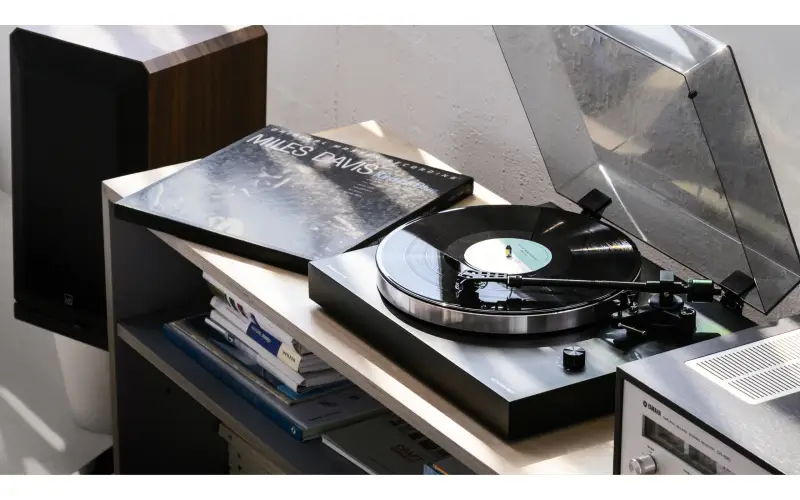
On the physical side, Heddon includes RCA inputs and outputs, which significantly expands its usefulness. You can connect a turntable (via an external phono stage), CD player, or other analog source and distribute that audio across multiple rooms. You can also use the RCA output to bring older, non-wireless Marshall speakers into the same synchronized system.
This hybrid approach—combining streaming, Bluetooth broadcast, and analog I/O—is one of Heddon’s strongest features and helps differentiate it from simpler Bluetooth-only solutions.
Compatible Speakers (At Launch)
At launch, Heddon supports synchronized playback with:
-
Marshall Acton III
-
Marshall Stanmore III
-
Marshall Woburn III
Marshall has also indicated that some older models can be integrated via RCA connections, allowing them to remain part of the system even if they don’t support Auracast natively. That backward compatibility is a meaningful value add, particularly for long-time Marshall owners.
Design and Usability
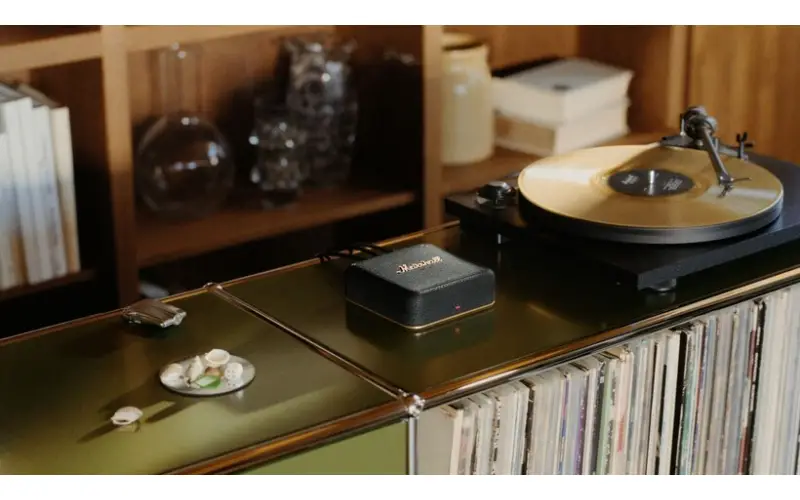
Physically, Heddon is understated. It’s a compact, square unit—roughly the footprint of a small streaming box—wrapped in Marshall’s familiar black, textured finish with a subtle logo on the front. There are no knobs or displays to speak of; the device is designed to disappear into a rack or shelf and be controlled almost entirely through software.
That minimalism aligns with Marshall’s brand identity, but it also puts pressure on the app experience. As BluSound and WiiM have shown, a polished, stable control app is just as important as hardware when building an ecosystem. This is an area where Marshall is playing catch-up.
Ecosystem Reality Check
It’s impossible to talk about Heddon without addressing the broader ecosystem question. Building a multi-room platform isn’t just about launching a hub—it’s about long-term software support, feature expansion, reliability, and responsiveness to user feedback.
Brands like BluSound have spent years refining their platforms. WiiM has gained a reputation for aggressive updates and fast feature rollouts. Eversolo has leaned into high-end hardware paired with rapidly evolving software.
Marshall is entering this space with a promising concept, but also with real competition that has a significant head start. On paper, Heddon checks many of the right boxes. In practice, its success will depend on how well Auracast performs in real homes, how robust the Marshall app proves to be, and how quickly the company iterates based on user feedback.
As Gustaf Living Rosell, Marshall’s Chief Product and Innovation Officer, puts it:
“Music listening habits keep evolving, and Heddon is designed to evolve with them. We see Heddon as a living platform.”
That’s an encouraging statement—but one that sets expectations high.
Pricing, Promotions, and Availability
-
Price:
-
$299.99 (US)
-
£179.99 (UK)
-
€199 (EU)
-
-
Availability:
-
Available starting January 21, 2026
-
Sold via marshall.com and select retailers
-
-
Promotions:
-
Buy an Acton III, Stanmore III, or Woburn III and get Heddon 50% off
-
Buy two or more eligible Marshall home speakers and receive Heddon free
-
Those incentives clearly signal Marshall’s intent to accelerate adoption and seed its ecosystem quickly.
The Bottom Line
The Marshall Heddon is a thoughtful, well-timed attempt to bring multi-room audio to a speaker lineup that has long been locked into Bluetooth-only use. It extends the life of existing products, introduces modern streaming support, and embraces Auracast as a forward-looking alternative to Wi-Fi-based speaker networks.
Still, ecosystems aren’t judged by spec sheets. They’re judged by stability, ease of use, and how well they hold up six months—or two years—down the line. Marshall has laid solid groundwork here, but it’s entering a crowded, competitive space where execution matters more than ambition.
Heddon looks good on paper. Now we wait to see how it performs where it really counts: in real homes, with real users, and real expectations.