By: Dipin Sehdev
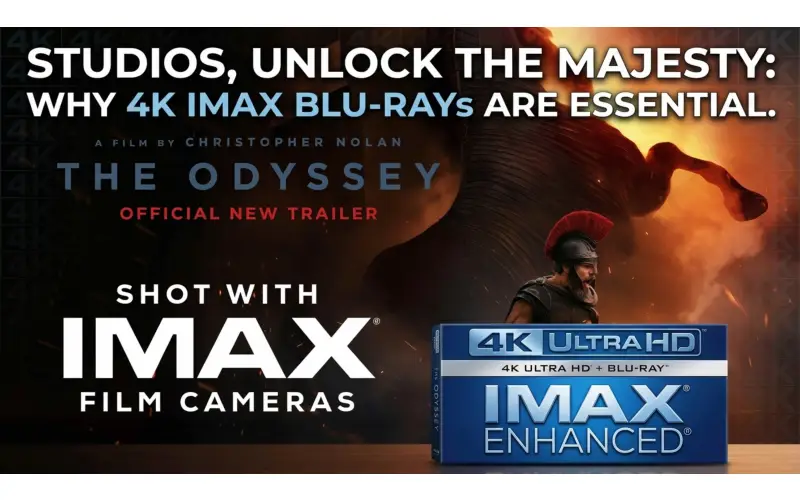
Two weeks after watching Christopher Nolan's The Odyssey, I still haven't stopped thinking about it. It's one of those rare films that stays with you long after the credits roll. The performances, the cinematography, Ludwig Göransson's incredible score, and Nolan's meticulous storytelling all come together to create what I genuinely believe is a masterpiece.
But there was another reason the experience felt so special. I watched it in 70mm IMAX, presented in its towering 1.43:1 aspect ratio.
It's cinema at its absolute best. Walking out of the theater, I immediately knew one thing: I'm buying this movie on 4K Blu-ray the day it's released. Then I started wondering... Will I actually be getting the same movie I just watched? Unfortunately, history suggests the answer may be no.
Experiencing 1.43:1 IMAX Is a Privilege Most People Don't Have
As incredible as The Odyssey was, there's another reality that's easy to overlook: very few people will ever get to experience it the way Christopher Nolan intended.
True 1.43:1 IMAX presentations require specialized 70mm IMAX projection systems or dual-laser IMAX theaters capable of displaying the full image. There are only a handful of those theaters across North America, and even fewer around the world. I consider myself incredibly fortunate to live in Georgia, where the Regal Mall of Georgia offers one of these rare 70mm IMAX experiences. For many movie fans, seeing The Odyssey in its full 1.43:1 glory simply isn't an option, they either don't live near one of these theaters or couldn't get tickets before screenings sold out.
That's exactly why preserving these films on 4K Blu-ray is so important.
No, a home theater can't replicate a six-story IMAX screen. But it can preserve the composition, framing, and visual storytelling that directors like Christopher Nolan spend years crafting. Giving collectors access to the expanded IMAX aspect ratio allows millions of fans to experience far more of the image than they would otherwise ever see. If the theatrical presentation is limited to a relatively small number of premium venues, then the physical release becomes the best opportunity to share that vision with the widest audience possible.
For many people, a properly authored 4K Blu-ray with the IMAX presentation won't just be the best way they'll ever watch the movie, it will be the only way they'll ever experience those expanded scenes at all.
IMAX on Disc Is Still Surprisingly Rare
Over the last decade, filmmakers like Christopher Nolan, Denis Villeneuve, Ryan Coogler, Joseph Kosinski, and the Russo Brothers have increasingly embraced IMAX cameras to capture breathtaking imagery. Yet when those films arrive on physical media, many lose their expanded IMAX presentation. Instead, collectors receive a standard widescreen version, even though much more image exists. Thankfully, there are some notable exceptions.
Movies That Include IMAX Sequences on 4K Blu-ray
If you're building a home theater and want to experience IMAX at home, these are among the best releases available:
| Movie | IMAX Expanded Aspect Ratio on Disc |
|---|---|
| The Dark Knight | Yes (1.43:1 scenes) |
| The Dark Knight Rises | Yes |
| Interstellar | Yes |
| Dunkirk | Yes |
| Tenet | Yes |
| Oppenheimer | Yes |
| Batman v Superman: Dawn of Justice | Yes |
| Zack Snyder's Justice League | Full 1.33:1 presentation |
| Mission: Impossible – Fallout | Yes |
| Mission: Impossible – Dead Reckoning | Yes |
| Top Gun: Maverick | Yes |
| Nope | Yes |
| First Man | Yes |
| Hail Mary (upcoming SteelBook) | Confirmed IMAX presentation |
| The Hunger Games: Catching Fire | Yes (IMAX scenes) |
That's a respectable list, but it should be much longer.
Many films shot using IMAX cameras never include those expanded scenes on Blu-ray or UHD Blu-ray.
It's Not a Disc Capacity Problem
When I first started researching this, I assumed there had to be a technical limitation. Maybe IMAX footage simply required too much storage. It turns out that's largely a myth.
A standard Ultra HD Blu-ray supports:
- 66GB dual-layer discs
- 100GB triple-layer discs
Modern HEVC (H.265) compression is remarkably efficient. Changing aspect ratios throughout a film doesn't significantly increase storage requirements because you're revealing more of the original image, not creating an entirely separate version of the movie.
Many 4K Blu-rays already include:
- Dolby Vision
- HDR10
- Dolby Atmos
- DTS:X
- Multiple audio tracks
- Bonus documentaries
- Deleted scenes
- Commentary tracks
Yet they still fit comfortably on a 100GB disc. In other words...The technology isn't what's stopping studios.
Streaming Isn't the Answer
Some studios have begun offering IMAX Enhanced versions through streaming services like Disney+. That's certainly appreciated. But for collectors, cinephiles, and home theater enthusiasts, streaming is still a compromise.
Even the best streaming services use significantly more compression than Ultra HD Blu-ray. A typical 4K stream may average 15–30 Mbps, occasionally peaking higher. A UHD Blu-ray can sustain 80–100 Mbps, with peaks approaching 128 Mbps.
That translates into:
- Better fine detail
- Less compression noise
- Cleaner gradients
- Higher bitrate Dolby Atmos audio
- More consistent HDR performance
If I'm spending thousands of dollars on an OLED television, projector, AV processor, speakers, and amplifiers, I want the best possible version of the film. Not the most convenient one.
Could Virtual Reality Become IMAX's Second Theater?
Ironically, there is a way to experience something remarkably close to a full-size IMAX presentation at home today, but it requires an Apple Vision Pro.
The IMAX app on Apple's headset recreates the feeling of sitting in a massive IMAX auditorium, complete with a towering virtual screen that fills much of your field of view. While it can't replicate the sheer physical scale of a six-story 70mm IMAX theater, it's arguably the closest most people can get without traveling to one of the handful of true IMAX venues.
Imagine if studios released IMAX versions of their films not only on 4K Blu-ray, but also in a dedicated VR format optimized for headsets like the Apple Vision Pro and future devices from Samsung, Meta, or Google. Suddenly, millions of people who live hundreds of miles from a true 1.43:1 IMAX theater could experience these movies in a way that feels dramatically closer to the theatrical presentation.
Would it replace a real 70mm IMAX screening? Absolutely not.
Nothing replaces the scale, projection quality, and shared experience of sitting inside one of the world's best IMAX theaters.
But VR has the unique ability to recreate something that no television can: the size of the image. A 98-inch TV or even a projection system still occupies only a portion of your room. A properly designed virtual IMAX theater can make the screen feel hundreds of feet wide, restoring much of the immersion that directors like Christopher Nolan, Denis Villeneuve, and Ryan Coogler intended.
The best part is that these ideas don't have to compete with each other.
Studios should absolutely continue releasing expanded IMAX presentations on 4K Blu-ray for home theater enthusiasts who want the highest possible picture quality and lossless Dolby Atmos audio. At the same time, IMAX could embrace VR as a complementary platform, one that finally gives movie fans around the world access to the scale and composition that have traditionally been reserved for a small number of premium theaters.
If the future of cinema is about making great experiences more accessible, then physical media and virtual reality may end up being two of IMAX's biggest opportunities.
Studios Already Did the Hard Work
This is what frustrates me most. Directors and cinematographers spend years planning these IMAX sequences. Studios invest millions shooting with expensive IMAX cameras. Entire marketing campaigns revolve around "Filmed for IMAX." Audiences pay premium ticket prices to experience those expanded images. Then the physical release arrives and suddenly those scenes disappear. After all that effort, why not preserve the filmmaker's work for collectors?
Christopher Nolan Showed What's Possible
Christopher Nolan has been one of the biggest champions of physical media. Nearly every one of his recent releases has preserved IMAX sequences on disc. Watching Interstellar, Dunkirk, Tenet, or Oppenheimer at home still delivers much of the magic experienced in an IMAX theater because the aspect ratio expands exactly when Nolan intended. That's how physical media should be treated. Not as an afterthought.
This Is My Plea to Hollywood
I sincerely hope The Odyssey receives the same treatment. More importantly, I hope it starts a broader trend. The recently announced Project Hail Mary SteelBook (Pre-Order Here), including the IMAX version, is encouraging because it proves studios know collectors care. Let's make that the standard.
Physical media enthusiasts aren't asking for exclusive bonus features or elaborate collector's packaging. We're simply asking for the version of the movie the filmmakers actually created. If a film was shot for IMAX, give us the IMAX version.
We bought the television. We built the home theater. We invested in Dolby Atmos speakers and 4K projectors because we care about experiencing films the way directors intended. Now it's time for studios to meet us halfway. Because if there's one thing The Odyssey reminded me, it's that some movies deserve to be experienced at their absolute best, not just in the theater, but every time we press play at home.