By: Dipin Sehdev
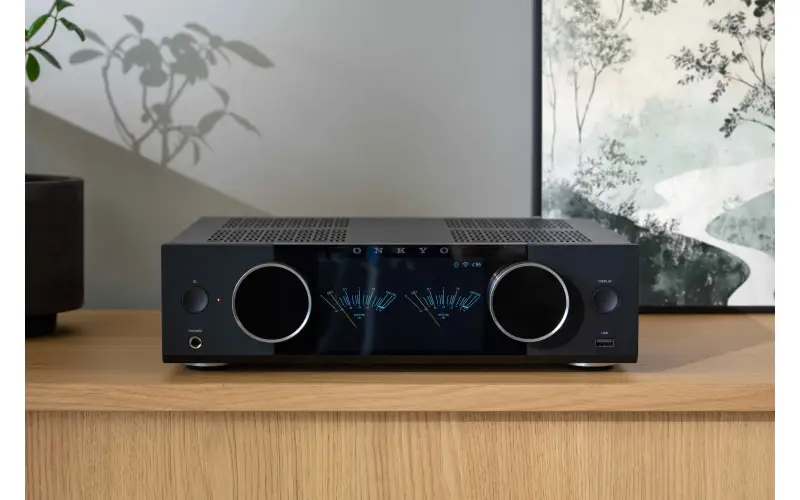
There’s something genuinely satisfying about seeing a legacy hi-fi brand get its moment right. At CES 2026, Onkyo didn’t just show up to celebrate its 80th anniversary—it showed up with intent. The new Onkyo Muse Series, led by the Y-50 and Y-40 network integrated amplifiers, feels like a confident step forward rather than a nostalgic look back.
I had the chance to hear the Muse Series in person at CES, and the first impression was immediate: these amps sound far bigger than their compact footprints suggest. Just as important, they feel right. The chassis is solid, the fit and finish are excellent, and the volume knobs—yes, the knobs—have that reassuring resistance and weight that reminds you this is hi-fi hardware, not a disposable gadget. It’s clear Onkyo spent time thinking about the physical interaction, not just the spec sheet.
A Streaming Amplifier That Respects Hi-Fi Roots
The Muse Series is built around a simple idea: deliver a true two-channel hi-fi experience without forcing users into stacks of boxes. Both models combine amplification, DAC, streaming, and connectivity into a single, compact chassis. Just add speakers and sources, and you’re off.
Under the hood, both the Y-50 and Y-40 use fully digital circuits paired with Axign Class D amplification and high-current MOSFET output stages. Class D has come a long way, and Onkyo is clearly leaning into its strengths here—speed, efficiency, and control—without losing musicality. At the show, the Muse amps delivered a clean, authoritative sound with good weight through the low end and a surprisingly spacious presentation for their size.
A large part of the appeal is usability. Dominating the front panel is a 5.46-inch color LCD display that shows album art, track metadata, and even an analog-style VU meter if you’re feeling nostalgic. It’s functional, legible from across the room, and honestly just fun to look at. This isn’t a screen bolted on for marketing—it actually improves the day-to-day experience.
Muse Y-50: Power, Control, and Room EQ
The Muse Y-50 is the flagship of the series and the model that will likely appeal to users with larger speakers or more demanding setups. It’s rated at 250 watts per channel into 4 ohms, which is serious output for an integrated amplifier of this size. Onkyo claims it can comfortably drive speakers of virtually any size, and based on what I heard at CES, that doesn’t feel like a stretch.
One of the Y-50’s standout features is Onkyo Room EQ, a built-in room calibration system designed to optimize sound based on your listening environment. This is becoming increasingly important as more people run hi-fi systems in real living spaces rather than dedicated listening rooms. The goal here isn’t to overcorrect or sterilize the sound, but to smooth out room-induced issues and let the amp and speakers perform at their best.
Connectivity is comprehensive:
-
Three pairs of analog RCA inputs
-
Digital coaxial input
-
HDMI ARC input (with HDMI output for TV and gaming audio)
-
MM/MC phono stage
-
Subwoofer pre-out
-
Ethernet and Wi-Fi
-
Upgraded speaker terminals
-
6.3mm headphone jack
Streaming support includes Spotify Connect, TIDAL Connect, Qobuz Connect, Chromecast, and AirPlay 2, all managed via the Onkyo Controller app. In practice, this makes the Y-50 a true hub—TV, turntable, streaming, and traditional sources all handled cleanly in one box.
Muse Y-40: The Sweet Spot for Most Systems
The Muse Y-40 takes the same core design language and streaming platform and packages it into a more affordable, slightly lower-powered option. It delivers 150 watts per channel into 4 ohms, which is still plenty for most bookshelf and floorstanding speakers.
The Y-40 shares the same 5.46-inch display, streaming services, and overall interface as the Y-50, but skips the built-in Room EQ. For many users—especially those with simpler rooms or near-field setups—that won’t be a dealbreaker. In fact, I suspect the Y-40 will end up being the volume seller in the lineup thanks to its balance of power, features, and price.
Connectivity mirrors the Y-50 closely, including HDMI ARC, phono input, coaxial digital input, Ethernet, Wi-Fi, and a headphone output. In short, it’s a modern integrated amplifier that doesn’t feel compromised.
Design Details That Matter
Beyond sound and features, the Muse Series gets the tactile details right. The newly designed volume knob feels excellent—smooth rotation, just enough resistance, and no wobble. The top panel vents feature a traditional Japanese “San Kuzushi” pattern, a subtle nod to Onkyo’s heritage that adds visual interest without becoming gimmicky.
The amps are available in black or silver, both understated and easy to integrate into modern living spaces. They look premium without screaming for attention, which is exactly what you want from hi-fi gear meant to live in shared rooms.
Limited-Edition 80th Anniversary Model
To mark its 80th anniversary, Onkyo is also planning a limited-edition Muse amplifier, inspired by the classic M-588 power amplifier. This version features a champagne-gold aluminum chassis with real walnut side panels, and is positioned as a flagship expression of Onkyo’s past meeting its future.
Only 1,000 units worldwide are planned, with availability expected in summer 2026. Pricing hasn’t been announced yet, but it’s safe to assume this will sit above the standard Muse models.
Pricing and Availability
-
Muse Y-50: $1,499 (US)
-
Muse Y-40: $999 (US)
-
Availability: May 2026
-
Limited 80th Anniversary Muse model: Summer 2026 (price TBA)
Final Thoughts
The Onkyo Muse Series feels like a product line built by people who actually use hi-fi systems. It balances modern streaming convenience with genuine amplifier performance, solid build quality, and thoughtful design touches. After hearing them at CES, I’m genuinely excited to see how these perform in longer-term reviews and real-world systems.
If this is what Onkyo’s “rebirth” looks like, the Muse Series is a strong statement—and a promising sign of what’s next.
Onkyo Muse Series Comparison
| Feature | Muse Y-50 | Muse Y-40 |
|---|---|---|
| Product Type | Network Integrated Amplifier | Network Integrated Amplifier |
| Amplifier Topology | Full Digital Circuit, Axign Class D with MOSFET output | Full Digital Circuit, Axign Class D with MOSFET output |
| Power Output | 250 W per channel @ 4Ω | 150 W per channel @ 4Ω |
| Room Calibration | Onkyo Room EQ (built-in) | — |
| DAC | Integrated high-resolution DAC | Integrated high-resolution DAC |
| Display | 5.46" Color LCD with metadata & analog-style VU meter | 5.46" Color LCD with metadata & analog-style VU meter |
| Streaming Services | Spotify Connect, TIDAL Connect, Qobuz Connect, Chromecast, AirPlay 2 | Spotify Connect, TIDAL Connect, Qobuz Connect, Chromecast, AirPlay 2 |
| Network Connectivity | Ethernet & Wi-Fi | Ethernet & Wi-Fi |
| HDMI | HDMI ARC input + HDMI output | HDMI ARC input |
| Analog Inputs | 3 × RCA line-level | 3 × RCA line-level |
| Digital Inputs | Coaxial | Coaxial |
| Phono Stage | MM / MC compatible | MM compatible |
| Subwoofer Output | Yes | Yes |
| Headphone Output | 6.3 mm | 6.3 mm |
| Speaker Terminals | Upgraded binding posts | Standard binding posts |
| Finish Options | Black or Silver | Black or Silver |
| Control App | Onkyo Controller App | Onkyo Controller App |
| MSRP (US) | $1,499 | $999 |
| Availability | May 2026 | May 2026 |