By: Dipin Sehdev
Artificial intelligence has officially reached the point of no return. It’s in our phones, our laptops, our smart speakers, our cars, and increasingly, in our homes. Now, Microsoft and Samsung are pushing it onto the biggest screen of them all: your television.
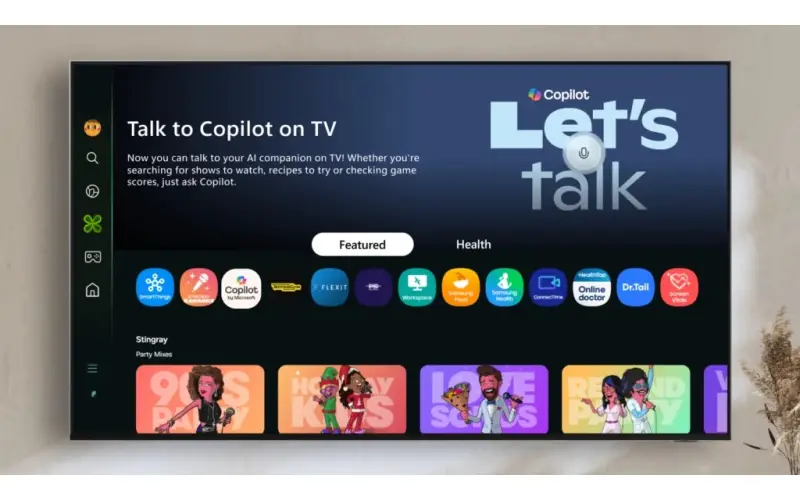
This year, Samsung is rolling out Microsoft’s Copilot AI assistant to its 2025 TV and monitor lineup. That means whether you’re watching the latest blockbuster, re-watching a favorite series, or just flipping channels, an animated, voice-powered AI companion will be standing by to “help.”
The promise? A TV that’s smarter, friendlier, and more personal. The reality? Another AI service you never asked for—and one you’ll only avoid if you refuse to update your Samsung TV.
AI Is Everywhere—And Now It’s on Your TV
There’s no escaping it: AI is everywhere, and television is simply the next frontier. For years, TV makers have been racing to differentiate their “smart” platforms. Samsung built Bixby into its TVs, LG leaned on Google Assistant and Alexa before pulling back, and Google TV has its own Gemini integration.
Now Microsoft is joining the living room arms race with Copilot, its AI assistant that has already taken over Windows PCs, Office apps, and mobile devices. By putting Copilot on TVs, Microsoft and Samsung argue they’re turning your TV into a social hub—a place where families and friends can watch together, ask questions, plan weekends, or even get cheered up after a breakup.
But let’s be honest: did anyone actually ask for this?
Different From Samsung’s Own AI
What makes Copilot’s arrival even more interesting is that Samsung has already been hyping its own AI technology across its 2025 TVs. Samsung’s in-house AI—baked into its Neo QLEDs, OLEDs, and even The Frame—is focused on picture and sound. Think AI-powered upscaling, automatic brightness adjustments, scene detection, and sound optimization.
That’s very different from Copilot. Instead of fine-tuning image quality or making sports sound more immersive, Copilot is a conversational assistant designed to answer questions, recommend shows, and provide spoiler-free recaps. One AI wants to make your picture better. The other wants to talk to you about The Crown.
So now Samsung TVs will have two layers of AI: one handling performance behind the scenes, and one showing up on screen with an animated avatar. That overlap raises a question: does anyone really want both?
What Copilot Can Do
According to Microsoft, Copilot on Samsung TVs isn’t just about shouting “Play Stranger Things” into your remote. The assistant can:
-
Provide spoiler-free recaps: Pick up a series where you left off by asking Copilot what you missed.
-
Offer ultra-specific recommendations: Ask for “a movie like The Queen’s Gambit, but about cooking instead of chess, and under two hours.”
-
Mediate group choices: Give Copilot the preferences of multiple people—rom-com, sci-fi, thriller—and it’ll try to find something everyone might like.
-
Deliver trivia and deep dives: Curious about the voice actor behind a character or what else a director has done? Copilot will dig it up.
-
Handle everyday questions: From weekend weather forecasts to mood-boosting suggestions, Copilot wants to be your living room companion.
Visually, Copilot isn’t just a voice. It’s an animated, lip-synced avatar that reacts with expressions while presenting results as large, card-style visuals—perfect for a big-screen experience.
Which TVs Get Copilot—and When
Copilot isn’t arriving as a future product teaser. It’s here now. Microsoft says the rollout has already begun on Samsung’s 2025 TV and monitor lineup, including:
-
Neo QLED TVs
-
OLED TVs
-
The Frame and The Frame Pro
-
Micro RGB models
-
M7, M8, and M9 Smart Monitors
The app will appear on the Samsung Daily+ home screen, inside the Tizen OS interface. You’ll also be able to activate it by pressing the microphone button on your Samsung remote.
The rollout covers select regions, including the U.S., and Microsoft says older TV models may be added later.
So unless you go out of your way to block software updates, Copilot will simply show up one day on your Samsung TV—whether you like it or not.
The Only Escape: Don’t Update
Samsung has confirmed that Copilot arrives via software update. That means the only guaranteed way to avoid Microsoft’s AI on your TV is to skip system updates altogether.
Of course, there’s a tradeoff. Refusing updates means missing out on important bug fixes, security patches, and even picture improvements. But for those who prefer their TVs without an animated AI avatar listening in, it might be the only option.
Déjà Vu: Remember Google Assistant?
It’s worth pointing out that AI assistants on TVs haven’t always had staying power. Remember when LG and Samsung both shipped TVs with Google Assistant deeply integrated? Just this year, LG announced that it’s pulling Google Assistant support from its TVs altogether. Samsung has also quietly dialed back features.
So, while Microsoft and Samsung are now hyping Copilot as the future of living room entertainment, there’s no guarantee it’ll stick around for the long term.
Who Actually Wants This?
That’s the real question. Voice assistants have had a mixed reception on TVs. Many users still prefer a physical remote or on-screen menus. Adding AI-generated recommendations, animated characters, and group-based watch suggestions might sound futuristic, but it also risks being intrusive.
There’s also the question of redundancy. Between Bixby, Alexa, Google TV’s Gemini, and now Microsoft Copilot, consumers are faced with a crowded AI landscape. Do we really need yet another assistant competing for our attention in the living room?
Or is this more about Microsoft and Samsung proving they can integrate AI everywhere—even if nobody asked for it?
The Bigger Picture: AI Is Everything
Whether you welcome it or not, Copilot on Samsung TVs is just another step in the inevitable march of AI into every corner of daily life. Microsoft has been clear: its ambition is to make Copilot the default interface across all devices, from PCs to phones to cars. Samsung, for its part, is eager to show it’s not just making better displays—it’s making “smarter” displays.
We’re past the point where AI is an optional add-on. It’s becoming the default. And as TVs join the list of AI-enabled devices, it’s clear there’s no escaping it. The only choice left is whether to embrace it—or turn off updates and resist it for as long as possible.
Final Thoughts
The arrival of Microsoft Copilot on Samsung TVs feels like both an evolution and a provocation. On one hand, it shows just how seriously both companies are treating AI as the future of consumer tech. On the other, it raises the uncomfortable question of whether consumers actually want AI avatars mediating their living room experiences.
If history is any guide, Copilot might end up like Google Assistant—heavily marketed, briefly popular, and eventually abandoned. But for now, AI has officially taken over your TV. And unless you opt out, it’s here to stay.
? Samsung 2025 TVs & Monitors with Microsoft Copilot
| Category | Models | Copilot Availability |
|---|---|---|
| Neo QLED TVs | Full 2025 lineup (4K & 8K) | Rolling out now via software update |
| OLED TVs | S95D, S90D, and other 2025 OLED models | Rolling out now via software update |
| Micro RGB TVs | New 2025 Micro RGB flagship models | Rolling out now via software update |
| The Frame | The Frame (2025) and The Frame Pro | Rolling out now via software update |
| Smart Monitors | 2025 M7, M8, and M9 series | Rolling out now via software update |
| Future Models | Select older Samsung TVs (TBA) | Expansion planned in later updates |