By: Dipin Sehdev
Spotify has always positioned itself as more than just a music streaming app. For many, it’s a cultural hub—a place where new artists are discovered, playlists are shared, and music sparks conversations across generations and geographies. Sharing music, after all, is one of the simplest and most powerful ways people connect with each other. A song passed between friends can hold more weight than a dozen text messages.
Now, Spotify is taking that idea and baking it directly into the app. This week, the company announced the launch of Spotify Messages, a direct messaging feature that allows users to share songs, podcasts, and audiobooks without ever leaving the platform. It marks the first time Spotify has rolled out a native, built-in DM system—something many social platforms have had for years, but music services have generally avoided.
The feature begins rolling out in select markets this week, with availability on mobile devices for both Free and Premium users aged 16 and older.
It’s an interesting move, and while it certainly has potential, it also raises a bigger question: Is this really what Spotify users have been waiting for—or is it yet another feature that feels like a distraction from the company’s long-delayed promise of Spotify HiFi?
A First for Spotify: Built-In Messaging
While Spotify has long supported sharing content through other apps like Instagram, WhatsApp, or Snapchat, this is the first time it’s introducing a native messaging system of its own.
Here’s how it works:
-
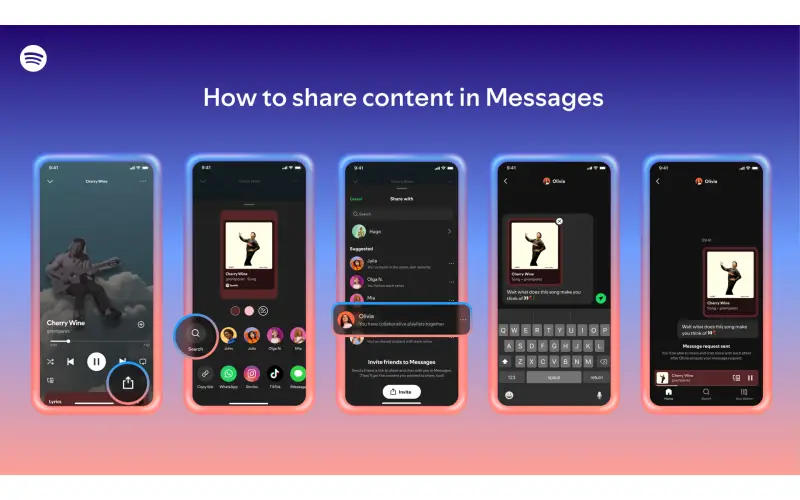
When listening to a track, podcast, or audiobook, users can tap the share icon in the Now Playing view and select a friend to send it to.
-
Messages can only be sent to people you’ve previously interacted with on Spotify—such as through Jams, Blends, Collaborative Playlists, or shared family/duo plans.
-
Once connected, users can exchange content, react with emojis, and carry on 1:1 text-based conversations.
-
All shared content is stored in a Messages inbox, accessed by tapping your profile picture in the top-left corner of the app.
Spotify emphasizes that the feature is designed for conversations users are already having about music, but now in a more organized and centralized way. Instead of sending a track link over iMessage or WhatsApp, Spotify wants those conversations to happen inside the app itself.
Music as a Social Glue
There’s no question that music is inherently social. Think about how people bond over playlists on a road trip, swap songs in group chats, or introduce each other to new artists. A single recommendation can spark an obsession, create a shared memory, or even define a friendship.
Spotify is clearly leaning into this truth. By offering built-in messaging, the company is trying to strengthen its role not just as a music service, but as a social platform centered around audio. The timing is also notable—at a moment when other social platforms like TikTok and Instagram are integrating music more deeply, Spotify is doing the reverse: adding social features to a music-first experience.
But the big question is whether users will actually adopt it. After all, Spotify isn’t the first place people think of when it comes to chatting. Most listeners already have well-established routines for sharing songs over iMessage, Instagram DMs, or even TikTok. Convincing users to move those interactions to Spotify will be a steep climb.
Privacy and Safety Considerations
Of course, with any messaging system comes the risk of abuse. Spotify says it’s building in industry-standard encryption for conversations, both in transit and at rest, and giving users granular control over who can message them.
-
Users can accept or reject message requests.
-
They can block or report accounts, as well as flag specific pieces of content.
-
Spotify will also proactively scan messages for unlawful or harmful content, with moderators reviewing flagged chats.
These measures are designed to prevent harassment, spam, or worse, but Spotify hasn’t clarified whether artist accounts will be able to use Messages to connect with fans—a potentially game-changing feature if implemented.
Complement, Not Replacement
Spotify insists that Messages is not meant to replace existing social integrations. You’ll still be able to share to Instagram Stories, Facebook, Snapchat, and TikTok just as before. Instead, the company frames the feature as a “complement”—a way to consolidate recommendations in one place while still benefiting from external networks.
For casual users, this could prove useful. Imagine swapping podcasts with your dad, sharing an audiobook with a book club, or sending your best friend a track that made you think of them—all in one dedicated inbox instead of buried among texts or social notifications.
Still, this is an experiment. Spotify hasn’t always had a stellar track record with social features. Past attempts, like its in-app “Stories” feature, never really caught on. Whether Messages sticks may depend less on the technology itself and more on whether Spotify users feel comfortable making the app a place for conversations, not just listening.
The Feature Rollout
Spotify Messages is rolling out starting this week, but only in select markets (Spotify hasn’t listed them yet). Both Free and Premium users will have access, provided they’re at least 16 years old.
The feature is mobile-first, meaning it will be available through the iOS and Android apps, though Spotify hasn’t confirmed whether desktop support is planned.
Meanwhile, Where’s Spotify HiFi?
It’s hard to talk about new Spotify features without bringing up the elephant in the room: Spotify HiFi.
First announced in 2021, HiFi was supposed to deliver lossless, CD-quality streaming, finally giving Spotify a way to compete with Apple Music, Tidal, Qobuz, and Amazon Music on audio quality. But nearly four years later, there’s still no sign of it.
And based on recent reporting, it doesn’t look like we’ll see it in 2025 either. Some industry watchers are even beginning to doubt if it will ever launch at all. Instead, Spotify has poured resources into podcasts, audiobooks, and social features like Messages.
For audiophiles and long-time Premium subscribers, that’s a tough pill to swallow. While competitors keep pushing into hi-res audio and immersive formats like Dolby Atmos, Spotify’s most loyal users are left wondering if the world’s most popular music streaming service will ever truly prioritize sound quality.
Will Users Actually Use It?
So the question remains: Will Spotify’s built-in messaging become an essential part of the platform, or will it join the list of underutilized features that fade quietly into the background?
There are arguments both ways. On one hand, consolidating recommendations in one inbox makes sense. People already share Spotify links constantly, and having them organized in-app could be genuinely helpful. On the other hand, entrenched behaviors are hard to break—most of us already have our go-to apps for chatting, and it’s unclear if Spotify can compete with them.
Spotify also faces the challenge of user perception. Many people see the app as a lean-back listening service, not a communication hub. Changing that perception will require more than just adding DMs—it may require a fundamental shift in how users think about Spotify.
Looking Ahead
Spotify Messages is an intriguing addition, one that underscores the company’s broader ambition to become not just a streaming app, but a community around audio. Whether it succeeds will depend on adoption, execution, and how seamlessly it integrates into people’s daily habits.
For now, it’s rolling out slowly, limited to select markets and mobile users. And while it might prove useful for some, it’s hard to ignore what’s missing: Spotify HiFi. After years of anticipation, many users would rather see lossless streaming than yet another social feature.
In the end, Spotify Messages feels like a step forward in building community, but also a reminder of the company’s shifting priorities. Sharing music may bring us together, but for audiophiles, high-quality streaming is what keeps us listening.