By: Dipin Sehdev
After nearly a decade of promises, Spotify has finally launched lossless audio for Premium subscribers. The rollout is underway in more than 50 markets, including the U.S., U.K., Germany, Japan, and Australia. While this marks a long-awaited upgrade for the world’s largest music streamer, there are caveats that highlight just how far Spotify lags behind competitors.
Most notably, Spotify’s new “lossless” tier isn’t true hi-res audio — it’s capped at CD-quality, 24-bit/44.1 kHz FLAC. In contrast, Apple Music, Tidal, Qobuz, Amazon Music, and Deezer all offer higher-resolution formats up to 24-bit/192 kHz. For serious audiophiles, Spotify’s late arrival feels more like a half-step than a revolution.
Why Lossless Matters
Lossless audio delivers music without the compression artifacts present in standard streaming formats. The result is cleaner dynamics, greater detail, and more transparency. For newcomers, it can make old favorites sound fresh again. But the tradeoff is larger file sizes, which means higher data usage — an important consideration for anyone streaming over mobile networks.
How Spotify Compares to Rivals
Spotify may have the largest subscriber base, but in audio quality it remains at the back of the pack. Here’s a snapshot of how the major players stack up:
| Service | Max Audio Quality | Price (USD/mo, Individual) | Notable Features |
|---|---|---|---|
| Spotify | Lossless CD quality (24/44.1) | $10.99 | AI playlists, DJ, Connect |
| Apple Music | Hi-Res up to 24/192 (ALAC) | $10.99 | Spatial Audio (Dolby Atmos), seamless Apple ecosystem |
| Tidal | Hi-Res up to 24/192 (FLAC/MQA) | $10.99 (HiFi), $19.99 (HiFi Plus) | Dolby Atmos, Sony 360 Reality Audio |
| Qobuz | Hi-Res up to 24/192 (FLAC) | $12.99 | Download-to-own store, editorial focus |
| Amazon Music Unlimited | Hi-Res up to 24/192 (FLAC) | $10.99 ($8.99 for Prime) | Alexa integration, broad catalog |
| Deezer | Hi-Fi up to 24/192 (FLAC) | $10.99 | Flow AI recommendation engine |
With this rollout, only YouTube Music remains outside the lossless club.
Spotify’s Rollout: Where and When
Spotify is launching lossless streaming in more than 50 markets through October 2025. Early access countries include:
-
United States
-
United Kingdom
-
Germany
-
Japan
-
Australia
-
Austria
-
Czechia
-
Denmark
-
New Zealand
-
The Netherlands
-
Portugal
-
Sweden
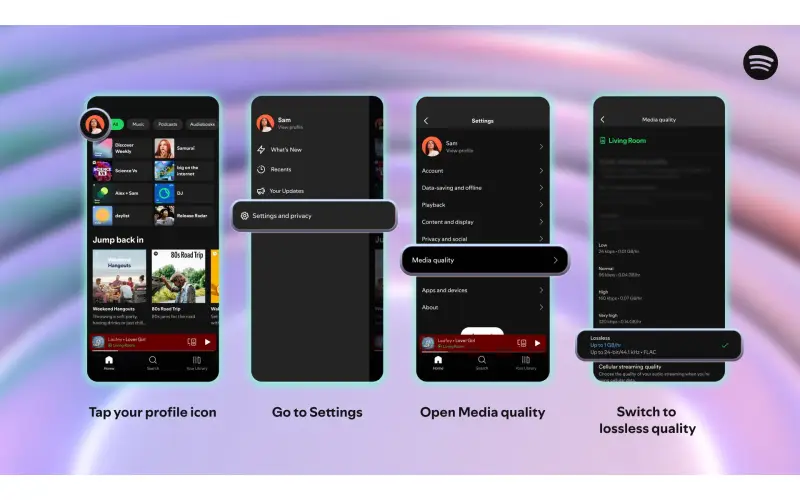
More regions will follow in the coming weeks. The feature comes at no extra cost — existing Premium subscribers can enable it in Settings → Media Quality.
Too Little, Too Late?
Spotify teased a “Spotify HiFi” tier back in 2021, promising higher fidelity “later this year.” That deadline came and went — multiple times. Rivals not only filled the gap, but also raised the bar with hi-res and immersive formats like Dolby Atmos and Sony 360 Reality Audio.
By finally delivering only CD-standard lossless, Spotify looks more outdated than innovative. For many listeners, the difference between high-quality lossy streams and CD-quality is subtle unless you’re using wired headphones or high-end speakers. The move feels more like Spotify catching up than leading.
The Artist Backlash
Even as Spotify touts its improved sound quality, artists continue to abandon the platform in protest. Recent months have seen bands like Deerhoof, King Gizzard & the Lizard Wizard, Xiu Xiu, Hotline TNT, The Mynabirds, and Young Widows remove their catalogs.
Their concerns go beyond audio fidelity. Many object to CEO Daniel Ek’s investment in Helsing, a European AI defense contractor developing military drones and surveillance systems. Ek’s venture firm invested over $100 million in Helsing and raised $700 million more in June 2025, with Ek serving as chairman.
As Deerhoof bluntly put it:
“We don’t want our music killing people. We don’t want our success tied to AI battle tech.”
This protest follows earlier waves of artist discontent: Thom Yorke railing against streaming royalties in 2013, Taylor Swift’s 2014 pullout over free music, and Neil Young and Joni Mitchell’s 2022 boycott over COVID misinformation. But the current exodus highlights not only political concerns but also Spotify’s reputation as the worst-paying major service.
The Royalty Problem
Spotify pays artists via a pro-rata model, pooling revenue and distributing it based on total stream share. In practice, this system favors megastars and leaves smaller acts struggling.
While Spotify insists it pays more in aggregate ($10 billion in 2024, the most of any service), per-stream payouts are notoriously low — often fractions of a cent. Independent artists argue that Spotify’s sheer scale makes survival harder, not easier.
Adding fuel to the fire is Spotify’s increasing use of AI-generated music, which some see as further devaluing human creativity. In a market already flooded with content, AI tracks risk crowding out independent musicians even further.
What This Means for Listeners
If you’re a Premium subscriber in one of the rollout countries, lossless is worth trying. But be prepared:
-
Higher data usage: A CD-quality album can easily be 500MB or more, compared to 100–150MB for a compressed stream.
-
Best with wired gear: Bluetooth connections can’t transmit full lossless streams without compression. Spotify Connect or wired headphones are the way to go.
-
Spotty availability: While most devices support lossless playback, some ecosystems — notably Sonos and Amazon Echo — won’t get support until later this year.
Conclusion: A Catch-Up Play That May Not Be Enough
Spotify’s lossless rollout is a long-overdue upgrade, but it lands with more of a shrug than a bang. After years of hype, the service has delivered a standard that was table stakes for competitors years ago. For casual listeners, the difference may be negligible. For audiophiles, Spotify still isn’t a real contender against Qobuz, Tidal, or even Apple Music.
Meanwhile, growing artist protests, low royalties, and the rise of AI-generated tracks continue to undermine Spotify’s cultural standing. With nearly 700 million users, Spotify may still dominate streaming — but in terms of innovation, quality, and trust, it’s starting to sound a little out of tune.