By: Dipin Sehdev
Philips is making a bold play. The 2026 OLED lineup, OLED951, OLED911, OLED811, and OLED761, the company isn’t just iterating on last year’s models, It’s trying to get ahead of the market. The headline feature says it all: these are the first TVs to support Dolby Vision 2 Max. That alone makes this one of the most interesting TV launches of the year. But as always with new formats, there’s a bigger question:
Does being first actually matter right now?
Dolby Vision 2 Max: Early Advantage, Future Payoff
Let’s start with the obvious. Philips is currently the only OLED brand shipping Dolby Vision 2 Max, which is the higher-tier version of Dolby Vision 2. That gives it a clear spec advantage over competitors like LG and Samsung for now.
Dolby Vision 2 Max promises:
-
More precise tone mapping
-
Better highlight control
-
Improved shadow detail
-
Scene-by-scene (and even frame-by-frame) optimization
In theory, it’s a meaningful step forward. In practice? We’re still waiting on content. That’s the reality. You’re buying into potential right now. But if Dolby Vision 2 Max gains traction, these TVs could age very well. And to Philips’ credit, this is about as close as you can get to “future-proofing” in today’s TV market—even if we all know that’s never a guarantee.
The Flagships: OLED951 and OLED911
At the top of the lineup sit the OLED951 and OLED911, both built around second-generation Tandem WOLED panels (also referred to as META 4.0 / Primary RGB Tandem). These are Philips’ answer to LG’s G-series and Samsung’s QD-OLED flagships.
What stands out:
-
Claimed peak brightness up to 4500 nits
-
Over 400 nits full-screen brightness
-
165Hz refresh rate
-
Improved anti-reflection coating
-
4 HDMI 2.1 ports (finally standard across the lineup)
The jump to four full-bandwidth HDMI 2.1 ports is long overdue and puts Philips on equal footing with competitors for gaming and high-end setups.
Processing Power
Both models use the new 10th Gen P5 AI processor, but the OLED951 goes a step further with a dual-chip configuration.
That allows for:
-
More advanced HDR tone mapping
-
Better upscaling
-
More precise image reconstruction
It’s the kind of thing you won’t notice immediately—but it shows up over time, especially with mixed-quality content.
Audio
-
OLED911 includes a Bowers & Wilkins 3.1 sound system
-
OLED951 skips the built-in premium audio for a cleaner design
That makes the 911 a better all-in-one option, while the 951 is clearly aimed at users with dedicated audio systems.
OLED811: The Surprise of the Lineup
If there’s one model to watch, it might actually be the OLED811. This is Philips’ mid-range OLED and it’s doing something unusual.
Philips claims:
-
Up to 2500 nits peak brightness (55–77")
-
Based on an upgraded OLED EX panel
That’s a big jump. If it holds up in real-world testing, it could challenge higher-end models in smaller sizes.
And importantly, it also includes:
-
Dolby Vision 2 Max
-
10th Gen P5 processor
-
165Hz refresh rate
-
4 HDMI 2.1 ports
This is where things get interesting. If the brightness claims are accurate, the OLED811 could end up being one of the best value TVs in 2026.
OLED761: Entry-Level OLED
At the bottom of the lineup is the OLED761, which introduces the new OLED SE panel.
This is Philips’ attempt to:
-
Lower costs
-
Compete with MiniLED TVs
-
Expand OLED accessibility
Key differences:
-
Peak brightness around 1000 nits
-
No Dolby Vision 2 Max
-
Uses a 7th Gen P5 processor
It still gets:
-
4 HDMI 2.1 ports
-
Ambilight
-
Solid overall performance
This is clearly the “good enough” option for people who want OLED without stepping into premium pricing.
Ambilight and AmbiScape: Still a Differentiator
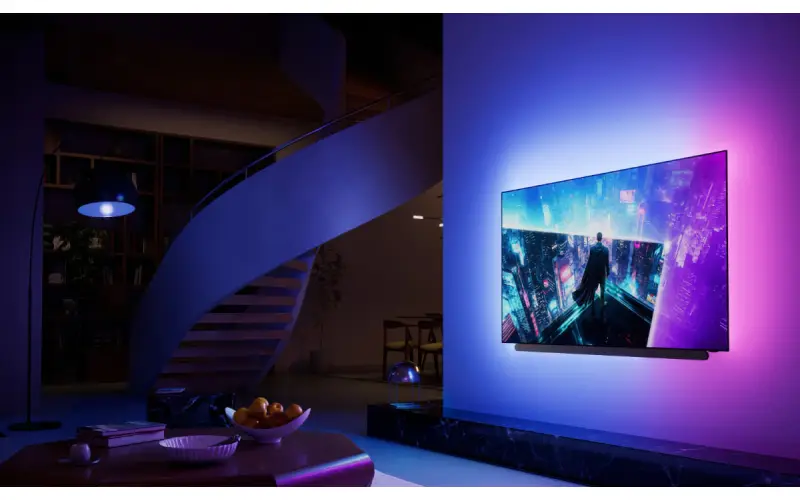
Philips continues to lean into Ambilight, which remains one of its biggest differentiators.
-
4-sided Ambilight on flagship models
-
3-sided Ambilight on mid and entry models
The new AmbiScape feature expands this further by syncing with smart lights like:
-
Philips Hue
-
Nanoleaf
-
IKEA
Done right, this can turn your entire room into part of the viewing experience.
Titan OS: A Big Shift
One of the more surprising changes this year is the move to Titan OS across the entire lineup.
Previously:
-
High-end models used Google TV
-
Lower-end models used Titan OS
Now it’s unified. That could simplify things, but it also raises questions about app support and long-term updates. Philips says Apple TV support is coming, but this is something to watch.
Philips 2026 OLED Lineup: Specs, Price, Availability
| Model | Panel | Peak Brightness | Dolby Vision 2 Max | Processor | Sizes | Availability | Price |
|---|---|---|---|---|---|---|---|
| OLED951 | Tandem WOLED (Gen 2) | Up to ~4500 nits (claimed) | Yes | Dual P5 AI Gen 10 | 65", 77" | Sept 2026 | TBD |
| OLED911 | Tandem WOLED (Gen 2) | Up to ~4500 nits (claimed) | Yes | P5 AI Gen 10 | 48", 55", 65", 77" | June 2026 | TBD |
| OLED811 | OLED EX (upgraded) | Up to ~2500 nits | Yes | P5 AI Gen 10 | 42"–77" | June–Sept 2026 | TBD |
| OLED761 | OLED SE | Up to ~1000 nits | No | P5 Gen 7 | 55", 65", 77" | June 2026 | TBD |
Note: Pricing has not been officially announced yet.
Gaming and Connectivity
Across the lineup (except the 761’s lower refresh ceiling), you get:
-
4K at 165Hz
-
VRR (Variable Refresh Rate)
-
ALLM (Auto Low Latency Mode)
-
Multiple HDMI 2.1 ports
This puts Philips firmly in the conversation for gaming TVs in 2026.
The Bigger Picture
Philips is clearly trying to do three things this year:
-
Lead on format support (Dolby Vision 2 Max)
-
Push brightness higher on OLED
-
Differentiate with Ambilight and ecosystem features
The Dolby Vision 2 Max piece is the most interesting. It’s early. There’s no real content yet. And history tells us new formats take time to matter. But if it does take off, Philips will have a head start.
Final Thoughts
The 2026 Philips OLED lineup feels ambitious in a way we haven’t seen from the company in a while.
-
The flagships aim directly at LG and Samsung
-
The OLED811 could be the sleeper hit
-
The OLED761 makes OLED more accessible
And then there’s Dolby Vision 2 Max, the wildcard. Right now, it’s more about potential than payoff. But it’s exactly the kind of feature that makes these TVs worth watching. Because once real-world content arrives, we’ll finally see if being first actually translates into being better.