By: Dipin Sehdev
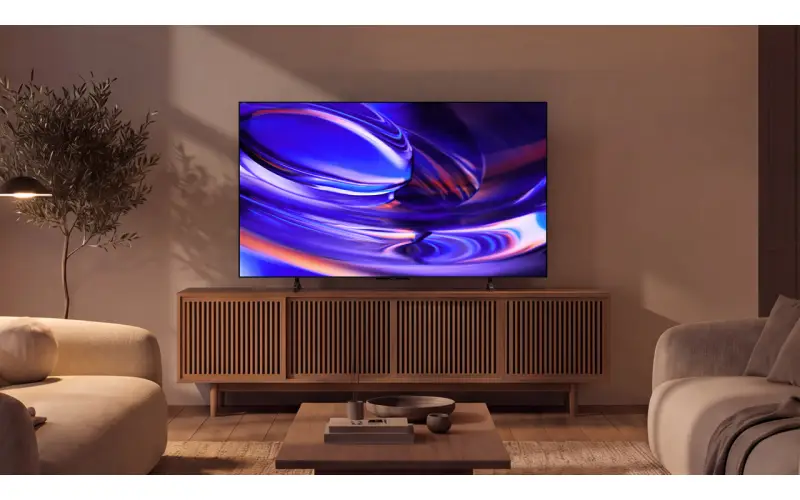
Sony has officially expanded its 2026 TV lineup with the Bravia 6 OLED, and while this is positioned as the company's more affordable OLED, there are a couple of details here that could be considerably more important than the model's place in the lineup.
First, Sony is finally offering a large-screen OLED again. The Bravia 6 will be available in 48, 55, 65, 77 and 83-inch sizes, giving Sony its first new 83-inch OLED since the A80L generation.
Second, and potentially much more significant for Sony's future TVs, the Bravia 6 features four HDMI 2.1 inputs. Reporting from FlatpanelsHD identifies the system chip as MediaTek's Pentonic 800, while Sony has not publicly confirmed the chipset to The Verge.
That's a substantial change for Sony.
Sony Finally Gets Four HDMI 2.1 Ports
Sony TVs have traditionally been limited to two full-bandwidth HDMI 2.1 connections, one of which also handles eARC. That's been a persistent annoyance for anyone connecting multiple current-generation consoles, gaming PCs and an AV receiver or soundbar. The Bravia 6 changes that with four HDMI 2.1 ports, supporting features including 4K/120Hz, VRR, ALLM and eARC. For a television positioned below Sony's premium models, that's a major connectivity upgrade.
It also raises a bigger question: Dolby Vision 2.
MediaTek's Pentonic 800 platform is associated with the hardware generation capable of supporting Dolby's next-generation format. The Bravia 6 already supports conventional Dolby Vision, but Sony has not announced Dolby Vision 2 support for the Bravia 6. So the presence of the newer MediaTek platform should not be interpreted as confirmation that Dolby Vision 2 is coming.
What it does mean is that Sony appears to have removed one of the hardware obstacles that could have prevented such an upgrade. With Dolby Vision 2 beginning its rollout on compatible 2026 TVs from other manufacturers, the Bravia 6 suddenly becomes a particularly interesting model to watch.
A More Affordable Sony OLED
The Bravia 6 sits below the existing Bravia 8 WOLED and Bravia 8 II QD-OLED. Sony is using a 120Hz WOLED panel, although the company hasn't identified the specific panel generation. That means buyers shouldn't expect the peak brightness or color volume of Sony's higher-end QD-OLED or True RGB televisions. Instead, Sony is targeting the increasingly competitive midrange OLED market occupied by TVs such as the LG C6 and Samsung S90H. The Bravia 6 also supports Dolby Vision, Dolby Atmos and DTS:X, while Google TV provides the smart platform along with Google's Gemini integration.
Sony has redesigned the remote as well, moving streaming shortcuts toward the top and enlarging the central navigation controls. One notable omission compared with Sony's premium OLED models is Acoustic Surface Audio+.
Sony Bravia 6 Specifications
| Specification | Sony Bravia 6 OLED |
|---|---|
| Display technology | WOLED |
| Resolution | 4K |
| Refresh rate | 120Hz |
| Sizes | 48, 55, 65, 77, 83 inches |
| Processor/SoC | MediaTek Pentonic 800 reportedly |
| HDMI 2.1 | 4 ports |
| 4K/120Hz | Yes |
| VRR | Yes |
| ALLM | Yes |
| eARC | Yes |
| Dolby Vision | Yes |
| Dolby Vision 2 | Not announced |
| Dolby Atmos | Yes |
| DTS:X | Yes |
| Smart platform | Google TV |
| Voice/AI | Gemini |
| Google Cast | Yes |
| Sony Pictures Core | Yes |
| Acoustic Surface Audio+ | No |
Sony Bravia 6 Pricing
| Size | U.S. MSRP |
|---|---|
| 48-inch | $1,300 |
| 55-inch | $1,500 |
| 65-inch | $2,000 |
| 77-inch | $3,000 |
| 83-inch | $4,000 |
The pricing puts Sony much more directly into the mainstream OLED conversation than we've seen recently.
Sony's Full 2026 TV Lineup
The addition of the Bravia 6 also fills an obvious hole in Sony's lineup between its Mini LED and premium OLED offerings.
| Model | Display Technology | Sizes | Position |
|---|---|---|---|
| Bravia 9 II | True RGB | 65, 75, 85, 115" | Flagship RGB |
| Bravia 7 II | True RGB | 50, 55, 65, 75, 85, 98" | Mainstream/premium RGB |
| Bravia 8 II | QD-OLED | 55, 65" | Flagship OLED |
| Bravia 8 | WOLED | 55, 65, 77" | Premium OLED |
| Bravia 6 | WOLED | 48, 55, 65, 77, 83" | Mainstream OLED |
| Bravia 5 | Mini LED | 55, 65, 75, 85, 98" | Midrange Mini LED |
| Bravia 3 II | LED LCD | 43, 50, 55, 65, 75, 85, 100" | Mainstream LED |
| Bravia 2 II | LED LCD | 43, 50, 55, 65, 75" | Entry-level LED |
Sony's 2026 range is unusually broad, stretching from conventional LED LCD all the way through Mini LED, WOLED, QD-OLED and the company's new True RGB technology. There's also an enormous range of screen sizes. The Bravia 7 II reaches 98 inches, the Bravia 3 II reaches 100 inches, and the flagship Bravia 9 II goes all the way to 115 inches and $30,999.99.
The 83-Inch OLED May Be Just as Important
The new chipset and four HDMI 2.1 ports will understandably attract attention, but Sony bringing back an 83-inch OLED shouldn't be overlooked. Sony hasn't offered a current 83-inch OLED since the A80L generation. The Bravia 8 tops out at 77 inches in the U.S., while the QD-OLED Bravia 8 II is limited to 55 and 65 inches. That has left buyers wanting a very large Sony OLED with few current-generation options.
At $4,000, the 83-inch Bravia 6 changes that. It also provides some reassurance about Sony's commitment to OLED. With the company putting so much emphasis on True RGB technology in 2026, there has been understandable speculation about where OLED fits into Sony's long-term strategy. The Bravia 6 suggests OLED isn't disappearing. Instead, Sony appears to be broadening its OLED strategy.
Does This Tell Us Something About Sony's Next Flagship OLED?
Potentially, and this might be the most interesting part of the announcement. The Bravia 6 is not Sony's flagship OLED. Yet it appears to introduce the newer MediaTek platform and four HDMI 2.1 inputs before Sony's premium OLED line has fully transitioned. That makes the Bravia 6 potentially a preview of Sony's next-generation TV architecture. If Sony eventually brings the same connectivity platform to a future flagship QD-OLED, it could finally eliminate one of the company's most persistent hardware disadvantages against LG and Samsung. And then there's Dolby Vision 2. There is no confirmation that the Bravia 6 will receive Dolby Vision 2, so buyers shouldn't purchase it expecting an upgrade. But a Sony OLED reportedly built around the Pentonic 800 makes the possibility much more technically plausible than it would have been on older hardware.
For now, what's confirmed is already meaningful: five OLED sizes, an 83-inch option, four HDMI 2.1 ports, 4K/120Hz gaming and a significantly lower entry point into Sony OLED. The Bravia 6 might technically sit toward the middle of Sony's lineup, but it could end up being one of the company's most consequential TVs of 2026.